








Stablecoins Aren’t Free: The Quiet Costs of Moving Back to Fiat


Stablecoins like USDT and USDC promise fast, low-cost transfers without crypto volatility. But converting them to local fiat ,especially in Africa,comes with real costs.
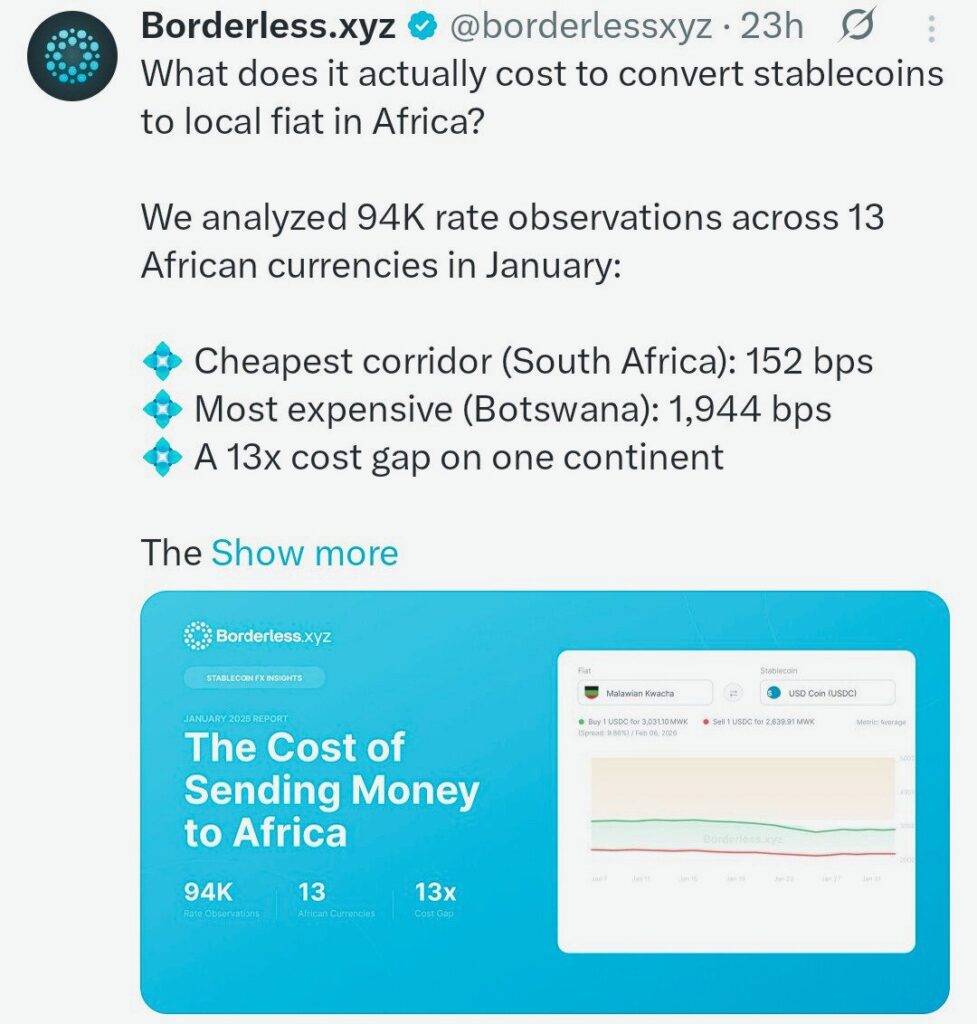
The Borderless.xyz January 2026 Benchmark report analyzed over 93,000 real-world rates across 33 currencies, spotlighting Africa as the most expensive region for these conversions.
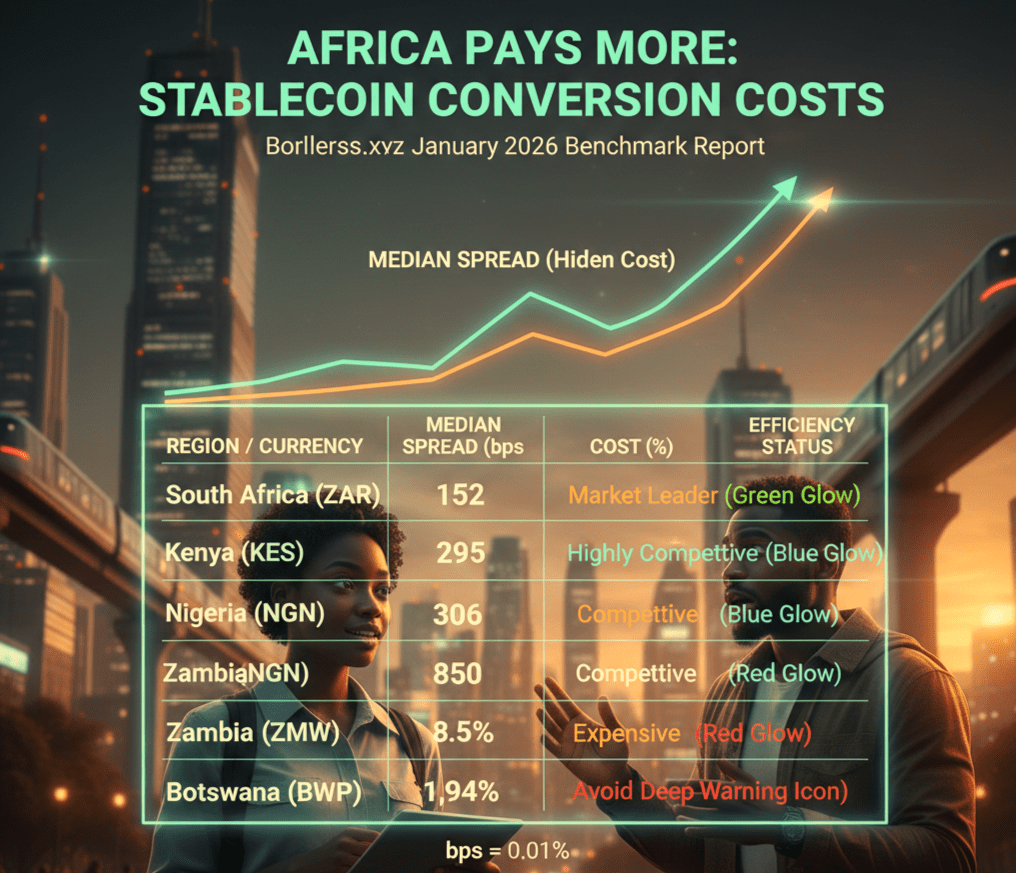
Africa Pays More Median spread (the hidden cost between buy/sell rates):
Competition is the key driver:
- corridors with multiple providers cluster around 300 bps;
- single-provider ones explode to 1,300+ bps.
Best Corridors in Africa : Cheapest (multi-provider winners):
- South Africa (ZAR): 152 bps median – standout efficiency.
- Kenya (KES): 295 bps – solid, with several providers and only +9 bps above interbank rates (mid-rate ~129.13 vs. 129.01 official).
- Nigeria (NGN): 306 bps.Ghana (GHS): ~300 bps.
Most expensive (avoid if possible):
- Botswana (BWP): 1,944 bps (nearly 19.4% cost — though it tightened 61% mid-month due to new providers).
- Congo (CDF): 1,311 bps.
- Zambia (ZMW): 850 bps.
In competitive spots like Kenya, stablecoins often match or beat traditional remittance costs, especially for speed.
Why This Matters for You as a Stablecoin User
Pros
In places like Kenya, Nigeria, or South Africa, stablecoins deliver near-instant settlements with spreads around 3% and premiums as low as +9 bps (KES).
- Great for remittances
- payroll
- imports
- hedging local currency swings.
Cons
- High spreads eat value : A 300 bps median means ~3% lost per swap; single-provider corridors can hit 13–19%.
- Liquidity & outages : Relying on one provider risks zero options if they go offline.
- Rate shocks : Mid-month swings (e.g., BWP improved dramatically) happen, but volatility cuts both ways.
Practical Tips for Smarter Stablecoin Use in Africa
- (Especially Kenya)Prioritize competitive corridors : Stick to KES, NGN, GHS, ZAR where multiple providers keep spreads ~295–306 bps.
- Shop around : In the same corridor, rates can differ by hundreds of bps (e.g., 6.5% savings possible in Zambia by picking the best provider).
- Monitor improvements : Watch for “regime changes” like Botswana’s rapid tightening, more providers = lower costs fast.
- Compare to TradFi : For small amounts or one-offs, check if local banks/M-Pesa beat the spread; for speed or cross-border, stablecoins usually win in Kenya.
- Stay safe : Use reputable platforms, verify stablecoin backing, and avoid parallel/unregulated quotes.
Bottom line
Stablecoins are already viable,and often superior,in Kenya and similar markets. But success depends on picking the right corridor and provider. As competition grows (and reports like this drive transparency), African costs should trend toward Latin America’s levels (128bps).If you’re sending/receiving in KES, the numbers look promising right now.
Register for free for the Nairobi stablecoin conference this Friday (Feb13)here.
Note: What “bps” (basis points) = a tiny unit for small percentage changes:
1 bps = 0.01%
100 bps = 1%
So 300 bps = 3%
In Kenya’s stablecoin conversions (e.g., USDT/USDC to KES), a ~300 bps spread means you typically lose about 3% of the value each time you swap.
Example (using current rates around Feb 11, 2026): Official/mid-market rate: ~1 USD = 129 KES (from CBK & converters) With a 300 bps (3%) spread, you might get only ~125 KES per USD when selling stablecoins (instead of 129 KES).
It’s the “hidden fee” for the conversion.