










Layer 1 vs Layer 2: How Blockchain Is Solving Scalability

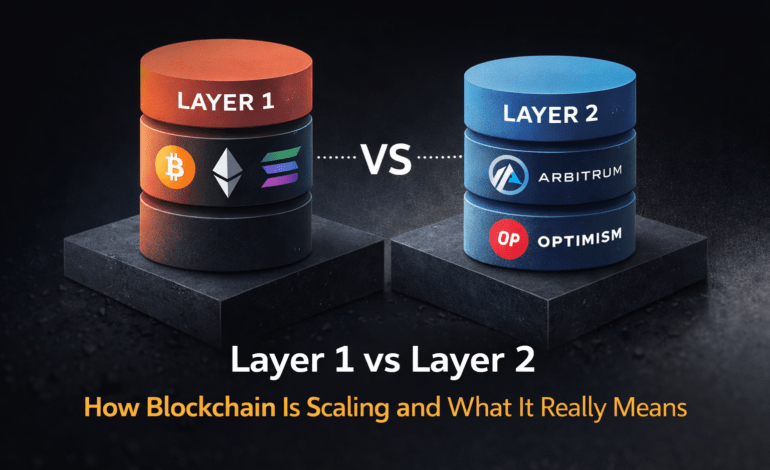
Blockchain technology has grown far beyond its early days, but one challenge still shapes everything: how to scale without breaking what makes it valuable.
As more people use networks like Ethereum and Bitcoin, transactions become slower and more expensive. This has led to two different paths forward. One improves the base layer itself. The other builds additional layers on top.
These are known as Layer 1 and Layer 2 ecosystems.
Understanding how they work is only part of the story. The real story is how they change control, security, and the future of the entire system.
What Layer 1 Really Does
Layer 1 is the foundation. It is the main blockchain where transactions are recorded and secured.
Examples include:
- Bitcoin
- Ethereum
- Solana
- Avalanche
Layer 1 handles everything at the core level. It validates transactions, secures the network, and ensures that no one can easily manipulate the system.
This is where trust lives.
But this strength comes with limits. Every transaction must be processed by the network, and that creates bottlenecks when demand increases.
For example, Ethereum can become expensive during busy periods. Fees can rise sharply, making simple actions costly. Bitcoin, while secure, processes transactions slowly by design.
Some Layer 1 chains try to solve this by increasing speed and capacity. Solana is a clear example. It offers fast and cheap transactions, but it relies on fewer validators compared to Ethereum. This creates ongoing debate about how decentralized it really is.
So Layer 1 faces a constant balancing act between security, decentralization, and scalability.
Why Layer 2 Exists
Layer 2 was created to reduce pressure on Layer 1 without changing its core structure.
Instead of processing every transaction directly on the main chain, Layer 2 systems handle activity separately and then send the final results back to Layer 1.
This approach reduces costs and increases speed.
A simple example is Ethereum’s rollups such as Arbitrum and Optimism.
Instead of recording thousands of transactions one by one, these systems bundle them together and submit a summary to Ethereum. This allows users to pay a fraction of the cost while still relying on Ethereum for final security.
In practice, this makes blockchain usable for everyday activity.
Security in a Layered System
Layer 2 systems are often described as inheriting security from Layer 1. This is partly true, but it is not absolute.
Layer 1 still acts as the final judge. If there is a dispute, the base chain can verify what is correct. This provides a strong safety net.
However, Layer 2 introduces new components that do not exist on Layer 1.
For example, many Layer 2 networks rely on something called a sequencer. This is responsible for ordering transactions before they are finalized. In many cases, this sequencer is controlled by a single entity.
This means that while funds are generally safe, control over transaction flow can be more centralized than users expect.
There are also risks when moving assets between layers. Bridges are used to transfer funds from Layer 1 to Layer 2 and back. These bridges have historically been targets for attacks. If a bridge fails, user funds can be affected even if the base blockchain remains secure.
So while Layer 2 improves efficiency, it also introduces new points of failure.
The Trade Off Between Simplicity and Scale
Layer 1 offers a single, unified system. Everything happens in one place.
Layer 2 changes that by creating multiple environments on top of the same foundation.
For Ethereum, this means users now interact with different Layer 2 networks such as Arbitrum, Optimism, and Base. Each has its own applications, liquidity, and user base.
This improves performance, but it fragments the experience.
Moving assets between these networks is not always smooth. It can require extra steps, time, and fees. While tools are improving, the process is still more complex than using a single chain.
Over time, this complexity may become invisible to users as wallets and applications handle it automatically. But behind the scenes, the system remains layered and interconnected.
Competing Visions of the Future
There are now two main approaches to scaling blockchain.
The first is to make Layer 1 as fast and efficient as possible. This is the path taken by chains like Solana. The idea is simple: keep everything in one place and optimize performance.
The second is to keep Layer 1 strong and decentralized, and move most activity to Layer 2. This is the direction Ethereum has taken.
Both approaches work, but they lead to different outcomes.
A strong Layer 1 approach creates a unified ecosystem but may sacrifice some decentralization.
A Layer 2 approach preserves decentralization at the base layer but creates a more complex system with multiple moving parts.
Economic Impact and Value Flow
As activity moves to Layer 2, it changes how value flows through the system.
Users pay lower fees on Layer 2, which can reduce direct revenue for Layer 1 in the short term. However, Layer 1 still benefits because it secures all final transactions.
At the same time, some Layer 2 networks introduce their own tokens and economies. This raises new questions about where value is actually captured.
In many cases, power and profit shift toward those who control key infrastructure such as sequencers, bridges, and major applications.
This means the system is not just scaling. It is also redistributing influence.
What This Means Long Term
Layer 2 is not just a temporary fix. It is becoming a core part of how blockchain operates.
As adoption grows, it is unlikely that a single chain will handle everything. Instead, the ecosystem is moving toward a network of layers and interconnected systems.
Some Layer 2 solutions will fail or be replaced. Others will grow into critical infrastructure.
At the same time, Layer 1 will remain essential. It acts as the anchor that everything else depends on.
The end result is not a simple system. It is a layered one where speed, cost, security, and control are constantly being balanced.
Layer 1 and Layer 2 are not just technical upgrades. They reshape how blockchain works at every level.
Layer 1 provides trust and security.
Layer 2 provides speed and usability.
Together, they make large scale adoption possible. But they also introduce new forms of complexity, new risks, and new concentrations of control.
The system is no longer just about decentralization.
It is about how that decentralization is structured across layers.








1 Comment
Keep on writing, great job!