









Flash Loan Attacks in DeFi: How Hackers Borrow Millions in Seconds

Mastercat
- April 2, 2026
- 5 min read
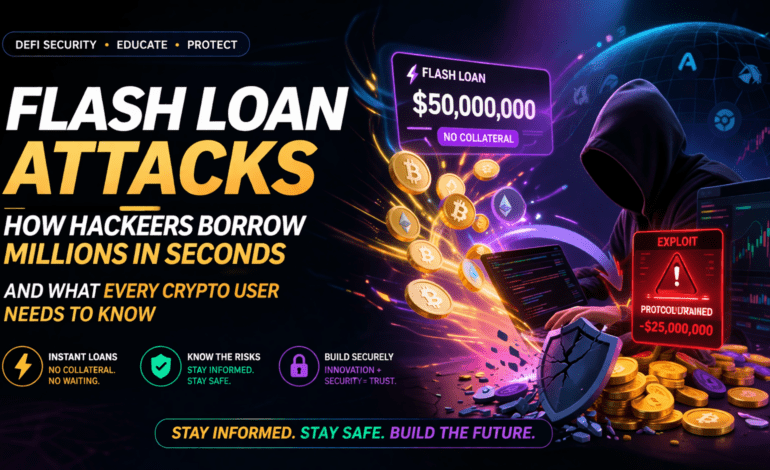
In the rapidly evolving world of decentralized finance (DeFi), innovation has unlocked powerful tools that were once unimaginable in traditional finance. One of those tools is the flash loan, a feature that allows users to borrow massive amounts of crypto instantly, without collateral.
It sounds revolutionary and it is.
But this same innovation has also become one of the most exploited mechanisms in DeFi, enabling attackers to drain millions of dollars from platforms in a matter of seconds.
So what exactly are flash loans, how do these attacks happen, and what does it mean for everyday crypto users?
Let’s break it down.
What Is a Flash Loan?
A flash loan is a unique type of loan available on certain DeFi platforms.
Unlike traditional loans:
- No collateral is required
- No credit check is needed
- The loan must be borrowed and repaid within the same transaction
If the borrower fails to repay instantly, the entire transaction is reversed meaning the loan never actually existed.
This “all-or-nothing” design makes flash loans safe for lenders, while giving borrowers access to huge capital sometimes millions of dollars for a very short time.
Originally, flash loans were created for legitimate purposes like:
- Arbitrage (profiting from price differences across platforms)
- Swapping collateral
- Refinancing positions
But as DeFi grew, so did the creativity of attackers.
How Flash Loan Attacks Work
Flash loan attacks don’t involve stealing the loan itself. Instead, attackers use the borrowed funds to exploit weaknesses in other protocols.
Here’s a simplified version of how a typical attack unfolds:
- The attacker takes out a large flash loan
- They use the funds to manipulate the price of a token on a decentralized exchange
- Another protocol relying on that manipulated price gets tricked
- The attacker exploits this to withdraw or borrow more than they should
- The flash loan is repaid instantly
- The attacker keeps the profit
All of this happens in a single transaction, often in seconds.
Because the attacker doesn’t need upfront capital, the barrier to entry is surprisingly low.
Real-World Attacks That Shook the Industry
Flash loan attacks are not rare incidents they’ve happened repeatedly, often in full view of the crypto community.
The First Wake-Up Call: bZx (2020)
One of the earliest flash loan attacks targeted the bZx protocol.
The attacker used a flash loan to manipulate the price of ETH and exploit a flaw in the platform’s logic.
Result: Hundreds of thousands of dollars lost within minutes.
This attack marked the beginning of a new era in DeFi exploits one where attackers didn’t need their own capital.
PancakeBunny (2021): A Sudden Collapse
PancakeBunny, a popular yield farming platform, suffered a major attack when a hacker used a flash loan to manipulate token prices.
This triggered the minting of excessive rewards, which were immediately sold off.
Result: Around $45 million lost, and the token price dropped by over 90%.
For many users, it was a harsh reminder of how quickly things can go wrong.
Beanstalk (2022): Governance Taken Over
In one of the most creative exploits, an attacker used flash loans to temporarily gain majority voting power in a DeFi protocol.
They pushed through a malicious proposal and transferred funds to themselves.
Result: Approximately $182 million drained in a single transaction.
This attack showed that flash loans could be used not just for price manipulation but also to hijack governance systems.
Euler Finance (2023): One of the Largest Attacks
Euler Finance experienced a major exploit involving flaws in its lending system.
The attacker used a flash loan to create artificial debt positions and drain funds across multiple assets.
Result: Nearly $200 million lost.
Although most of the funds were eventually returned, the incident shook confidence in even well-established platforms.
Why This Matters for Crypto Users
You don’t need to be a developer to be affected by flash loan attacks.
If you:
- Hold tokens
- Provide liquidity
- Participate in yield farming
- Use DeFi platforms
…then you’re indirectly exposed.
A successful attack can:
- Crash token prices instantly
- Drain liquidity pools
- Trigger massive losses across the ecosystem
Even trusted platforms can be vulnerable.
How to Protect Yourself
While you can’t control how protocols are built, you can reduce your risk.
For Everyday Users
- Be cautious with new or unaudited platforms
- Avoid chasing extremely high returns
- Diversify your funds across multiple platforms
- Stay informed about security incidents
For Builders and Developers
- Use secure and reliable price oracles
- Implement safeguards like circuit breakers
- Conduct thorough audits before launch
- Test systems against manipulation scenarios
The Bigger Picture
Flash loans are not inherently harmful.
They represent one of the most innovative breakthroughs in DeFi making capital more efficient and accessible.
The problem lies in how systems are designed around them.
When powerful tools meet weak security, the result can be catastrophic.
Conclusion
Flash loan attacks have revealed both the strength and vulnerability of DeFi.
They show how quickly value can move and how quickly it can disappear.
As the crypto ecosystem continues to grow, one thing is clear:
Innovation must be matched with security.
For users, staying informed is your best defense.
For builders, designing with security in mind is no longer optional, it’s essential.
Because in DeFi, everything happens fast and sometimes, that’s exactly the risk.

Mastercat
Web3, Nfts, Crypto Investor. Builder 👷♂️ Business Development | Web3 Growth | Network Builder.