







The Hidden Tradeoffs of Web3: Blockchain, Bridges, Stablecoins and Liquidity

Web3 arrived with a bold promise, a financial and digital order that is open, permissionless, and truly owned by its users.
Yet beneath the surface of this vision lies a quieter, more enduring truth:
Every system demands a sacrifice.
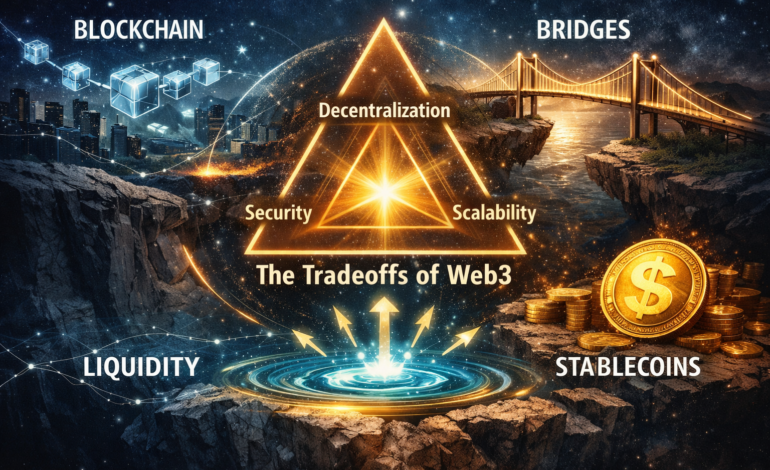
In blockchain, we neatly package it as the trilemma. But it runs deeper than a technical limitation. It is a design philosophy that quietly shapes everything from how liquidity moves to how ordinary people experience ownership in an increasingly digital world.
To truly grasp where Web3 is headed, we must first accept what it can never fully escape.
Blockchain: The Starting Point of Every Choice
Every Web3 experiment begins with a blockchain. And every blockchain is, at its core, a series of deliberate choices.
Bitcoin chose radical decentralization and ironclad security, willingly sacrificing speed and throughput. Ethereum brought programmability to the table, unlocking smart contracts and a new universe of applications,but at the price of added complexity and fresh attack surfaces.
Newer chains chase scalability: faster transactions, near-zero fees, smoother user flows. Yet performance gains almost always extract their toll, sometimes in reduced decentralization, sometimes in altered security assumptions, or in higher barriers for validators.
There is no flawless chain. Only different priorities, different compromises.
In regions like ours, where reliable infrastructure is not always guaranteed, these choices matter profoundly. A chain that feels lightning-fast on paper may still stumble when real-world conditions test its resilience.
Bridges: The Fragile Threads Connecting Islands
Web3 is no longer a single chain. It has become an archipelago.
Bridges were built to connect these islands. But they do not truly transport assets, they replicate them.
When you “bridge” from one chain to another, you lock or burn the original and receive a wrapped representation on the destination. What moves is not the asset itself, but a promise backed by varying degrees of trust.
This introduces a new layer of risk that cannot be wished away:
- Custodial bridges offer speed and convenience, but they rely on trust in operators or multisigs.
- Trustless bridges lean on cryptography and verification, yet they often come with higher costs and slower finality.
- The fastest solutions frequently birth new vulnerabilities that attackers quickly learn to exploit.
In practice, bridges have emerged as one of DeFi’s most persistent weak points , concentrated points of failure where billions have vanished through exploits, smart contract bugs, or compromised validators.
They are not mere infrastructure. They are concentrated risk in a fragmented ecosystem.
Liquidity: The Silent Force That Binds and Breaks
Liquidity is the lifeblood of Web3. Yet it is rarely just about capital. It is about coordination, getting the right people, at the right time, to commit resources in an open system.
And coordination always carries tradeoffs:
- Deep liquidity often requires concentration in a few dominant pools or venues.
- Capital efficiency demands structure and incentives.
- Truly permissionless systems sacrifice centralized control and optimization.
AMMs democratized market making, allowing anyone to provide liquidity without needing a counterparty. But they did so at the expense of capital efficiency and exposure to impermanent loss.
Order books brought back precision and efficiency,yet they struggle to bootstrap in fully open, permissionless environments.
Liquidity is never infinite. It flows where incentives pull it, fragments across chains and ecosystems, and can vanish with startling speed when confidence erodes or volatility spikes.
In emerging markets, where users are often bridging small amounts across volatile local conditions, this fragility is felt most acutely.
Stablecoins: Engineering Stability in an Unstable World
True stability does not emerge naturally in crypto. It must be engineered.
Fiat-backed stablecoins like USDC maintain their peg through centralized reserves and issuer guarantees. Their strength lies in that very promise ,someone, somewhere, stands behind the token.
Decentralized alternatives reduce single points of failure through overcollateralization and algorithmic mechanisms. They trade issuer trust for capital inefficiency and complex liquidation dynamics.
Algorithmic designs attempt to balance supply and demand through incentives alone. Elegant in theory, they have repeatedly shown their limits when market stress tests the assumptions.
Each model solves one problem while introducing another. At the end of the day, a stablecoin is not merely a token. It is a carefully constructed system of trust, one that users in high-inflation or underbanked regions are increasingly relying on for daily survival.
Web3 at the Human Level: The Personal Trilemma
For everyday users, the trilemma stops being abstract and becomes deeply personal.
Web3 is attempting to balance three things most people want simultaneously:
- Simplicity that feels like Web2
- True self-custody and ownership
- Robust security against mistakes, hacks, and loss
Improve two, and the third almost always suffers.
Custodial platforms deliver seamless experiences but surrender ownership. Self-custody restores control but burdens users with seed phrases, gas fees, and irreversible errors.
Tools like smart wallets, account abstraction, and chain abstraction are working to close this gap. Yet even these innovations often introduce subtle new layers of trust or dependency.
In the end, convenience in Web3 is rarely free. It always carries a hidden cost.
Liquidity as the Thread That Runs Through Everything
Across blockchains, bridges, stablecoins, and user interfaces, one force quietly connects them all: liquidity.
It enables movement across chains. It anchors the stability of assets. It determines how deep, or shallow, markets feel. It ultimately shapes whether Web3 feels empowering or frustrating.
But liquidity is also fragile. It concentrates in a handful of blue-chip pools and chains. It fragments as new ecosystems emerge. And in moments of crisis, it can evaporate, leaving users exposed.
Understanding liquidity is, in many ways, understanding Web3 itself.
Designing Wisely Within Limits
Web3 is not flawed because of these tradeoffs. It exists precisely because of them.
The trilemma is not a puzzle waiting to be solved once and for all. It is a boundary within which we must learn to build intelligently.
Every protocol, every chain, every stablecoin mechanism is ultimately answering the same quiet question:
What are we willing to sacrifice?
The future of Web3 will not belong to those chasing an illusion of perfection. It will belong to the builders, users, and communities who clearly see the constraints,and choose, with eyes wide open, how to navigate them.
In a world still searching for better systems of money, coordination, and ownership, that clarity may be the most valuable edge of all.