









“Regulation Should Follow Innovation”: Stakeholder Pushback at Kenya’s Final Public Hearing on Draft VASP Regulations 2026

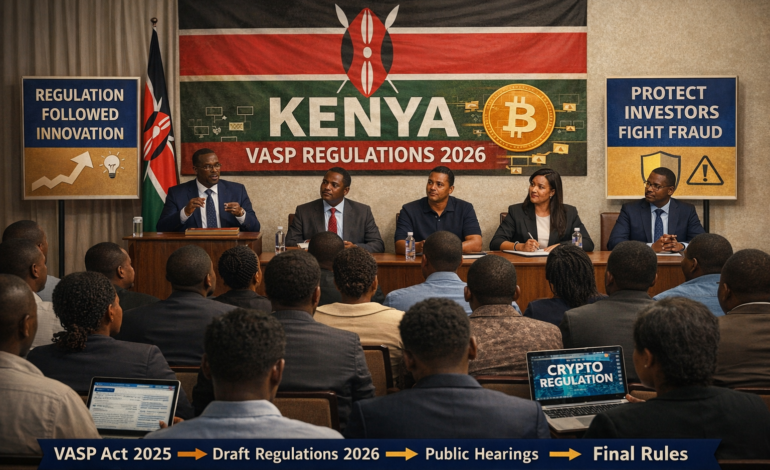
On 10 April 2026, the final day for public submissions on Kenya’s Draft Virtual Asset Service Providers (VASP) Regulations 2026, stakeholders converged at the Cooperative University of Kenya. The session marked the climax of nationwide consultations on rules designed to operationalize the Virtual Asset Service Providers Act, 2025, which was assented to on 15 October 2025.
Exchanges, wallet providers, fintech startups, regulators, and ordinary citizens debated how best to govern a sector characterized by high local adoption alongside persistent risks of scams, fraud, and financial crime. Written comments were due by end of day, closing a consultation period that will shape Kenya’s digital asset future.
Government officials stressed the need for robust oversight to mitigate “risks of scams, fraud, brokers and conmen.” Industry voices countered with a principle drawn from Kenya’s own fintech success: regulation should follow innovation, not precede or stifle it.
From Act to Operational Rules
The 2025 VASP Act laid the legal foundation. The 2026 draft regulations, developed by a multi-agency task force involving the Capital Markets Authority (CMA), Central Bank of Kenya (CBK), Financial Reporting Centre (FRC), and others, seek to translate that framework into practical requirements.
The draft rests on four main pillars:
- Capital and licensing requirements
- Operational, governance, and cybersecurity standards
- Consumer protection measures, including asset segregation
- Market conduct, AML/CFT controls, and growth-oriented rules
It aims to align with international standards (including FATF recommendations) while addressing Kenya-specific realities: significant crypto usage for remittances, hedging, and payments, coupled with documented consumer losses from unregistered platforms and scams.
Concrete Concerns: Capital Thresholds and Compliance Burden
A recurring theme was whether the proposed rules strike the right balance between protection and accessibility.
Peter Mwangi,VALR representative, captured the industry sentiment: “In case of Mpesa, regulation followed innovation.”
He and others warned that the draft’s capital requirements are disproportionately high for many local players. Stablecoin issuers would need up to KSh 500 million (~$3.8 million) in paid-up capital, funds that cannot come from loans or internal revaluations.
Investment advisers face lower but still material thresholds starting at around KSh 2.5 million. Multiple service lines could require separate licenses, compounding costs.
With exchange trading margins often as thin as 0.1%, participants argued these barriers “don’t make business sense” for startups. Stephen Gachanja of Swypt and Linus Kakai of the Virtual Assets chamber of commerce (VACC) highlighted possible duplication in governance, and compliance obligations, which would raise operational costs without necessarily delivering proportional risk reduction.
Stakeholders also pointed to gaps or ambiguities in the draft, including clearer treatment of:
- Digital lending and credit products
- Hybrid models blending traditional finance with virtual assets
- Certain stablecoin operational details (beyond reserve and redemption rules)
They proposed practical adjustments such as:
- A regulatory sandbox for testing
- Risk- and size-based tiered licensing
- Reduced frequency of some reporting
- Regionally compatible licensing (“passporting”) to ease cross-border operations
- Capital thresholds calibrated more closely to local economic realities
Government Position and Safeguards
Regulators responded that the thresholds are risk-proportionate and draw from international benchmarks.
The framework includes important protections: fit-and-proper tests for owners and directors, mandatory client asset segregation (with some stablecoin reserve requirements involving local bank deposits), cybersecurity audits, mandatory insurance, and strengthened AML/CFT obligations.
They noted existing tools like data protection laws and emphasized the goal of building trust to attract institutional capital while safeguarding consumers. Ronald Nyangara ,the Task force head captured the official tone: “Your voice matters… we want a system that works for all.”
Recent data shows crypto-related fraud rates in Kenya and across Africa are declining (down to around 2.5–2.6% in 2025 from higher levels the prior year), partly due to improved compliance on platforms.
Yet scams and unregistered actors remain a real concern that has eroded trust and complicated banking relationships for legitimate firms.
The M-Pesa Parallel: Lessons and Limits
Participants repeatedly invoked M-Pesa as proof that light-touch early regulation can foster inclusive innovation. The analogy carries weight: Safaricom’s mobile money service scaled dramatically under an iterative “test and learn” approach with the CBK.
However, it was never pure deregulation. It operated with trust accounts, audits, and eventual formal guidelines, backed by a large telco with strong partnerships.
Crypto differs in important ways, it is borderless, pseudonymous at its core, and involves higher volatility, custody, and cross-border ML/TF risks. Kenya’s 2023 virtual asset ML/TF risk assessment highlighted vulnerabilities in the unregulated space.
The challenge is to apply M-Pesa’s adaptive spirit without repeating the costs of prolonged grey-area operation.
Analysis: Promise and Peril
The draft introduces meaningful safeguards,asset segregation, disclosure rules, cybersecurity standards, and AML controls,that could professionalize the sector, reduce consumer harm, and open doors to institutional and banking partnerships.
Yet the risk is real: high fixed compliance costs (capital, audits, insurance, physical office requirements, local incorporation) could favor larger, better-capitalized players, often foreign, and sideline Kenyan startups and innovators who drove early adoption.
If local talent and capital migrate to more accommodating jurisdictions, Kenya could lose its potential as a regional crypto hub.The tension is not abstract. Kenya has demonstrated an ability to turn digital innovation into broad-based growth.
The question is whether this regulatory moment will extend that legacy or impose barriers that arrive too heavy and too early for the current stage of market development.
What Comes Next
With public participation now closed, the National Treasury and regulators will review submissions before finalizing the regulations.
The outcome will help determine whether Kenya:
- Positions itself as an attractive, trusted regional hub that encourages local innovation, or
- Creates an environment where compliance costs concentrate activity among a few well-resourced entities
For everyday users, clearer rules could mean safer platforms and better recourse. For builders and entrepreneurs, the stakes involve whether Kenya remains a fertile ground for fintech experimentation.
A proportionate path forward would likely include tiered, risk-based licensing, realistic capital calibration, an effective regulatory sandbox, and iterative adjustments as the market evolves. Stablecoins and digital lending deserve explicit, workable treatment to avoid leaving important segments in limbo.
Kenya has a strong track record of converting digital opportunity into inclusive progress. The final VASP Regulations will test whether regulators can honor that legacy by prioritizing smart, adaptive guardrails over one-size-fits-all rigidity.
The consultations have surfaced clear voices; the review process now offers a chance to translate them into rules that protect users while keeping the door open for innovation.