









The Legal Crisis Facing Prediction Markets Explained

EXECUTIVE SUMMARY
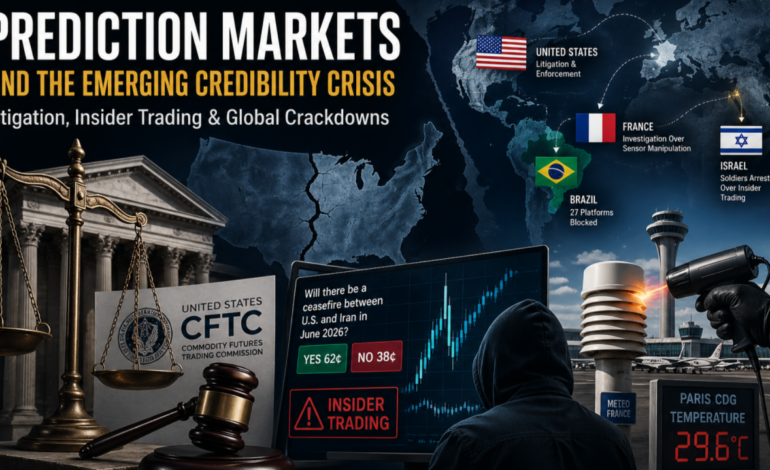
Prediction markets have moved from the regulatory fringe to the center of a multi-front legal crisis. In the United States, the fundamental jurisdictional question, whether event contracts are federally regulated derivatives or state-regulated gambling, remains unresolved across more than a dozen active lawsuits, with courts in different circuits reaching contradictory conclusions. The Trump administration has escalated the conflict by suing states directly on behalf of the CFTC, while a shrinking regulatory apparatus struggles to police credible insider trading allegations linked to military operations, elections, and geopolitical developments. Internationally, Brazil has moved decisively in the opposite direction, blocking 27 platforms, including Kalshi and Polymarket, by executive action. In France, a criminal investigation has been opened after a government weather sensor was apparently physically tampered with to rig Polymarket contracts. The structural integrity of prediction markets, not merely their legal classification, is now the defining question facing lawmakers and regulators worldwide.
I. THE U.S. JURISDICTIONAL BATTLE
A. The Core Legal Question
The entire litigation landscape flows from a single unresolved classification question: are prediction market event contracts federally regulated derivatives, specifically “swaps” under the Commodity Exchange Act (CEA), or are they sports bets and gambling products subject to traditional state police powers? Kalshi and other platforms argue that CFTC oversight is exclusive and pre-empts state law. Approximately 40 states have filed or joined actions arguing that the products are functionally indistinguishable from gambling, regardless of how they are labeled.
The stakes are substantial. If the federal pre-emption theory prevails, it would permit nationwide sports and event betting through prediction market platforms without compliance with any state gaming licensing regime, responsible gambling requirements, or gaming tax obligations. If states prevail, the business model becomes significantly more complex to operate, and platforms would face 50 separate regulatory frameworks.
B. Trump Administration Sues Three States
On April 2, 2026, the Trump administration filed lawsuits on behalf of the CFTC against Illinois, Connecticut, and Arizona, the furthest federal officials have gone to override state laws and assert exclusive jurisdiction over the sector. CFTC Chairman Michael Selig stated the agency “will continue to safeguard its exclusive regulatory authority over these markets and defend market participants against overzealous state regulators.” The suits characterize prediction market contracts as “swaps,” a category of financial derivatives already subject to CFTC supervision.
Critics have been pointed. Amanda Fischer, former SEC Chief of Staff and now Policy Director at Better Markets, characterized the industry’s approach as a “catch me if you can” strategy: “They’re willing to take more legal risk and break the laws and essentially develop enough incumbency, enough customers, enough profitability and political power that the law is bent to fit their business model.”
C. A Divided Judiciary
The absence of a binding appellate authority has produced sharply contradictory outcomes:
- Tennessee (February 19, 2026): A federal court in the Middle District of Tennessee granted Kalshi a preliminary injunction, finding its sports event contracts are likely “swaps” under the CEA and that federal law likely pre-empts state regulation.
- Massachusetts (January 2026): A Suffolk County Superior Court ruled that Kalshi’s sports event contracts are subject to Massachusetts gaming laws, calling the CFTC pre-emption argument “overly broad.” The state Appeals Court subsequently stayed the injunction and ordered expedited briefing; the case is widely expected to reach the Massachusetts Supreme Judicial Court.
- Arizona: A federal judge blocked Arizona’s criminal case against Kalshi at the CFTC’s request, citing interference with federal authority. Arizona had separately filed the first criminal charges against Kalshi for allegedly operating an unlicensed casino and violating state bans on election wagering.
- Nevada (Ninth Circuit, April 22, 2026): A three-judge panel heard oral arguments in four consolidated Nevada cases involving Kalshi, Robinhood Derivatives, and Crypto.com. The hearing lasted nearly 150 minutes. A ruling is expected to be a bellwether for whether the Supreme Court intervenes.
- Third Circuit (April 2026): Kalshi secured a victory before the Philadelphia-based Third Circuit, shortly before the Ninth Circuit hearing.
In addition to state-regulator disputes, tribal governments in California and Wisconsin have sued Kalshi, alleging violations of the Indian Gaming Regulatory Act (IGRA). The Northern District of California denied injunctive relief, finding IGRA does not apply to third-party platforms and that federal law expressly exempts CFTC-regulated trading.
New York Attorney General Letitia James has extended the enforcement front by suing Coinbase and Gemini, alleging their prediction market offerings constitute illegally unregistered gambling. The CFTC responded by suing New York, adding it to its growing list of state defendants.
Legal experts broadly anticipate that the circuit split will eventually require Supreme Court resolution, though a definitive ruling may not materialize before 2027.
D. Congress: 14 Bills and Counting, No Consensus
At least 14 bills have been introduced in Congress addressing prediction markets, reflecting deep divisions rather than a coherent legislative response. Proposals range across a broad spectrum: some would ban election-related contracts outright; others target war, assassination, and death markets on national security grounds; still others would impose insider trading rules modeled on securities law; and a bipartisan pair from Senators Adam Schiff (D-CA) and John Curtis (R-UT) would ban sports-related wagers altogether. Representative Blake Moore (R-UT) introduced a bipartisan bill stating that “under-regulated prediction markets have exposed America to needless public safety and national security risks.” Representative Nikki Budzinski (D-IL) has proposed banning executive branch political appointees, the president, lawmakers, their families, and others from betting on government actions, a bill that gained additional co-sponsors following the April 16 CFTC hearing. The sheer volume and variety of proposals signal broad recognition of the problem, but no consensus on the remedy.
II. INSIDER TRADING: FROM THEORETICAL RISK TO ACTIVE ENFORCEMENT
A. The Maduro Raid and First Criminal Charges
In late December 2025 and early January 2026, a user of Polymarket’s offshore exchange purchased a high volume of contracts predicting the ouster of Venezuelan President Nicolás Maduro. Following the U.S. military’s capture of Maduro on January 3, 2026, the user reportedly secured a payout of more than $400,000. The trader was subsequently identified as Gannon Ken Van Dyke, a U.S. Army Special Forces soldier involved in planning the operation. He was arrested and charged criminally; the CFTC simultaneously filed a civil action seeking restitution, penalties, and a permanent trading ban. Notably, Kalshi stated that Van Dyke had separately attempted to place a similar trade on its platform but failed to pass its screening.
The CFTC’s February 25, 2026, advisory confirmed that a political candidate had “potentially” violated Rule 180.1 by trading event contracts regarding his own candidacy, an important signal that the agency is willing to extend insider trading concepts beyond the classical misappropriation framework.
B. Iran Ceasefire Trades
Separately, newly created Polymarket accounts placed highly specific, well-timed bets on a U.S.-Iran ceasefire in the hours before President Trump publicly announced it. The CFTC has disclosed it is investigating suspicious oil futures trades made shortly before Trump announced major policy changes regarding Iran. Congressional scrutiny over these trades dominated the April 16, 2026, CFTC oversight hearing before the House Agriculture Committee, overshadowing the broader agenda.
A prior CNN investigation had identified a single trader who made nearly $1 million in “perfectly-timed” bets over two years on American and Israeli military actions against Iran, prompting sustained accusations of insider trading.
C. Political Candidates Trading on Their Own Races
On April 22, 2026, Kalshi announced the suspension and fining of three political candidates for “political insider trading”, specifically, placing bets on the outcomes of their own campaigns. The cases are the most aggressive enforcement actions taken to date against political candidates and come as primaries for the 2026 midterms are already underway.
The most notable case involves Minnesota State Senator Matt Klein, a co-author of SF 4511, a Minnesota bill that would ban prediction markets from operating in the state. Klein placed a $50 wager last October on his own primary victory after hearing from friends that a market existed. He settled with Kalshi for $539.85 and accepted a five-year suspension. Klein subsequently acknowledged the violation publicly, stating: “This was a mistake and I apologize. My experience, like many other Minnesotans, points to the need for clearer rules and regulations for these types of markets.” The irony was not lost on observers: the lawmaker drafting the ban did not fully understand what was prohibited under existing rules. Efforts to advance SF 4511 intensified in the days following the Klein disclosure.
The other suspended candidates were Virginia independent Senate candidate Mark Moran (fined $6,229.30 after refusing to settle, having framed his trades as deliberate protest to draw attention to what he called “illegal gambling” on prediction sites) and Texas Republican Ezekiel Enriquez (fined $784.20, fully cooperative).
D. Platforms’ Self-Regulatory Response
Facing mounting political and legal pressure, the major platforms have moved to strengthen internal controls, though the adequacy of self-regulation remains contested. Kalshi announced it would ban political candidates from trading on their own campaigns and preemptively block anyone involved in college or professional sports from trading contracts related to their sport. Polymarket rewrote its rules to expressly bar users from trading contracts where they may possess confidential information or could influence the outcome. In February 2026, Kalshi opened 200 investigations and froze a number of accounts over insider trading concerns.
CFTC Chairman Selig has maintained that platforms are the “first line of defense” against insider trading, with the CFTC and DOJ policing “on the back end.” Critics argue this posture is inadequate given the agency’s diminished capacity following DOGE-era staffing reductions. Following those cuts, the CFTC contracted to approximately 535 employees by February 2026, smaller than at any point during Trump’s first term, even under the budget request Selig submitted to Congress.
E. State Executives Fill the Ethics Vacuum
In the absence of federal action on ethics, several state governors have issued executive orders targeting insider trading by government employees specifically:
- California: Governor Gavin Newsom banned state employees from prediction market trading using insider information.
- Illinois: Governor J.B. Pritzker signed an executive order on April 21, 2026, applying to state employees under his jurisdiction.
- New York: Governor Kathy Hochul signed Executive Order No. 60 on April 22, 2026, prohibiting state officers and employees from using confidential information acquired in the course of their official duties to further their personal financial interests through prediction markets. Violations may result in dismissal, sanctions, or referral to law enforcement. Hochul explicitly criticized the federal government for failing to establish “meaningful ethical standards.”
These orders operate independently of the gambling-vs.-derivatives jurisdictional dispute and represent a parallel regulatory strategy that does not require winning the pre-emption argument.
F. Conflict of Interest Concerns
The structural conflict-of-interest question looms over the entire regulatory landscape. Donald Trump Jr. holds an investment stake in Polymarket through a venture capital fund and serves as a paid adviser to both Polymarket and Kalshi. Trump Media & Technology Group has announced plans to build its own prediction platform, “Truth Predict.” The Trump-appointed CFTC, simultaneously advocating for industry expansion and responsible for policing it, has drawn sustained Democratic criticism on this basis. Southern District of New York prosecutors have separately held meetings with Polymarket executives to explore whether existing insider trading law applies to the platform, though no charges have been filed.
III. MARKET MANIPULATION BEYOND INSIDER TRADING: THE FRANCE CASE
A. Physical Tampering with a Government Weather Sensor
On April 6 and again on April 15, 2026, a temperature sensor operated by Météo France near the Paris-Charles de Gaulle airport runway recorded anomalous spikes of several degrees Celsius before returning to normal within minutes. No other weather station in the area recorded comparable readings.
On each occasion, Polymarket traders had placed well-timed, high-return bets on Paris temperature outcomes that resolved in their favor as a direct result of the anomalous readings. Blockchain analytics firm Bubblemaps flagged one trade: a $120 bet placed at under 1% odds that returned approximately $21,000, a 180x gain, placed minutes before the April 15 anomaly. Across both incidents, combined payouts exceeded $35,000. Trading volume on the April 15 market alone reached $590,527.
Following a physical inspection, Météo France concluded there were signs of deliberate human interference and filed a criminal complaint with airport gendarmerie. Speculation in online trading forums and from meteorologists has centered on someone applying a battery-powered hairdryer or lighter to the sensor to generate an artificial temperature spike. The winning trader deleted their Polymarket account after meteorologists publicly ruled out a natural explanation.
Polymarket subsequently changed its resolution source for Paris temperature markets from the Charles de Gaulle sensor to the Le Bourget airport station. However, it did not cancel the affected contracts or require return of the winnings.
B. Structural Implications: The Oracle Problem
The Paris sensor incident exposes a foundational vulnerability in blockchain-based prediction markets. Polymarket and similar platforms rely on “oracles”, mechanisms that feed external, real-world data into smart contracts to determine financial outcomes. When a market settles on a single official data source, any interference with that source directly manipulates the financial outcome. The market has no internal mechanism to detect or correct for such tampering. This is not a hypothetical risk but a demonstrated attack vector with criminal law implications in at least one jurisdiction.
The incident is the second market integrity failure to hit Polymarket within a two-week period: the prior week, UFC announcer Bruce Buffer misread a fight result live on air at UFC 327, briefly sending one fighter’s odds to 99.9% before the error was corrected, enabling a trader to convert $500 into more than $252,000.
The oracle problem is not an edge case. It is a foundational vulnerability for any prediction market that settles on single-source real-world data. The Paris incident is its first criminal manifestation.
IV. BRAZIL: DECISIVE REGULATORY ACTION
A. The Block
On April 24–25, 2026, the Brazilian federal government, acting through Finance Minister Dario Durigan and the National Telecommunications Agency (Anatel), shut down 27 prediction market platforms operating in the country, including Kalshi and Polymarket. Anatel mobilized a network of more than 19,000 internet service providers to enforce the block. Both platforms were offline in Brazil by Friday afternoon.
The legal basis was a new rule issued by the National Monetary Council (CMN) restricting the derivatives market to contracts based on economic and financial benchmarks, specifically price indexes, interest rates, and exchange rates. Contracts tied to sports outcomes, online gaming, politics, elections, cultural events, and social outcomes were expressly excluded. The Finance Ministry’s technical note characterized prediction markets as binary event contracts where users take yes-or-no positions on future outcomes, falling outside the permitted derivatives framework.
B. Context: Brazil’s Regulated iGaming Market
Brazil’s regulated online betting market launched on January 1, 2025. In its first year, licensed operators generated approximately $7 billion in gross gaming revenue, making Brazil one of the largest iGaming markets globally. The Lula government has framed prediction markets as unlicensed competitors to this regulated ecosystem and a threat to household financial stability among lower-income groups. President Lula has publicly called for stricter regulation to prevent the gaming market from “destroying family wealth.”
The enforcement action also carries political dimensions. The Workers’ Party has incorporated a “BBB Taxation” platform plank, targeting Banks, Bets, and Billionaires, as part of its 2026 re-election campaign strategy.
C. Regulatory Architecture Debate
Before the block, Brazil’s Securities Exchange Commission (CVM) and B3 (the national stock exchange) had explored a narrower path: in February 2026, B3 announced plans to offer binary options contracts on the dollar, Ibovespa, and bitcoin as regulated derivatives, a Class I financial prediction market. This approach, authorized by the CVM, would have created a domestic regulated prediction market limited to financial instruments. The CMN rule effectively closed that distinction for non-financial events.
Academic debate in Brazil mirrors the U.S. jurisdictional question. A March 2026 paper published on SSRN proposed a four-instrument regulatory framework, including a joint interpretive note from multiple Brazilian regulators establishing a Class I/II typology to distinguish financial event contracts from non-financial ones, and a specific statute for prediction markets on non-financial events. The regulatory vacuum, its author warned, would simply push activity offshore.
D. Treatment of Foreign Regulated Platforms
Notably, Brazil’s enforcement framework did not distinguish between Kalshi, a CFTC-registered U.S. exchange subject to federal oversight, and Polymarket, which operates primarily on unregulated offshore infrastructure. Both were blocked under identical authority. This signals that foreign regulatory status does not confer access rights in Brazil, and that the classification question is determined entirely by Brazilian law.
V. BROADER INTERNATIONAL DEVELOPMENTS
A. Israel
In February 2026, Israeli authorities arrested two soldiers accused of placing bets on Polymarket using classified information about Israel’s operations against Iran. The case is the international counterpart to the U.S. Maduro case and further illustrates that insider trading in prediction markets is not a uniquely American phenomenon. It also raises unresolved questions about the extraterritorial reach of U.S. enforcement where trades are executed on offshore platforms by non-U.S. nationals.
B. France
Beyond the Paris sensor case detailed in Section III, France’s engagement with Polymarket represents a novel form of international regulatory contact: a government agency filing a criminal complaint about manipulation of its own data infrastructure by prediction market participants. This may mark the first instance of a national government’s public data systems being directly weaponized for prediction market fraud, and it raises questions about the responsibility of platforms that rely on a single government data source without redundancy or verification mechanisms.
VI. MARKET STRUCTURE AND INDUSTRY EXPANSION
Notwithstanding the legal and regulatory turbulence, the commercial trajectory of prediction markets continues upward. According to Bernstein, prediction market volumes reached $51 billion in 2025 and are on pace to reach approximately $240 billion in 2026, implying roughly 80% compound annual growth. Bernstein projects volumes could reach $1 trillion by 2030.
Coinbase entered the space through a partnership with Kalshi, offering access to more than 1,000 contracts. A Cantor Fitzgerald report identified both Robinhood and Coinbase as the leading public-market beneficiaries of the sector’s growth, noting that their business model, generating fee revenue from trading activity rather than taking the other side of bets, mirrors their existing equities and crypto infrastructure.
Polymarket is separately reported to be in discussions to raise $400 million at a roughly $15 billion valuation, following a $600 million investment from Intercontinental Exchange. Crypto.com, Coinbase, and Robinhood have formed a Coalition for Prediction Markets lobby group, signaling that the industry now has the organizational infrastructure to engage Congress and federal regulators systematically.
Kalshi and Polymarket have each secured data partnerships with major sports leagues, news organizations, and financial media. The NBA has reportedly been in discussions with both platforms about commercial arrangements. These agreements serve to further legitimize the platforms as financial and media infrastructure rather than gambling operations, a distinction that remains live before the courts.
VII. KEY LEGAL QUESTIONS PENDING RESOLUTION
The following questions remain unresolved and will determine the trajectory of the sector:
- Pre-emption: Do prediction market event contracts constitute “swaps” under the CEA, such that CFTC jurisdiction is exclusive and pre-empts state gambling law? Circuit courts are divided; Supreme Court review is probable but not imminent.
- Insider Trading Framework: Does Rule 180.1 (the CFTC’s antifraud rule) extend to trading on material non-public information without breach of a fiduciary duty, or is misappropriation a required element? The CFTC’s February 2026 advisory suggests it may extend further than classical doctrine.
- Oracle Liability: What legal obligations do prediction market platforms bear when their resolution mechanisms are manipulated through interference with third-party data sources? The Paris case will test this in French criminal courts.
- Self-Certification: May CFTC-registered exchanges self-certify that individual event contracts comply with federal law without prior agency review? This model underlies the industry’s rapid expansion and is challenged by states.
- Extraterritorial Enforcement: To what extent can U.S. law reach traders executing contracts on offshore, crypto-based platforms such as Polymarket’s Panama exchange? The SDNY inquiry is the first serious probe of this question.
- Foreign Access Rights: As Brazil’s action illustrates, federally regulated U.S. exchanges do not automatically obtain market access rights in foreign jurisdictions. No international framework governing prediction market cross-border access currently exists.
FINAL NOTE
The recent weeks may be remembered as the moment the prediction market industry’s credibility crisis fully converged. The same week that produced a federal hearing on insider trading dominated by war-bet scandals, a Minnesota lawmaker was caught betting on his own election while co-authoring a bill to prohibit it, France opened a criminal investigation into physical tampering with government weather infrastructure, and Brazil blocked the two most prominent U.S. platforms outright.
The Minnesota story is illustrative beyond its irony. Senator Klein did not believe he was committing a violation because the rules governing prediction market participation, even for people studying those rules professionally, remain genuinely unclear. That ambiguity is not incidental; it is the product of an industry that has deliberately operated in legal grey zones while accumulating enough market depth and political allies to resist straightforward classification. The industry’s bet, as Amanda Fischer summarized, is that incumbency will outlast regulatory clarity.
Whether that bet pays off depends on two variables the industry does not control: the courts and the credibility of its self-regulatory claims. On the former, the Ninth Circuit’s consolidated ruling and any subsequent Third Circuit divergence will likely force Supreme Court resolution within 18 to 24 months. On the latter, each insider trading scandal and manipulation incident narrows the window in which “we police ourselves” remains a politically viable defense before a Congress already circulating 14 competing bills.
Brazil’s move is significant not because it is likely to be replicated wholesale in other major jurisdictions, but because it demonstrates that the political economy of prediction markets, particularly their relationship to regulated gambling tax revenues and consumer protection frameworks, can produce decisive action at speed.