








The Long March of the Machine: From Steam Engines to AI Workers

The fear that machines will replace human beings is not new. Every generation believes it is standing at the edge of a technological cliff, watching the future arrive faster than society can absorb it. Yet history shows something more complex. Technology does not simply destroy work. It transforms it. It reshapes power, productivity, and the meaning of labor itself.
What we are witnessing today with artificial intelligence in the crypto industry is not an isolated event. It is the latest chapter in a story that began centuries ago during the Industrial Revolution.
Before factories, most human labor was painfully manual. Farming relied on muscle, weather, and long days under harsh conditions. Goods were crafted slowly by hand. Travel between cities could take weeks. Productivity was limited not by intelligence, but by physical exhaustion.
Then came the steam engine.
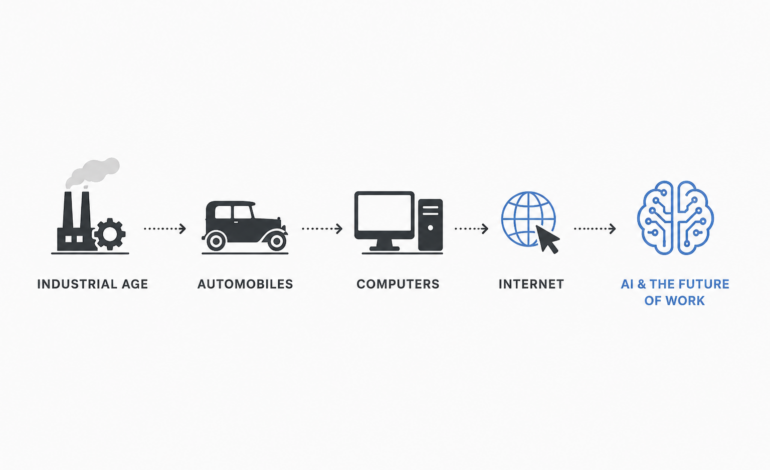
The Industrial Age changed civilization permanently. Steam-powered machines could produce textiles faster than entire villages of workers. Railways connected economies. Factories multiplied output on a scale humanity had never seen before. Naturally, workers feared replacement. Many resisted mechanization violently. The Luddites in 19th-century England destroyed industrial machinery because they believed machines were stealing livelihoods.
But industry did not stop.
The automobile then transformed mobility in the early 20th century. Horses disappeared from cities. Entire industries collapsed while new ones emerged overnight. Mechanics replaced blacksmiths. Assembly lines changed manufacturing forever. Henry Ford’s moving production line reduced costs so dramatically that ordinary people could suddenly own vehicles once reserved for elites.
Electricity followed. Then telephones. Then computers.
Each wave carried the same anxiety.
Humans feared becoming obsolete. Yet every technological leap also created new forms of employment unimaginable in the previous era. The computer destroyed some clerical jobs but created software engineering, digital finance, e-commerce, cybersecurity, and global communications industries worth trillions.
The internet accelerated this transformation further. A teenager in Nairobi today can build a business serving customers in New York, Dubai, or Singapore using only a smartphone and connectivity. Technology collapsed geographical barriers and democratized opportunity at unprecedented scale.
Now artificial intelligence is doing the same thing to intellectual labor.
The crypto industry has become the first major proving ground for AI-driven workforce transformation because crypto itself is already technology-native, borderless, and heavily automated. The layoffs sweeping through exchanges and blockchain firms in 2026 are not merely responses to market downturns. They reflect a deeper shift.
Coinbase’s recent workforce cuts revealed a reality many industries are only beginning to understand. AI systems can now write software code, analyze data, respond to customer inquiries, generate reports, and assist with decision-making faster than large human teams. Tasks that once required departments can now be executed by smaller groups augmented by intelligent systems.
This mirrors what happened when tractors reduced agricultural labor or when industrial machines reduced factory manpower. Productivity increases rarely ask permission before changing society.
Yet history also warns against simplistic conclusions
When automobiles emerged, humanity did not stop moving. When computers arrived, humanity did not stop working. Instead, work evolved upward. Humans shifted toward areas requiring creativity, judgment, emotional intelligence, strategic thinking, and accountability.
The same pattern is unfolding with AI.
Routine coding tasks are increasingly automated. Basic customer support functions are being absorbed by conversational systems. Data aggregation and repetitive analysis are becoming machine territory. But entirely new categories of work are simultaneously emerging.
The modern economy now needs AI auditors, AI trainers, prompt engineers, machine ethicists, protocol architects, digital governance specialists, blockchain security experts, and hybrid professionals capable of operating between decentralized systems and intelligent automation.
Technology historically eliminates repetitive labor first before elevating human specialization.
A farmer operating advanced machinery today produces more than entire communities once could manually. A single developer equipped with AI tools can now accomplish what previously required a full engineering team.
This is not necessarily the death of work. It is the compression of effort.The deeper philosophical question is whether humanity measures value only through labor itself.
For centuries, survival demanded constant physical exertion. Technological advancement has progressively reduced that burden. Washing machines reduced domestic labor. Automobiles reduced travel strain. Computers reduced administrative work. AI now seeks to reduce cognitive repetition.
Civilization, in many ways, has been a long attempt to free human beings from unnecessary toil.
The danger lies not in technology alone, but in unequal adaptation. Societies that fail to retrain workers, rethink education, or prepare institutions for rapid automation risk widening inequality and social instability. The challenge is not merely technological. It is political, economic, and deeply human.
Crypto firms embracing AI today are offering a preview of the future economy. Machine employees are no longer science fiction. Algorithms already execute trades, monitor networks, generate market intelligence, and assist software development in real time.
But machines still lack conscience, moral accountability, intuition, and human trust.
A courtroom still needs responsibility. Communities still need leadership. Economies still require vision. Human beings remain essential not because machines are incapable of processing information, but because civilization ultimately depends on judgment beyond calculation.
The industrial worker once feared the steam engine. The office worker feared the computer. Today’s digital worker fears artificial intelligence.
Yet history suggests the future rarely belongs to those who resist technological change entirely. It belongs to those who learn how to direct it.
The machine is not simply replacing labor. It is redefining what it means to be valuable in the modern world.