









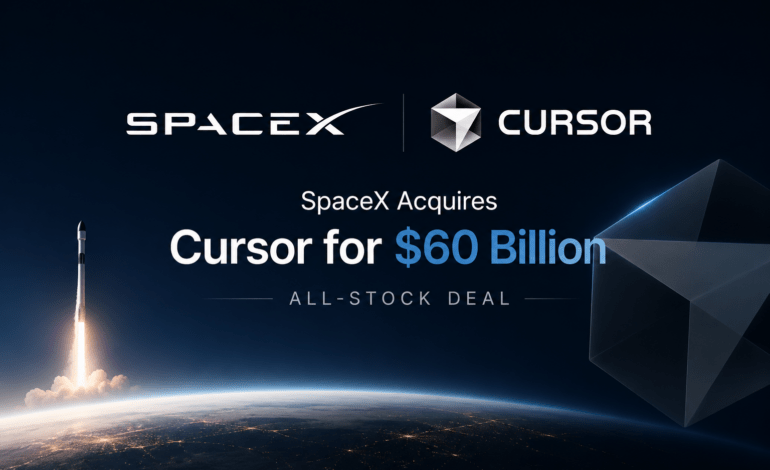
In a deal that could redefine the future of software development and artificial intelligence, SpaceX has agreed to acquire Anysphere, the company behind the breakout AI coding assistant Cursor, in an all-stock transaction valued at $60 billion.
The acquisition comes just days after SpaceX’s historic June 12 IPO and highlights a growing reality in the technology industry:
AI coding tools are no longer niche developer products.
They’re becoming strategic infrastructure.
From Strategic Partnership to Full Acquisition
The transaction formalizes a relationship that had already been developing behind the scenes.
Earlier in 2026, SpaceX and Anysphere entered into a strategic agreement that gave SpaceX the option to either:
- Acquire Cursor outright for $60 billion, or
- Invest approximately $10 billion in collaborative development efforts focused on advanced coding and knowledge-work AI systems.
Those initiatives reportedly leveraged SpaceX’s expanding compute capabilities, including access to the Colossus supercomputer ecosystem connected through its broader AI ambitions.
According to newly disclosed filings, SpaceX has now chosen the acquisition route.
Cursor will operate as a wholly owned subsidiary of SpaceX, with the deal expected to close during the third quarter of 2026.
Existing Anysphere investors will receive SpaceX shares in exchange for their equity.
Cursor’s Extraordinary Rise
Founded in 2022 by a group of MIT dropouts, Anysphere transformed Cursor from an ambitious startup project into one of the fastest-growing products in software development.
Its rise has been remarkable.
Reported milestones include:
- More than one million paying users;
- Enterprise adoption by major companies including Uber and Nvidia;
- Annualized revenue exceeding $2 billion in early 2026;
- Rapid growth that reportedly supported plans for a funding round valuing the company at roughly $50 billion.
Cursor distinguished itself by allowing developers to generate, edit, debug, and understand code using natural language.
Tasks that previously consumed hours could often be completed within minutes.
For many engineers, Cursor became less of an assistant and more of a collaborative teammate.
Why SpaceX Wants Cursor
At first glance, an aerospace company acquiring a coding startup might seem unusual.
But viewed through the lens of modern AI competition, the logic becomes clearer.
SpaceX increasingly sits at the intersection of:
- Massive computing infrastructure;
- Complex engineering challenges;
- Real-world operational systems;
- Long-term AI ambitions.
By bringing Cursor in-house, SpaceX gains three critical assets.
1. A Proven Product
Unlike many AI startups that promise future potential, Cursor already generates substantial revenue and serves a large user base.
The acquisition delivers immediate commercial value.
2. Elite Talent
Anysphere’s engineering team has demonstrated an ability to translate frontier AI capabilities into products developers genuinely love.
In the AI race, talent acquisition can be just as valuable as technology acquisition.
3. Vertical Integration
Perhaps most importantly, SpaceX gains tighter control over multiple layers of the AI stack.
That stack increasingly includes:
- Compute infrastructure;
- Models;
- Developer tools;
- Enterprise applications;
- Real-world deployment environments.
The future winners in AI may be those that own as much of this stack as possible.
Market Reaction
Investors largely welcomed the announcement.
SpaceX shares reportedly moved higher following the news, with supporters viewing the acquisition as a bold bet on one of generative AI’s strongest commercial categories.
Using newly public stock also allowed SpaceX to preserve cash while limiting dilution.
However, not everyone is convinced.
Critics argue that paying $60 billion for what remains, fundamentally, a coding platform represents a significant premium.
The valuation exceeds Cursor’s previously reported private valuation by a substantial margin.
The central question becomes:
Is Cursor simply a developer tool, or is it the foundation for how knowledge work itself will be performed?
The answer determines whether this price tag appears visionary or excessive.
The Bigger Picture
This acquisition reflects a broader shift occurring across the technology landscape.
The battle is no longer just about building the smartest model.
Companies are racing to control the entire ecosystem surrounding AI.
From semiconductor manufacturers and cloud providers to applications and end users, ownership of the stack increasingly matters.
For developers, this could mean:
- More powerful coding experiences;
- Deeper enterprise integrations;
- Access to larger compute resources.
For SpaceX, it could unlock new efficiencies across:
- Rocket design simulations;
- Manufacturing systems;
- Starlink operations;
- Mission planning;
- Future Mars initiatives.
In other words, coding assistants may evolve into engineering operating systems.
What It Means for the AI Industry
The SpaceX-Cursor deal may be remembered as one of the defining acquisitions of the AI era.
It sends several messages to the market:
- AI coding has become one of the first proven commercial successes of generative AI.
- Strategic buyers are willing to pay extraordinary premiums for category leaders.
- The boundaries separating industries are collapsing.
- The next phase of AI competition will revolve around integration, not just intelligence.
The future of AI won’t simply be about who builds the best models.
It may be about who controls the systems those models power.
The Bottom Line
SpaceX’s acquisition of Cursor isn’t just another tech deal.
It’s a statement about where the industry is headed.
Software development has become strategically important enough to attract one of the world’s most ambitious engineering companies.
For developers, investors, and competitors alike, the implications extend far beyond writing code.
As one observer put it:
“It’s not just about code anymore. It’s vertical integration for the AI age.”
The race to define the next generation of computing just accelerated.
Sources
- Nigerians Can Now Buy Into SpaceX Ahead of Its Historic IPO
- The US Government’s Anthropic Models Ban Was Never Just About an AI Jailbreak
- Cursor Official Website
- Coverage from TechCrunch and Forbes