






SEC Admits Luno, GetEquity and Five Others Into Nigeria’s Crypto Sandbox

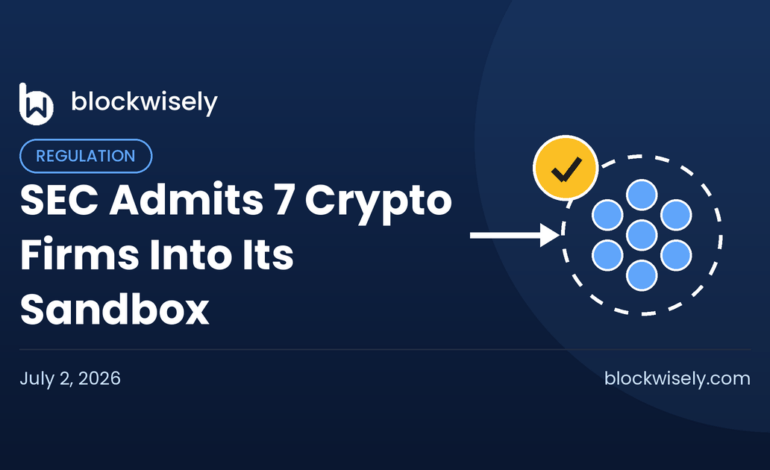
Nigeria’s Securities and Exchange Commission (SEC) has admitted seven additional digital asset and fintech companies into its regulatory sandbox, marking another milestone in the country’s journey toward a fully regulated digital asset ecosystem.
Announced on July 2, 2026, the approvals grant the companies Approval in Principle (AiP) under the SEC’s Accelerated Regulatory Incubation Programme (ARIP) a framework designed to allow innovative firms to operate under regulatory supervision while permanent rules continue to evolve.
For anyone following the SEC crypto sandbox Nigeria has been building since 2024, the message is becoming increasingly clear: rather than pushing crypto businesses to the sidelines, the regulator wants them operating within a transparent, supervised framework.
The Seven Firms Admitted Into ARIP
The latest cohort represents a broad cross-section of Nigeria’s digital asset industry.
The approved firms are:
- Luno Fintech Nigeria
- GetEquity
- Bitbarter Technologies
- Koinkoin Global Network
- Wrapped CBDC
- Trovotech
- Blockvault Custodian
Among them, Luno stands out as the headline entrant. The Nigerian subsidiary of the global cryptocurrency exchange originally founded in South Africa and now owned by Absa Group becomes the first internationally backed crypto exchange admitted into the programme.
Its inclusion reflects both the maturity of Nigeria’s digital asset market and the SEC’s willingness to engage with established global players operating locally.
The remaining companies highlight the diversity of the ecosystem. They span startup investing, digital asset custody, blockchain infrastructure, tokenization, and central bank digital currency innovation.
Rather than focusing solely on crypto exchanges, the SEC appears to be regulating the entire digital asset value chain.
Luno described the approval as a significant milestone following extensive engagement with the Commission, adding that it reinforces the company’s commitment to responsible growth in one of Africa’s largest crypto markets.
What Approval in Principle Actually Means
One important distinction should not be overlooked:
Approval in Principle is not a licence.
Instead, it is conditional regulatory approval that allows companies to operate within the SEC’s supervised environment while meeting ongoing compliance obligations.
To qualify for the SEC crypto sandbox Nigeria operates, firms must:
- Be incorporated in Nigeria;
- Have a resident Chief Executive Officer;
- Register with Nigeria’s financial intelligence authorities;
- Submit detailed operational and compliance plans;
- Provide regular regulatory reports, including weekly or monthly trading data where applicable.
The programme is designed to help regulators observe how innovative products perform under real market conditions before issuing permanent licences.
Failure to comply carries significant consequences.
Companies that breach the programme’s conditions may face penalties starting at ₦5 million, while firms operating outside the regulatory framework risk even more severe sanctions.
In essence, ARIP functions as a live testing environment where innovation and regulation evolve together.
The Cautionary Lesson From Quidax
Participation in the sandbox should not be mistaken for guaranteed long-term success.
Quidax, one of Nigeria’s best-known crypto exchanges and an early participant in ARIP, suspended its peer-to-peer (P2P) trading service earlier this year after roughly five months.
While the company remains operational, the decision illustrated that regulatory participation still requires difficult operational adjustments.
Approval in Principle offers regulatory visibility not immunity from changing compliance requirements.
At the same time, the compliance landscape continues to evolve beyond securities regulation.
Nigeria’s emerging digital asset tax framework requires exchanges to provide transaction information that can help authorities assess tax obligations, creating an environment where platforms must satisfy both securities regulators and tax authorities simultaneously.
Why This Matters for Crypto Users
For everyday investors and traders, the latest approvals are a positive development.
Platforms operating inside the SEC crypto sandbox Nigeria are subject to regulatory oversight, reporting obligations, governance requirements, and investor protection expectations that did not exist for much of the industry’s early growth.
Regulatory participation is also becoming a competitive advantage.
Banks, institutional investors, payment providers, and enterprise clients increasingly prefer to work with platforms operating under recognized regulatory frameworks.
For users, the practical takeaway is straightforward:
- Verify whether your preferred platform has regulatory approval.
- Understand that Approval in Principle is temporary and conditional.
- Recognize the difference between a supervised platform and an unregulated offshore exchange.
Regulation does not eliminate risk but it can significantly improve transparency and accountability.
The Bigger Picture
The admission of these seven firms builds on the approval of Quidax and Busha in 2024 and reflects Nigeria’s broader effort to formalize its digital asset industry.
Recent developments including the Investments and Securities Act, stricter capital requirements for VASPs, expanding tax rules, and growing regional regulatory cooperation across African capital markets point to a clear direction of travel.
Nigeria is no longer debating whether digital assets should be regulated.
The focus has shifted to how they should be regulated.
As one of Africa’s largest cryptocurrency markets, the country’s regulatory decisions are increasingly shaping conversations across the continent.
The companies most likely to succeed in this next phase will not simply be those with the fastest-growing user bases.
They will be the ones that treat compliance as a competitive advantage rather than a regulatory burden.
Bottom Line
The SEC’s latest ARIP approvals mark another significant step in Nigeria’s transition from a largely unregulated crypto market to one built on supervision, accountability, and investor protection.
For businesses, the message is clear: regulation is becoming part of the cost of operating in Nigeria’s digital asset economy.
For users, the message is equally important: always verify a platform’s regulatory status before depositing funds, understand what Approval in Principle actually means, and remember that compliance is an ongoing process not a one-time achievement.
As Nigeria continues to refine its digital asset framework, the SEC crypto sandbox Nigeria has built is becoming more than a testing ground. It is increasingly serving as the foundation for the country’s next generation of regulated crypto businesses.
Disclaimer: This article is for informational purposes only and should not be considered financial, investment, or legal advice. Always conduct your own research and verify a platform’s regulatory status through official SEC Nigeria channels before investing or using any digital asset service.
Sources