








Paystack Index Lets AI Agents Complete Everyday Payments for Nigerians

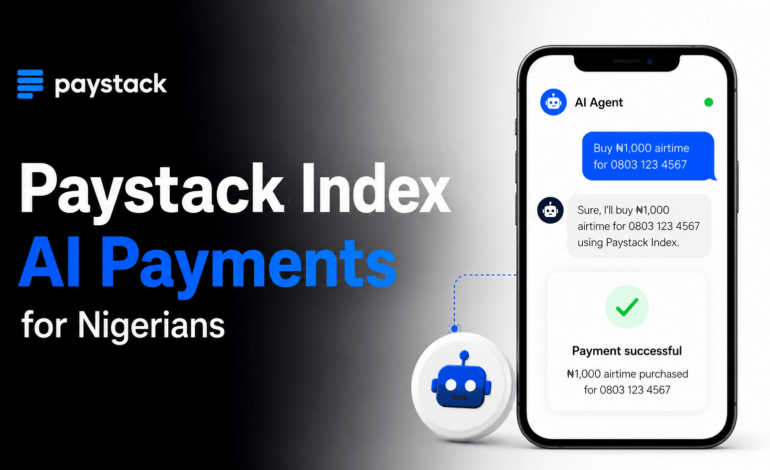
Paystack has launched Paystack Index, an experimental product that allows users in Nigeria to ask supported AI agents to complete everyday transactions such as buying airtime, purchasing mobile data, sending money, paying bills, and ordering food.
The early-access service works with AI assistants including ChatGPT, Claude, and OpenClaw. Users connect their AI agent to Index, issue a natural-language instruction, and allow the system to route the request through Paystack’s payment infrastructure.
The launch represents Paystack’s first major consumer-facing experiment with agentic commerce, a model in which AI systems move beyond providing recommendations and begin carrying out purchases or financial tasks on a user’s behalf.
What Paystack Index can do
At launch, Paystack Index supports a limited set of familiar transactions for Nigerian users.
These include:
- buying airtime;
- purchasing mobile data;
- paying supported bills;
- sending money;
- funding a Zap balance; and
- ordering food through Chowdeck.
Paystack describes Index as an “AI-native commerce index for Africa,” offering a curated catalogue of services that supported agents can access through Paystack’s payment rails.
A user could, for example, tell an agent:
Buy ₦500 of MTN airtime for this phone number.
Or:
Order lunch from Chowdeck near me for less than ₦3,000.
Paystack’s support documentation also gives sending money to a Nigerian bank account as an example of the kinds of instructions Index can process.
How the service works
Paystack Index connects AI agents to commerce and payment tools through the Model Context Protocol, commonly called MCP.
MCP provides a structured way for an AI assistant to access external tools and services. In the case of Index, it allows the agent to convert a user’s request into an authorised action such as buying airtime or initiating a food order.
The process generally works as follows:
- The user creates a Paystack Index account.
- The user connects a supported AI agent through an authorisation flow.
- The user sets permissions, limits, and approval requirements.
- The user describes the transaction in ordinary language.
- The AI agent converts the request into an instruction.
- Index checks whether the action falls within the granted permissions and spending limits.
- The payment or order is processed through Paystack, Zap, or a participating merchant.
Paystack says every completed action appears in the user’s transaction history.
Users need a Zap balance
Index relies heavily on Zap, Paystack’s consumer payment product, for money movement.
When a transaction is executed, real money moves from the user’s Zap balance. Paystack says the financial effect is the same as when the user personally makes a payment through another application.
This means Index is not giving the AI agent direct access to a user’s bank credentials or debit-card details.
The user funds their Zap balance or uses Paystack’s hosted payment infrastructure, after which the agent can initiate permitted transactions from that balance.
Zap may charge a small fee for some transfers, while airtime and data purchases are generally charged at their face value.
The AI agent does not receive card details or PINs
Paystack says Index does not store card numbers, CVVs, PINs, or bank-account credentials.
Card information goes directly through Paystack’s hosted payment page and does not pass through Index. The connected AI agent is also unable to see the user’s password, PIN, or authentication codes.
The agent only receives the information required to perform a requested task, such as:
- the transaction amount;
- a recipient’s phone number;
- a bank account;
- an order request; or
- a delivery address.
For example, a phone number may be passed to a mobile network when airtime is purchased, while a delivery address may be shared with Chowdeck when food is ordered.
Users can set spending limits and approval requirements
Paystack Index is not intended to give an AI agent unlimited authority over a user’s money.
Users can configure permissions, budgets, spending limits, merchant restrictions, and approval workflows. They can also require personal approval for every transaction.
Paystack says Index automatically checks with the user before certain large transactions or payments to new recipients, even where the user has permitted some routine transactions to proceed without fresh approval.
At launch, the default per-transaction caps are:
- ₦5,000 for airtime, data, and bill payments; and
- ₦100,000 for food orders.
Paystack can change these limits and may reject, delay, suspend, or reverse transactions that exceed applicable controls or appear inconsistent with the product’s intended use.
Users remain responsible for their agents
One of the most important details in Paystack Index’s terms is that users are responsible for actions performed by an authorised AI agent within the permissions they granted.
Paystack says an authenticated agent acts as the user’s tool and representative. Transactions initiated within its authorised scope may be treated as actions taken directly by the user.
That means a user may still be responsible where:
- the AI misunderstands an instruction;
- the agent chooses the wrong merchant;
- an incorrect amount is sent;
- the agent makes a poor recommendation; or
- the user granted permissions that were too broad.
Paystack’s terms explicitly warn that an AI-generated transaction is not automatically considered unauthorised merely because the user did not personally review it or later disagrees with the agent’s decision.
Users can revoke an agent’s authority by disconnecting it, but the revocation only applies to future activity and does not cancel transactions already initiated.
Supported AI agents
At launch, Paystack officially supports:
- ChatGPT;
- Claude; and
- OpenClaw.
Other agents are not yet officially supported, although Paystack says the list may expand based on demand and actual usage.
Users authorise their chosen agent using a standard sign-in and consent process. The consent screen identifies the permissions being requested before the agent can access Index tools.
The agent can then read limited information such as the user’s Index-linked Zap balance, initiate approved transactions, and view recent activity where permission has been granted.
Security measures built into Index
Paystack says Index uses several controls intended to reduce fraud, accidental transactions, and unauthorised access.
These include:
- encryption of personal data at rest;
- HTTPS for connections;
- rate limits on transaction APIs;
- masked personal information in system logs;
- single sign-on and two-factor authentication for administrative access;
- spending caps;
- account-level permissions; and
- transaction-processing controls designed to prevent duplicate charges.
Users can immediately pause or disconnect an AI agent from their Index dashboard.
However, Paystack warns that anyone who gains access to a connected agent may be able to instruct it to transact within the limits the user has configured.
Users therefore need to secure both their Index account and the AI agent itself.
The service is still in beta
Paystack Index remains an experimental, early-access product.
Its terms state that the beta service may experience frequent updates, temporary interruptions, functionality changes, or discontinuation of features.
Paystack is starting with a small number of merchants, services, and users so it can study how Nigerians want to use AI for commerce.
Techpoint Africa reported that Paystack does not expect agentic purchasing to achieve immediate mass adoption and intends to use the experiment to understand both consumer behaviour and the infrastructure merchants need to participate safely.
The gradual rollout also reflects the wider uncertainty around whether consumers are ready to trust AI systems to spend real money.
Available only in Nigeria for now
Paystack Index is available only to Nigerian users at launch.
Paystack says it plans to introduce the service in Ghana, Kenya, and South Africa, although it has not provided firm public launch dates for those markets.
The Nigerian rollout gives Paystack access to a large digital-payments market in which consumers are already familiar with bank transfers, mobile airtime purchases, food-delivery apps, and fintech wallets.
Starting with common and relatively low-risk transactions may help the company evaluate whether users are comfortable allowing AI agents to carry out purchases.