









Most people who buy cryptocurrency think about what could happen to its price.
Will Bitcoin rise? Will a stablecoin maintain its value? Will the token they bought still exist in five years?
Far fewer people ask another important question:
What happens to your crypto when you die?
It is an uncomfortable subject. Most of us do not imagine that death could happen soon, especially when we are young, healthy and planning for the future.
However, an accident, illness or other unexpected event can happen at any age.
Your family may know that you owned Bitcoin, Ether or USDT. They may even know which wallet or exchange you used. However, knowing that the assets exist does not mean they can access them.
Without a clear crypto inheritance plan, your digital assets could remain inaccessible forever.
What Happens to Crypto When You Die?
Cryptocurrency can form part of your estate after death.
However, it does not automatically move to your spouse, children or other relatives. What happens next depends mainly on where you stored it.
There are two common situations:
- You held the crypto in a self-custody wallet.
- You held it on a centralised exchange such as Binance.
With a self-custody wallet, your family may need the seed phrase or another approved recovery method.
With an exchange, the beneficiary or estate representative must normally follow the platform’s inheritance process.
In both cases, planning is essential.
Billions of Dollars in Crypto May Be Inaccessible
There is no reliable global figure showing how much cryptocurrency became inaccessible because its owners died.
A blockchain can show that coins have not moved for years. However, it cannot usually explain why.
The owner may have:
- Died without leaving instructions.
- Lost their private keys.
- Forgotten a wallet password.
- Damaged or misplaced a device.
- Chosen to hold the coins without moving them.
Glassnode tracks a category of Bitcoin that it considers “probably lost.” The metric includes coins that have remained inactive since the first Bitcoin exchange launched in July 2010.
As of July 2026, Glassnode valued this group of probably lost Bitcoin at about $94.6 billion. However, some of those coins could still move in the future. [1]
It would therefore be inaccurate to say that $94.6 billion belonged to people who died.
The figure includes Bitcoin that may be inaccessible for many reasons. Still, it shows how much digital wealth can be lost when people fail to prepare proper recovery instructions.
Many People Think They Have More Time
Most people do not ignore inheritance planning because they do not care about their families.
They simply believe they have more time.
Someone in their twenties or thirties may think a will is only necessary after marriage, home ownership or retirement.
Meanwhile, a crypto investor may spend hours protecting an account from hackers. Yet, they may never explain what should happen to that account after their death.
Some people also fear that discussing death somehow invites it.
It does not.
Wearing a seat belt does not mean you expect an accident. Buying insurance does not mean you expect your house to burn down.
In the same way, creating a crypto inheritance plan does not mean you expect to die soon.
It means you want your assets to reach the right people if something unexpected happens.
The Friend Who Updates Their Will Every Year
I know someone who reviews their will every year.
At first, that may sound excessive. Why would a healthy person need to check the same document annually?
The reason is simple: life changes.
Within one year, someone may:
- Get married or divorced.
- Have a child.
- Buy land or a house.
- Start a business.
- Open a new investment account.
- Buy cryptocurrency.
- Change their intended beneficiary.
Updating a will does not always mean writing a new one from the beginning. It may simply involve checking whether the information still reflects the person’s life.
Crypto holders can learn from this habit.
The wallet you used three years ago may now be empty. You may have moved your assets to another exchange. Your original beneficiary may also no longer be the right person.
Reviewing your crypto inheritance plan once a year helps keep it accurate.
Crypto Held in a Self-Custody Wallet
A self-custody wallet gives you direct control over your cryptocurrency.
Examples include hardware wallets and mobile or desktop wallets where you control the private key or seed phrase.
A seed phrase is a group of words that can restore access to a wallet. Anyone with the correct phrase may be able to control the assets.
When the owner dies, the blockchain does not automatically transfer the crypto to their relatives.
The blockchain does not read death certificates. It does not recognise family relationships or interpret a will. It only accepts transactions authorised with the correct credentials.
Therefore, if nobody can find the private key or seed phrase, the crypto may become permanently inaccessible.
There is usually no company that can reset the wallet or issue a new password. Binance Academy warns that self-custody assets may be unrecoverable when the owner has not secured proper access instructions. [2]
Self-custody gives you greater control. However, it also gives you greater responsibility.
Crypto Held on a Centralised Exchange
A centralised exchange holds the private keys connected to its customers’ accounts.
Because the exchange controls the account system, it may have a formal process for handling the assets of a deceased user.
Family members should not simply take the person’s phone, open the account and transfer the funds.
Even when they know the password, accessing the account without legal authority could create security, compliance or legal problems.
Instead, the executor, trustee or beneficiary should contact the exchange and follow its official inheritance process.
The exchange may request:
- A death certificate.
- Identification documents.
- A legally recognised will.
- Court-issued estate documents.
- Proof that the applicant can manage the estate.
The exact requirements depend on the exchange and the laws that apply to the estate.
How Binance Inheritance Works
Binance currently provides two features that can help users prepare for crypto inheritance:
- Emergency Contact
- Claim Inherited Assets
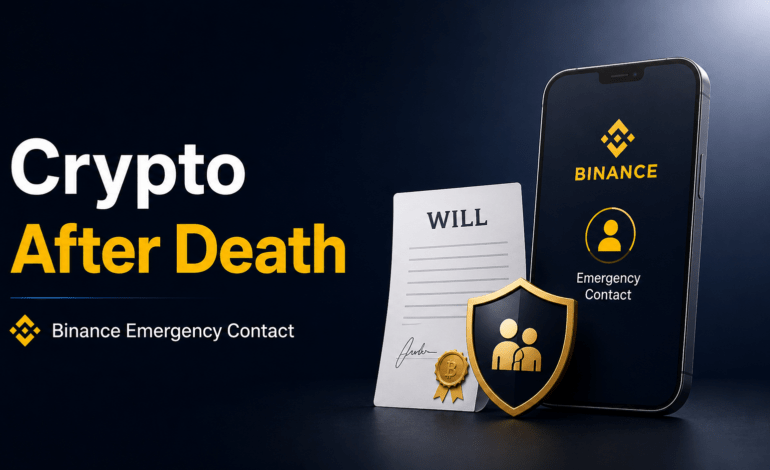
The Emergency Contact feature allows you to add the contact details of a trusted person.
The Claim Inherited Assets service allows a family member, beneficiary or authorised representative to submit a claim after a Binance user dies.
The Emergency Contact feature does not automatically transfer your crypto.
Instead, Binance may contact you and your emergency contact after your account remains inactive for a selected period.
The emergency contact can then submit an inheritance claim. However, the person must still provide valid documents showing that they are entitled to receive or manage the assets. [3][4]
What Is a Binance Emergency Contact?
A Binance emergency contact is someone Binance can reach after your account has remained inactive for a long period.
You provide the person’s:
- Name.
- Email address.
- Telephone number.
Binance requires at least an email address or telephone number. The application also says it is preferable for the emergency contact to be a Binance user.
After you save the contact, Binance activates the emergency contact process.
If your account remains inactive for the period you selected, Binance first tries to contact you. If you remain unreachable, Binance may then contact your emergency contact by email or SMS. [3]
The emergency contact may then have the option to submit an inheritance claim.
How to Add an Emergency Contact on Binance
The current Binance application places the feature under the Security settings.
To add an emergency contact:
- Log in to the Binance application.
- Open your profile or account settings.
- Select Security.
- Scroll to Advanced Security.
- Select Emergency Contact.
- Read the information provided.
- Select Add Emergency Contact.
- Enter a name the person will recognise.
- Add their email address, telephone number or both.
- Review the information and select Save.
Check the contact details carefully. Binance will use them when trying to reach the person.
Binance also allows users to add an optional secondary emergency contact. [3]
The location and wording may differ depending on your country, device and version of the Binance application.
How Binance’s Inactivity Period Works
Adding an emergency contact does not mean Binance will contact the person immediately.
First, you select an Inactivity Period. This is how long the account must remain inactive before Binance starts the contact process.
The default period is one year. Other available options may include:
- Two years.
- Three years.
- Five years.
Binance measures inactivity using actions such as your last login or session renewal. [3]
After the inactivity period ends, Binance first tries to contact you.
You can also choose an Initial Contact Duration. This determines how long Binance will continue trying to reach you before contacting your emergency contact.
The default duration is one month. Other options may include two or three months. [3]
For example, suppose you choose:
- A one-year inactivity period.
- A one-month initial contact duration.
Binance will begin trying to contact you after one year of inactivity. If you remain unreachable for another month, it may contact your emergency contact.
This extra period reduces the risk of starting the inheritance process simply because someone temporarily stopped using their account.
Is an Emergency Contact Automatically a Beneficiary?
No.
A Binance emergency contact is someone Binance can reach after prolonged account inactivity.
A beneficiary is someone legally entitled to receive part or all of the deceased person’s estate.
The same person can hold both roles. However, Binance should not assume that the emergency contact is automatically the beneficiary.
For example, you might choose a trusted sibling as your emergency contact because they understand cryptocurrency.
However, your will may state that your crypto should be divided among your children.
The sibling could help start the claim. The assets would still need to be distributed according to the will and applicable inheritance law.
How a Family Member Can Claim Binance Assets
The current Binance application shows a Claim Inherited Assets option under its support topics.
An applicant can look for it by following these steps:
- Log in to their own Binance account.
- Open Customer Support.
- View the available support topics.
- Find Financial Services.
- Select Claim Inherited Assets.
- Enter the requested information.
- Upload the necessary documents.
- Submit the claim for review.
The Binance website may use slightly different wording.
It may direct applicants to View All under Self Service and then display Legacy Inheritance. Binance has also referred to the service as an Inheritance Appeal. [4]
These names refer to the process for claiming assets belonging to a deceased Binance user.
What Information Will Binance Request?
The applicant must have their own Binance account before submitting the claim.
Binance says the deceased user can be identified using one of the following:
- Email address.
- Telephone number.
- Binance ID.
The applicant must also provide valid inheritance documents.
Depending on the case, these may include:
- A death certificate.
- The applicant’s identification.
- A legally recognised will.
- Proof of relationship to the deceased.
- Probate or estate-administration documents.
- A court order.
- Proof that the applicant is an executor, trustee or beneficiary.
Binance may request more information during the review.
What Happens After the Claim Is Submitted?
A Binance team reviews the information and documents.
The team must confirm:
- That the Binance user has died.
- That the correct account has been identified.
- That the applicant has the right to make the claim.
- That the documents are valid.
- That the transfer complies with applicable law.
After approval, Binance transfers the assets to the rightful beneficiary or trustee.
Binance says the process usually takes about one to two months. More complicated cases may take longer. [4]
The beneficiary does not receive the deceased user’s password or take control of the original account.
Binance Emergency Contact Does Not Replace a Will
The Binance Emergency Contact feature can make it easier for the platform to reach someone you trust.
However, it should not replace a legally recognised will.
A complete digital asset estate plan should answer four questions:
- Discovery: How will your family know that the account exists?
- Contact: Who should Binance contact after prolonged inactivity?
- Ownership: Who should legally inherit the assets?
- Recovery: Which documents will be needed to claim them?
Your emergency contact helps with communication and recovery.
Your will explains who should legally receive the assets.
You should also maintain a separate crypto inventory. The inventory can show which exchanges and wallets you use without exposing passwords or private keys.
Should You Put Your Seed Phrase in Your Will?
Do not casually place your seed phrase inside an ordinary will.
Lawyers, witnesses, executors, court officials or relatives may see the document during the inheritance process.
Anyone who obtains your seed phrase may be able to move the crypto.
Instead, your will can state:
- Who should inherit the assets.
- Who will manage the estate.
- That separate recovery instructions exist.
- Where those instructions are stored.
You can store the sensitive information separately in a secure location.
Possible options include:
- A secure safe.
- A safe-deposit facility.
- An encrypted storage device.
- A professional custody service.
- A carefully designed multisignature wallet.
The right method depends on the value of the assets and the technical ability of your beneficiary.
Create a Crypto Asset Inventory
Your family cannot recover assets they do not know exist.
Create a simple inventory showing where you hold cryptocurrency.
It may include:
- Centralised exchange accounts.
- Hardware wallets.
- Mobile and desktop wallets.
- Decentralised finance platforms.
- Staking accounts.
- Non-fungible tokens.
- Mining income.
- Crypto-related business interests.
You do not need to record every balance.
The main purpose is to help your executor find the assets and begin the correct recovery process.
Update the inventory whenever you open or close an account.
Leave Instructions a Beginner Can Follow
Do not assume your family understands cryptocurrency.
Terms such as seed phrase, private key, gas fee and hardware wallet may be unfamiliar to them.
Explain:
- Which assets exist.
- Where they are held.
- Who should receive them.
- Which documents may be required.
- Who can provide professional help.
- Which actions they should avoid.
Also warn them about scams.
A scammer may pretend to work for Binance or offer to recover a wallet. Your family should never send a seed phrase through WhatsApp, email or social media.
Do Not Share Your Password Too Early
Crypto inheritance planning does not mean giving another person immediate control of your assets.
Sharing your Binance password, private key or seed phrase while you are alive can expose the assets to theft or misuse.
A good plan should achieve two things:
- Nobody can access the assets without permission while you are alive.
- The authorised person can recover them after your death.
If the plan is too open, someone may steal the assets.
If it is too secret, your beneficiary may never find them.
Review Your Crypto Inheritance Plan Every Year
Return to the friend who reviews their will every year.
Crypto holders should follow a similar routine.
During your yearly review, ask:
- Do I still use the same wallets and exchanges?
- Is my Binance emergency contact still the right person?
- Does my will include my digital assets?
- Can my executor find my crypto inventory?
- Are my recovery instructions still correct?
- Does my beneficiary understand what to do?
You should also review the plan after marriage, divorce, the birth of a child or the death of a beneficiary.
An outdated plan can create almost as many problems as having no plan.
Crypto Inheritance Checklist
Use this checklist to begin your crypto estate planning:
- List the exchanges and wallets you use.
- Decide who should inherit your crypto.
- Choose a responsible executor or trustee.
- Include digital assets in a valid will.
- Store recovery details securely.
- Leave clear instructions.
- Add a Binance emergency contact.
- Select an appropriate inactivity period.
- Check the contact’s email address and telephone number.
- Explain how to find the Claim Inherited Assets service.
- Warn your family about recovery scams.
- Review the plan every year.
The Blockwisely Take
Crypto gives people more control over their money.
However, that control comes with responsibility.
A self-custody wallet does not have a support team that can replace a missing seed phrase. A centralised exchange may offer an inheritance process, but your family must still know that the account exists.
Binance’s Emergency Contact feature helps solve part of this problem. It allows the platform to contact a trusted person after prolonged account inactivity.
However, an emergency contact is not automatically a beneficiary.
The feature should form part of a broader crypto inheritance plan that includes a will, a secure asset inventory and clear recovery instructions.
Conclusion
So, what happens to your crypto when you die?
The assets do not automatically disappear. However, they may become inaccessible when nobody knows where they are stored or how to claim them.
A simple plan can prevent this.
Create an inventory. Prepare a valid will. Protect your seed phrase. Add an emergency contact and explain how the Claim Inherited Assets process works.
You worked to build your digital assets.
A little planning today can help them reach the people you intended to protect.
Frequently Asked Questions
Can my family inherit my cryptocurrency?
Yes. Cryptocurrency can form part of an estate. However, the beneficiary needs a legal right to receive it and a practical way to recover it.
What happens if nobody knows my seed phrase?
Crypto held in a self-custody wallet may become permanently inaccessible when nobody can recover the seed phrase or private key.
What is a Binance emergency contact?
It is a trusted person Binance may contact after your account remains inactive for the selected period and Binance cannot reach you.
Is a Binance emergency contact automatically a beneficiary?
No. The person may still need to prove their legal right to inherit the assets.
Where can a family member claim Binance assets?
The Binance application may display Claim Inherited Assets under Financial Services. The website may use Legacy Inheritance or Inheritance Appeal.
How long does a Binance inheritance claim take?
Binance says the process usually takes about one to two months. Complex cases may take longer. [4]
References
[1] Glassnode, Bitcoin Probably Lost Supply Chart. The metric tracks Bitcoin considered probably lost because it has remained inactive for a long period.
[2] Binance Academy, How to Protect and Pass On Your Crypto After Death. The guide discusses self-custody recovery, wills and digital asset inheritance planning.
[3] Binance Support, How Does the Emergency Contact Feature Work?, published May 7, 2025 and updated March 5, 2026.
[4] Binance Support, How to Use the Inheritance Appeal Feature on Binance?, published April 3, 2024 and updated November 28, 2025.
This article is for general educational purposes. It does not constitute legal, financial or tax advice. Inheritance laws and crypto recovery procedures differ by country.