









Imagine This…
You bought Bitcoin a few months ago.
Shortly after your purchase, the price dropped by 30%.
You are not worried because you believe Bitcoin will recover over time. Instead of selling at a loss, you decide to wait patiently for the market to bounce back.
Then life happens.
Your car breaks down.
A family member needs urgent medical attention.
Your landlord is asking for rent.
Or another unexpected expense suddenly appears.
Now you need cash immediately.
You seem to have only two choices.
The first is to sell your Bitcoin at a loss, giving up the opportunity to benefit if the price recovers.
The second is to take a high-interest emergency loan that could leave you paying back far more than you borrowed.
But there is a third option that many Bitcoin holders don’t know exists.
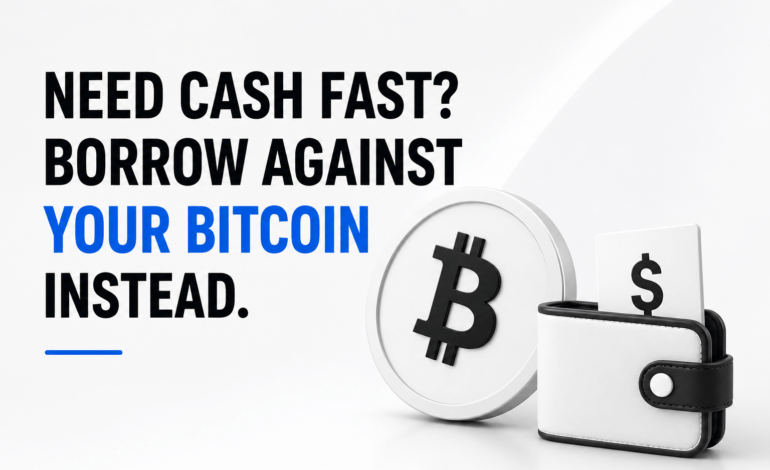
If you own Bitcoin, you may be able to use it as collateral for a loan instead of selling it.
This allows you to access cash for short-term needs while keeping your long-term investment intact. Once you repay the loan and any agreed interest, your Bitcoin is returned to you.
It sounds like the best of both worlds, but like any financial product, Bitcoin-backed loans come with both benefits and risks.
Let’s look at how they work and whether they could make sense for you.
What Is a Bitcoin-Backed Loan?
A Bitcoin-backed loan is exactly what it sounds like.
Instead of selling your Bitcoin, you temporarily pledge it as collateral to a lender. In return, the lender gives you cash or stablecoins such as USDT or USDC.
Once you repay the loan, together with any interest and fees, your Bitcoin is returned to you.
Think of it like using a car or house as collateral for a traditional loan. The difference is that your Bitcoin serves as the security.
Why Not Simply Sell Your Bitcoin?
Selling your Bitcoin is often the quickest solution, but it has some drawbacks.
If Bitcoin’s price rises after you sell, you miss out on those gains.
Selling may also create a taxable event depending on your country’s tax laws.
For people who believe Bitcoin will increase in value over time, selling during a temporary cash shortage may not be the ideal solution.
How a Bitcoin Loan Works
The process is usually straightforward.
- Deposit your Bitcoin with a lending platform.
- The platform values your Bitcoin.
- You receive a loan worth a percentage of your Bitcoin’s value.
- You repay the loan plus interest before the agreed deadline.
- Your Bitcoin is returned after the loan is fully repaid.
The amount you can borrow depends on something called the Loan-to-Value (LTV) ratio.
What Is Loan-to-Value (LTV)?
Loan-to-Value, or LTV, measures how much you borrow compared to the value of your Bitcoin.
For example:
- You own Bitcoin worth $10,000.
- The lender offers a 30% LTV loan.
- You can borrow up to $3,000.
A lower LTV generally reduces your risk because there is more room for Bitcoin’s price to fall before your loan is affected.
What Happens If Bitcoin’s Price Falls?
This is one of the biggest risks.
If Bitcoin’s price drops significantly, your collateral may no longer be enough to secure the loan.
Depending on the lender, you may receive a margin call, asking you to:
- Deposit more Bitcoin as collateral.
- Repay part of the loan.
- Do both.
If you fail to act, the lender may automatically sell part or all of your Bitcoin to recover the loan. This is known as liquidation.
Advantages of Borrowing Against Bitcoin
Using Bitcoin as collateral can provide several benefits.
You Keep Your Bitcoin
If Bitcoin’s price increases while your loan is active, you still benefit because you continue to own the asset after repaying the loan.
Quick Access to Cash
Many crypto lending platforms can process loans much faster than traditional banks.
Potential Tax Benefits
In some countries, borrowing against Bitcoin does not trigger capital gains tax because you are not selling your asset.
However, tax rules vary from country to country, so it is important to seek professional advice.
Risks You Should Know
Bitcoin-backed loans are not risk-free.
Liquidation Risk
A sharp drop in Bitcoin’s price could result in your collateral being sold automatically.
Custody Risk
Many lenders require you to transfer your Bitcoin into their custody.
If the company experiences financial problems, is hacked or becomes insolvent, your Bitcoin could be at risk.
Interest Costs
Loans are never free.
Always compare interest rates, repayment periods and any additional fees before borrowing.
Regulatory Changes
Crypto lending services are not available in every country and regulations continue to evolve around the world.
When Does a Bitcoin Loan Make Sense?
Borrowing against Bitcoin may be suitable if:
- You need short-term cash.
- You expect to repay the loan within a reasonable period.
- You want to keep your long-term Bitcoin investment.
- You understand the risks involved.
It may not be suitable if:
- You are unsure how you will repay the loan.
- You would struggle if Bitcoin’s price fell sharply.
- You cannot afford liquidation.
Should You Borrow or Sell?
There is no single answer that works for everyone.
Selling Bitcoin permanently reduces your exposure to future price movements.
Borrowing lets you keep your Bitcoin, but introduces new risks such as liquidation and interest payments.
Before making a decision, consider your financial situation, repayment ability and risk tolerance.
Final Thoughts
Bitcoin is becoming more than just an investment.
Today, many holders can use it as collateral to access liquidity without immediately selling their coins.
For people facing a temporary cash shortage, a Bitcoin-backed loan may offer flexibility while preserving long-term ownership.
However, borrowing against Bitcoin should never be taken lightly. Understanding concepts such as Loan-to-Value (LTV), margin calls and liquidation is essential before using your Bitcoin as collateral.
Used carefully, a Bitcoin-backed loan can be a valuable financial tool. Used carelessly, it could result in losing the very Bitcoin you were trying to keep.