







Coinbase Lists Kenya and Nigeria Among Supported Markets, but Services Remain Limited

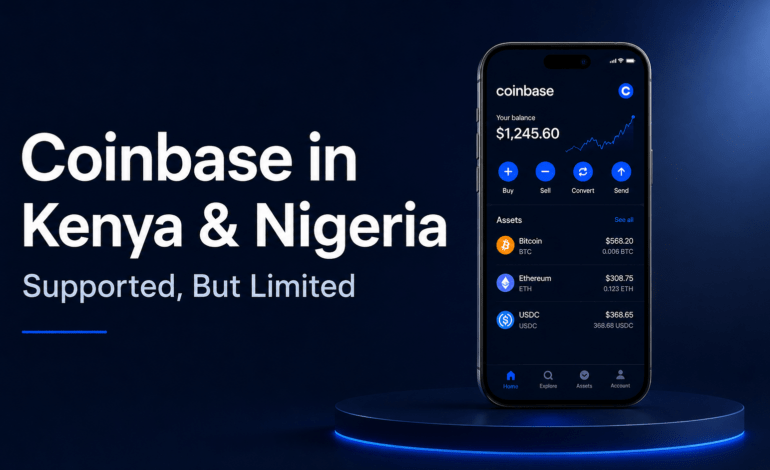
Coinbase lists Kenya and Nigeria among the countries eligible for selected cryptocurrency services, giving users in both markets access to features such as crypto-to-crypto conversion and certain USDC services.
However, the inclusion of the two countries on Coinbase’s availability pages should not be interpreted as a full launch of the Coinbase exchange in either market.
The services available to users can differ depending on their country, account status, payment method and the specific Coinbase product being used. Coinbase itself warns that it may restrict services based on a user’s location to comply with local regulations.
This means a customer in Kenya or Nigeria may be able to open an account, verify their identity, hold crypto or convert between supported cryptocurrencies while still lacking access to some features available to users in countries such as the United States or the United Kingdom.
Kenya and Nigeria Appear on Coinbase’s Trading List
Coinbase’s official list of countries where crypto-to-crypto trading pairs are available includes both Kenya and Nigeria.
Crypto-to-crypto trading allows a user to convert one cryptocurrency into another. For example, a user may be able to exchange Bitcoin for USDC or convert another supported asset into Ether.
It is different from full fiat trading support.
A market with complete fiat support would normally allow users to deposit their local currency, buy cryptocurrency directly, sell cryptocurrency for local currency and withdraw the money to a local bank account or payment service.
Coinbase’s inclusion of Kenya and Nigeria on its crypto-to-crypto trading list confirms that the countries are recognised within its global service coverage. It does not confirm that every retail trading, banking and withdrawal feature is available.
Both Countries Can Access Selected USDC Services
Coinbase’s current USDC regional availability page provides a clearer picture of the difference between the two markets.
Both Kenya and Nigeria are listed as eligible for fiat-to-crypto exchanges involving USDC. They are also included among the African countries eligible for crypto-to-crypto exchanges involving the dollar-backed stablecoin.
However, there is an important difference when users want to convert USDC back into fiat currency.
Coinbase lists Kenya among the African countries eligible for crypto-to-fiat USDC exchanges. Nigeria does not appear on that particular list.
According to the current Coinbase service matrix:
- Users in Kenya may be eligible for fiat-to-USDC, USDC-to-fiat and crypto-to-crypto USDC exchanges.
- Users in Nigeria may be eligible for fiat-to-USDC and crypto-to-crypto USDC exchanges.
- Nigeria is not currently listed for USDC-to-fiat exchanges on the same page.
This does not necessarily mean that every eligible Kenyan user can withdraw USDC directly to a Kenyan bank account. Actual access can still depend on the payment partners, account verification, supported payment methods and regional restrictions attached to the customer’s account.
It also does not mean Nigerians have no way to convert USDC into naira through other providers. The Coinbase list only describes the availability of the company’s own supported USDC exchange flows.
Being Supported Does Not Mean Coinbase Has Fully Launched Locally
Coinbase operates several different products. These include its custodial retail exchange, self-custody wallet services, institutional products, developer infrastructure and the Base blockchain ecosystem.
A country may be supported by one product but not another.
For example, access through a self-custody wallet does not necessarily mean the user has access to the full Coinbase exchange. In a self-custody wallet, the user controls the wallet’s recovery credentials and interacts directly with blockchain networks and third-party services.
A standard Coinbase exchange account is different. Coinbase holds the assets on the customer’s behalf and determines which trading, deposit, withdrawal, staking and payment features are available in that jurisdiction.
This distinction became particularly relevant in Africa after Coinbase announced a partnership with Yellow Card in January 2024.
Coinbase said the partnership would expand access to USDC and Base-powered transactions across 20 African countries. Users in the supported markets would be able to purchase USDC through the Coinbase Wallet experience, while Yellow Card customers could access USDC on Base through Yellow Card’s platform.
The partnership focused heavily on stablecoin access, remittances and lower-cost blockchain transfers. It was not presented as a full rollout of Coinbase’s centralised exchange, local bank accounts and complete retail trading platform in all 20 countries.
What Users in Kenya and Nigeria Should Expect
Users should not assume they will receive the same account features simply because their country appears on a supported-country page.
Before depositing money or transferring cryptocurrency, a customer should check the services shown inside their own verified account.
The user should confirm whether they can:
- Purchase crypto using a card, bank account or other local payment method
- Deposit Kenyan shillings or Nigerian naira
- Sell cryptocurrency for local currency
- Withdraw fiat currency to a local bank or payment provider
- Transfer cryptocurrency to an external wallet
- Access staking, rewards or advanced trading
- Use a particular asset or trading pair
Coinbase notes that buying or funding may be unavailable when identity verification is incomplete, an account is restricted, a payment method is unsupported or local regulations limit the service in the user’s location.
Two users in the same country could therefore see different options depending on their verification status, account history and the Coinbase entity serving them.
Identity Verification Is Available for Both Countries
Coinbase’s identity-verification guidance includes Kenya and Nigeria among the countries for which it provides accepted identification procedures.
Its proof-of-residency page also lists documents for residents of both countries. Kenyan users may be asked for documents such as a national identity card, residence permit or driving licence. Nigerian users may similarly use eligible national identity and residency documents.
The presence of country-specific verification documents provides further evidence that Coinbase recognises customers from Kenya and Nigeria within parts of its account and compliance infrastructure.
However, successful identity verification does not guarantee access to every service. It confirms the customer’s identity and residency, after which Coinbase determines which features are permitted for that account and jurisdiction.
Why Coinbase Is Interested in Kenya and Nigeria
Kenya and Nigeria are among Africa’s most active digital asset markets.
Users in both countries commonly turn to cryptocurrency and stablecoins for international payments, online work, trading, access to dollar-linked assets and cross-border business transactions.
Coinbase’s Africa strategy has placed particular emphasis on USDC.
When announcing its Yellow Card partnership, the company said stablecoins could offer people and businesses faster and cheaper ways to transfer value, receive remittances and access dollar-denominated assets. It also said users in participating African countries would be able to send USDC through shareable links on platforms such as WhatsApp, Telegram, email and iMessage.
This approach allows Coinbase to expand the reach of USDC and Base without immediately building a complete local exchange, banking and regulatory operation in every African country.
For Coinbase, partnerships with existing African payment and stablecoin companies can provide local currency access while reducing some of the difficulty of developing separate banking relationships in each market.
For users, however, it means the Coinbase service they encounter may be powered partly by a local partner rather than provided entirely through the main Coinbase exchange.
Is This a New Coinbase Launch?
The current country listings should not automatically be treated as evidence of a completely new Coinbase launch in Kenya or Nigeria.
Coinbase publicly announced its expansion of USDC access across 20 African countries in January 2024. Kenya and Nigeria were among the major markets associated with that initiative through Yellow Card.
The latest availability pages provide useful confirmation that the two countries remain eligible for selected services. They do not, by themselves, show that Coinbase has recently launched full local exchanges, introduced direct bank deposits or secured new operating licences in Kenya and Nigeria.
A more accurate interpretation is that Coinbase continues to recognise both countries as supported markets for specific crypto and stablecoin functions while maintaining significant product and regional limitations.