









VALR Lets South Africans Borrow Against Their Crypto Without Selling

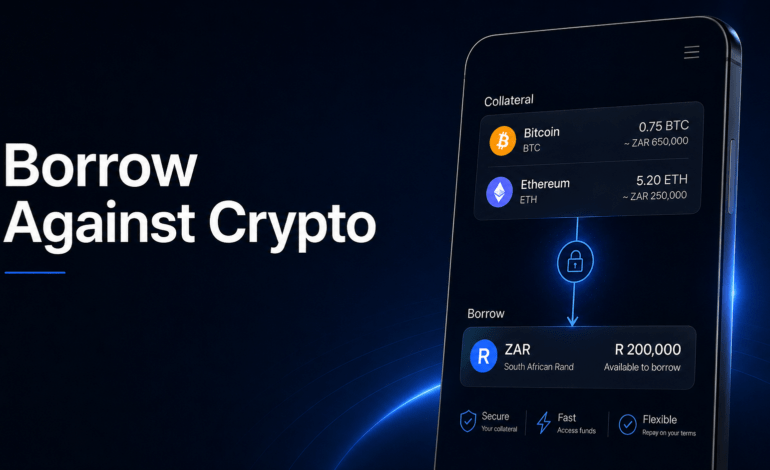
South African crypto exchange VALR has launched a new borrowing product that allows eligible users to access funds without first selling their Bitcoin, Ethereum or other supported crypto assets.
The product, called Borrow, was announced on August 25, 2026. According to VALR’s official launch announcement, users can pledge crypto as collateral, receive borrowed funds directly into their VALR account and then use those funds for trading, conversion to fiat, withdrawals or payments through VALR Pay.
For investors who want to remain exposed to their crypto holdings while still accessing liquidity, the appeal is straightforward.
Instead of selling Bitcoin to raise cash, a user can borrow against it.
But there is an important trade-off.
The crypto remains exposed to market movements, and if the value of the collateral falls too far relative to the debt, VALR can begin liquidating assets to protect the loan. VALR’s own Crypto Loans documentation warns that borrowers can lose some or all of the assets provided as collateral.
That makes the product useful in some circumstances, but potentially risky in others.
How VALR Borrow Works
The basic idea is similar to a secured loan.
A borrower has an asset.
Instead of selling that asset, they use it to secure access to other funds.
With VALR Borrow, the asset being pledged is cryptocurrency.
According to VALR’s loan guide, collateral is reserved in the user’s account while the loan remains outstanding.
Suppose someone holds Bitcoin worth R100,000.
They might not want to sell because they believe Bitcoin could rise over the long term.
But they may still need liquidity.
Instead of selling part of the Bitcoin, the user can place qualifying assets into a margin-enabled account and borrow against them.
The amount available is not necessarily equal to the full market value of the collateral. VALR says borrowing limits are based on the value of the pledged assets, the relevant leverage settings and the risk profile of those assets.
That buffer exists because crypto prices can move quickly.
Users Can Keep Their Crypto Exposure
The main selling point is that borrowers do not have to sell the crypto they already own.
If a Bitcoin holder sells part of their position to raise cash, they no longer participate in future price gains on the portion sold.
With a collateralised loan, the asset remains in the account as collateral.
If Bitcoin subsequently rises, the borrower still has economic exposure to that increase.
VALR described Borrow as a way of creating a bridge between long-term crypto ownership and short-term financial flexibility in its product launch announcement.
That is one reason crypto-backed loans have become popular among investors who do not want to sell long-term holdings every time they need liquidity.
What Can Borrowed Funds Be Used For?
VALR says borrowed funds are credited directly to the user’s account.
From there, the money can potentially be:
- traded on VALR’s markets;
- converted into another currency;
- converted to fiat;
- withdrawn from the platform; or
- used through VALR Pay.
The company says Borrow is designed for both individual investors and corporate clients.
VALR Chief Product Officer Badi Sudhakaran said the product is intended to let users access money when they need it without being forced to sell crypto they want to keep. The company has suggested use cases ranging from short-term expenses to business liquidity and new investment opportunities.
That flexibility is important.
But borrowing money to make another investment can also magnify risk.
There Are No Traditional Credit Checks
Another major difference from a conventional bank loan is how the lender assesses the borrower.
Traditional lending often considers:
- income,
- credit history,
- employment,
- existing debt,
- and ability to repay.
VALR says Borrow does not rely on traditional credit checks or extensive paperwork.
Instead, the loan is secured by crypto already held as collateral.
Loan limits are primarily determined by the assets pledged and their risk characteristics, according to the Borrow launch information.
In practical terms, the collateral partly replaces the need for the lender to rely on the borrower’s creditworthiness.
If the borrower fails to maintain sufficient collateral, the platform has assets available to sell to cover the debt.
That is also why liquidation risk is so important.
Interest Is Charged Hourly
VALR’s Crypto Loans documentation says interest rates are variable and charged hourly.
The interest is added to the outstanding loan.
Before completing a borrowing transaction, users can see an indication of the likely next hourly rate and an estimate of how much they can borrow.
VALR’s broader margin and lending terms say interest accrues hourly, is capitalised hourly in arrears and may change according to rates set by VALR.
That means the cost of borrowing is not necessarily fixed for the entire life of the loan.
A borrower should therefore look at the current rate and understand that costs can accumulate the longer the debt remains open.
There Is No Fixed Repayment Schedule
VALR says users do not have to follow a conventional monthly instalment schedule.
Borrowers can repay part or all of the loan when they choose.
According to the platform’s loan guide, repayments can be made by transferring or depositing the borrowed asset into the relevant margin-enabled sub-account.
Borrowers can also sell collateral into the currency they owe and use the proceeds to repay the loan.
VALR says there are no early-settlement penalties.
This flexibility may make the product useful for someone who expects to need liquidity only temporarily.
But having no fixed repayment date does not mean the loan can be ignored indefinitely.
Interest continues to accrue, and worsening collateral values can trigger liquidation.
The Biggest Risk Is Liquidation
Imagine someone deposits Bitcoin worth R100,000 and borrows against it.
If Bitcoin rises, the collateral becomes more valuable.
That generally improves the safety margin.
If Bitcoin falls sharply, the opposite happens.
The debt has not necessarily fallen.
But the asset securing the debt is now worth less.
At a certain point, the platform may need to start selling the borrower’s assets.
VALR explains in its Crypto Loans guidance that when an account falls below its maintenance margin, it begins gradually liquidating assets before the account reaches a level where the remaining collateral may no longer cover the debt.
That means a borrower can lose crypto even if they never intentionally chose to sell it.
This is one of the most important differences between simply holding Bitcoin and borrowing against Bitcoin.
If you only hold the asset, you can theoretically choose to wait through a price crash.
If the asset is securing a loan, your lender may not allow you to wait indefinitely.
A Simple Example
Suppose you own:
R100,000 worth of Bitcoin.
You do not want to sell.
You borrow:
R30,000.
Your Bitcoin remains collateral.
If Bitcoin rises by 20%, the collateral becomes worth around R120,000, ignoring fees and other factors.
You still owe the loan and accrued interest, but your collateral position has strengthened.
Now imagine Bitcoin falls 50%.
Your collateral is worth around:
R50,000.
The R30,000 debt is still outstanding, plus interest.
Your safety margin has become much smaller.
If the price keeps falling, VALR may start liquidating the collateral.
The exact liquidation point depends on the account’s margin requirements and other assets in the relevant sub-account.
That is why the question should not simply be:
“How much can I borrow?”
A more useful question is:
“How much could the crypto fall before my position becomes unsafe?”
Not Every Customer Can Borrow ZAR in the Same Way
There is also an important South African regulatory limitation.
VALR’s guidance on borrowing ZAR for spot margin says direct ZAR borrowing is currently available only to qualifying business customers meeting certain criteria.
Individual customers cannot currently borrow ZAR for leveraged spot purchases in the same way.
However, VALR says individuals can use assets such as ZAR as collateral to borrow other supported currencies, such as USDC, depending on the product and account setup.
That distinction matters because the phrase “borrow against your crypto” can sound as though every South African user can simply deposit Bitcoin and immediately borrow rand.
The exact assets available to borrow and the eligibility conditions depend on the customer’s account and VALR’s rules.
Borrow Is Built on VALR’s Existing Margin Infrastructure
Although Borrow was formally launched as a new consumer-facing product on August 25, VALR already had crypto-loan functionality within its margin system.
Its help centre had previously documented the ability to borrow against crypto assets.
The new launch is therefore better understood as VALR making collateralised borrowing a more prominent and accessible product rather than inventing the underlying lending system from scratch.
VALR describes its margin engine as fully collateralised and cross-margined in its Margin Trading Guide, meaning qualifying assets inside a margin-enabled sub-account can contribute toward covering outstanding debt.
That also means users should understand that more than one asset in a margin-enabled sub-account may potentially be exposed when liquidation occurs.
VALR Loans Is Registered With South Africa’s Credit Regulator
The regulatory structure behind the product is also noteworthy.
According to VALR’s official licensing disclosures, VALR Loans Proprietary Limited is registered with South Africa’s National Credit Regulator under registration number NCRCP15447.
VALR Proprietary Limited is separately licensed as a Financial Services Provider by the Financial Sector Conduct Authority, under FSP number 53308.
The group’s VALR DAM business also holds its own FSP licence and an Over-the-Counter Derivatives Provider licence.
That is an important distinction because crypto exchanges increasingly offer products that overlap with activities traditionally associated with financial-services and credit providers.