








Nomba Cross-Border Payments: Why Its $3M Africa-Asia Push Matters

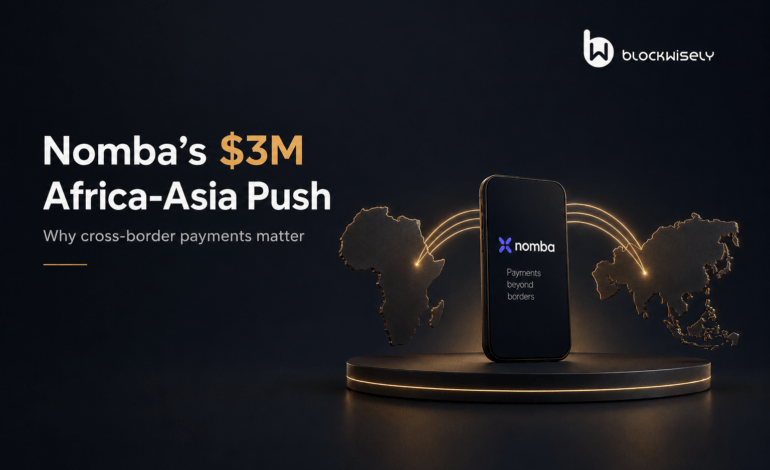
Nomba cross-border payments are becoming a bigger story in African fintech after the Nigerian company secured a $3 million debt facility from CardinalStone Finance Company Limited.
The facility will support Nomba’s cross-border payment infrastructure from the Democratic Republic of Congo. It will also give the company more US dollar liquidity through banking relationships in Hong Kong and Singapore.
At first glance, $3 million may not look huge in a fintech market used to large venture rounds. But this deal is not just about the size of the funding. It is about what Nomba is trying to build: payment rails for African businesses that trade across borders.
The bigger question is simple. Can African fintechs move beyond local payments and become the infrastructure behind global trade?
What Nomba Announced
Nomba has raised a $3 million debt facility to expand its cross-border payments business. The financing came through CardinalStone Finance Company Limited, the financing arm of CardinalStone Group.
The company plans to use the facility to grow its operations from the DRC. Nomba sees the country as a base for trade settlement between Central Africa and Asia.
The facility also gives Nomba more dollar liquidity. That matters because cross-border payments often fail, slow down or become expensive when a provider cannot access enough foreign currency at the right time.
Nomba says it currently processes more than $480 million in cross-border payments every month across its DRC operations and its Canadian-licensed money service business. It wants to push that figure above $1 billion per month.
Why the DRC Is Important
The DRC is not a random choice.
The country sits at the centre of major commodity and trade flows. It is rich in minerals such as copper and cobalt, which are important to global supply chains. Asian demand, especially from China, has made the DRC a key trade partner.
TechEconomy reported that China-DRC trade reached $26.7 billion in 2025, with China importing mainly copper and cobalt from the DRC while exporting goods into the country.
That trade creates a real payment problem.
African businesses need to pay suppliers, settle invoices, receive international funds and convert currencies. Many still depend on slow banking channels, fragmented intermediaries and expensive foreign exchange processes.
This is where Nomba wants to position itself. It is not only selling payment tools to local merchants. It is trying to build rails for businesses that move money across countries.
Why This Is Bigger Than a Funding Story
Many African fintech funding stories focus on how much money a company raised. This one is different.
Nomba did not announce a large equity round. It secured debt. That means the company is using financing to strengthen liquidity and transaction capacity, not simply to extend its runway.
That distinction matters.
A payments company needs liquidity to settle transactions. If it wants to serve importers, exporters, remittance companies or trade businesses, it must move money quickly across currencies. A lack of liquidity can make transactions slower and more expensive.
For Nomba, this facility gives it more room to support business payments across Africa-Asia corridors. It could help the company serve merchants and enterprises that need faster settlement between the DRC, Asia and other African markets.
Nomba also plans to expand into Zambia and Uganda, according to reports. That could turn the DRC operation into a gateway for Central and East African trade flows.
The Web3 Angle: Stablecoins and Last-Mile Payouts
Nomba’s story also matters to Web3 because cross-border payments are one of the strongest use cases for stablecoins.
Nomba’s official remittance infrastructure page says it supports stablecoin rails, including accepting USDT and USDC inflows, converting them to local currency and settling to bank accounts or mobile money.
That does not mean this $3 million facility is only about stablecoins. It is not. The deal is mainly about liquidity and cross-border payment infrastructure.
However, it shows where African payments are heading. The future will likely mix bank rails, mobile money, foreign currency accounts and stablecoin settlement. Businesses will not care which rail sits behind the payment if the money arrives quickly, safely and at a fair rate.
For African fintechs, the winning model may not be “crypto versus banks.” It may be a system where stablecoins, banks and local payment networks work together behind the scenes.
What This Could Mean for African Businesses
For businesses, better cross-border payment infrastructure can solve practical problems.
An importer in Kinshasa may need to pay a supplier in Asia. A distributor may need to receive dollars and pay local vendors in Congolese francs. A remittance company may need to move funds into Africa and settle through mobile money or bank accounts.
If those payments take too long, business slows down.
Nomba’s DRC platform already presents itself as a tool for business payments, international payments, mobile money interoperability and bank transfers. It also says it is licensed and regulated by the Banque Centrale du Congo.
That licence gives Nomba a stronger base to serve companies operating in or through the DRC. It also helps the company build trust in a market where compliance matters.
Why Liquidity Is the Real Product
Cross-border payment companies do not only sell software. They sell reliability.
A beautiful app is not enough if payments delay for days. A good API is not enough if users cannot access dollars when they need them. A wide country list is not enough if settlement fails under pressure.
This is why liquidity matters.
When Nomba says the facility will support dollar liquidity, it is pointing to a core problem in African trade payments. Businesses need predictable settlement. They need to know that a payment will arrive when promised.
If Nomba can provide that across difficult corridors, it becomes more than a Nigerian fintech. It becomes trade infrastructure.
The Risks Nomba Must Manage
The opportunity is strong, but the risks are real.
Cross-border payments require heavy compliance. Nomba must manage KYC, anti-money laundering checks, foreign exchange rules and local licensing across different markets.
The DRC also presents operational challenges. Payment providers must deal with currency volatility, regulatory complexity and fragmented financial infrastructure.
Expansion into Zambia and Uganda could add more complexity. Each market has its own rules, partners, banks, mobile money operators and liquidity needs.
There is also competition. Banks, remittance companies, stablecoin startups and global payment firms are all chasing the same opportunity.
Nomba’s advantage will depend on execution. It must prove that it can move money faster, cheaper and more reliably than older channels.
Why Blockwisely Readers Should Care
This story is important because it shows where African fintech is going next.
The first wave of fintech growth focused on wallets, POS terminals, transfers and consumer payments. The next wave is moving deeper into infrastructure.
That means cross-border settlement, liquidity, FX, APIs, merchant finance, stablecoin rails and trade corridors.
Nomba is trying to play in that deeper layer. Its $3 million debt facility may look modest, but it points to a much larger shift. African fintech companies are no longer only helping people pay locally. They are trying to connect African businesses to the rest of the world.
Bottom Line
The Nomba cross-border payments story is not just another fundraising update.
It is a signal that African fintech infrastructure is moving into a new phase. Nomba wants to use the DRC as a base for Africa-Asia trade payments, supported by more dollar liquidity and international banking relationships.
If it works, the impact could go beyond Nomba. It could help African businesses settle faster, trade more easily and access better payment rails across borders.
The bigger story is clear. Africa’s next fintech winners may not be the loudest consumer apps. They may be the companies quietly building the rails that global trade runs on.
FAQ
What did Nomba announce?
Nomba announced a $3 million debt facility from CardinalStone Finance Company Limited to expand its cross-border payment infrastructure from the DRC.
Why is Nomba focusing on the DRC?
Nomba sees the DRC as a base for trade settlement between Central Africa and Asia. The country is also important in commodity trade, especially copper and cobalt.
How much does Nomba process monthly?
Nomba says it processes more than $480 million in cross-border payments every month across its DRC operations and Canadian-licensed money service business.
Why does this matter for African businesses?
It could help businesses make faster international payments, access better settlement options and reduce friction when trading across borders.