









ZARU Adds Absa as Second Major Bank Behind Its Rand Stablecoin Network

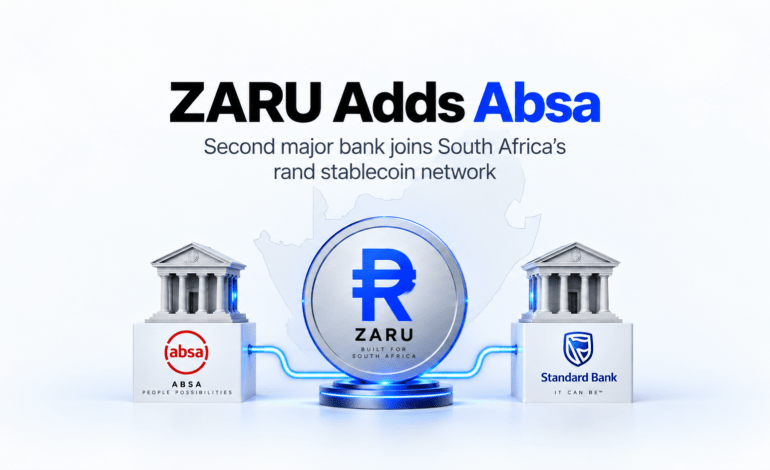
South Africa’s rand-backed stablecoin ZARU has added Absa to its banking network.
The move gives ZARU a second major banking partner as it builds stronger links between the traditional financial system and blockchain settlement.
BlockTower, the company behind ZARU, announced the addition in early September 2026. It said Absa would provide another institutional banking route alongside Standard Bank.
Absa Corporate and Investment Banking has also acknowledged its role. In its comments on digital assets, the bank said digital assets need credible counterparties. It also highlighted the importance of reserve management, governance and due diligence.
Absa Becomes ZARU’s Second Major Banking Partner
Absa joins Standard Bank, which has been ZARU’s main banking and custody partner since launch.
BlockTower says the new relationship gives institutions more than one route between the rand and blockchain infrastructure.
That matters for three reasons.
It can improve settlement capacity. It can reduce dependence on one bank. It can also make the network more resilient if one route has a problem.
In simple terms, ZARU now has more banking support behind it.
What Exactly Is ZARU?
ZARU stands for ZAR Universal.
It is a South African stablecoin designed to maintain a value of one ZARU for one South African rand.
The project launched on February 3, 2026, with support from Luno, Sanlam, EasyEquities and Lesaka.
According to ZARU’s official launch announcement, the token first launched on Solana. The goal was to provide 24/7 blockchain settlement while keeping the reserves backing the token inside South Africa’s financial system.
Unlike Bitcoin, ZARU is not designed to rise or fall freely against the rand.
One ZARU is meant to represent one rand.
What Backs ZARU?
ZARU says every token in circulation is backed by rand-denominated reserves.
Its reserve and transparency information says the token is backed 1:1 by rand reserves. It also says those reserves are independently verified.
Several South African financial institutions play different roles in the structure.
BlockTower South Africa issues ZARU.
Sanlam Specialised Asset Management manages the reserve assets.
Moore Johannesburg provides independent reserve attestations.
Standard Bank has served as the main banking and custody provider.
The ZARU white paper explains that Standard Bank handles transactional banking for mint deposits. It also provides segregated custody arrangements for reserve assets.
This helps keep ZARU’s reserves separate from BlockTower’s normal operating funds.
Absa now adds another major bank to that setup.
Why Would a Stablecoin Need Two Banks?
Stablecoins may live on blockchains, but the money backing them still sits inside the traditional financial system.
When an institution wants to mint ZARU, rand must first enter the banking system. ZARU can then issue an equivalent amount of tokens.
When someone redeems ZARU, the process runs in reverse.
So ZARU sits between two systems.
On one side, there is blockchain infrastructure that can operate 24 hours a day.
On the other, there are banks, reserve accounts, settlement systems and compliance teams.
And, somewhere in the process, probably a spreadsheet that chooses the worst possible moment to stop working.
Having more than one banking partner can make that bridge more reliable.
BlockTower says Absa adds settlement capacity and wider banking coverage. It also reduces reliance on a single banking route.
This Is Mainly an Institutional Infrastructure Story
The Absa announcement does not suddenly change how ordinary users interact with ZARU.
For now, ZARU is mainly positioned as institutional financial infrastructure.
Its official network overview describes the stablecoin as a fully reserved rand-backed asset built for compliant and programmable settlement.
Access is mainly aimed at qualified institutional participants.
Luno gives a similar explanation.
In Luno’s institutional guide to ZARU, the company says ZARU is designed to let institutions move rand-denominated value using blockchain infrastructure.
Luno also says the reserves are held onshore, managed by Sanlam and regularly checked through independent attestations.
So Absa joining the network is not about launching a flashy new feature.
It is about strengthening the plumbing underneath the product.
And financial plumbing is rarely exciting until it stops working.
ZARU Wants to Put the Rand on Blockchain Rails
ZARU’s bigger goal is to give the rand some of the features that have made stablecoins such as USDT and USDC popular.
Traditional settlement can depend on banking hours, clearing systems and several intermediaries.
Stablecoins can move continuously.
That includes weekends and public holidays.
In its February launch announcement, ZARU said it wants to connect the rand to the global digital economy while keeping the reserve assets inside South Africa.
That means the actual rand can stay in the local financial system even if its digital representation moves across a blockchain.
Over time, this could make ZARU useful for institutional settlement, treasury operations, payments and cross-border transactions.
South Africa’s Stablecoin Market Is Getting More Serious
ZARU is not the only rand-backed digital asset in South Africa.
Other projects are also experimenting with tokenised versions of the rand.
At the same time, banks and other financial institutions are exploring blockchain settlement.
What makes ZARU stand out is the number of established financial companies involved.
Its network already includes Luno, EasyEquities, Sanlam and Lesaka.
Standard Bank provides primary banking and custody support.
Now Absa has joined the network as well.
That does not guarantee ZARU will become South Africa’s leading rand stablecoin.
Stablecoins still need real usage, good liquidity and reliable redemption.
Big-name partners help, but they are not enough on their own.
Still, institutional backing helps answer one of the most important questions people should ask about any stablecoin:
Where is the money?
For ZARU, more of that answer now sits inside South Africa’s regulated banking system.