








Web3Bridge Says It Has ‘Closed Up Shop.’ What Is Africa’s Web3 Talent Factory Building Next?

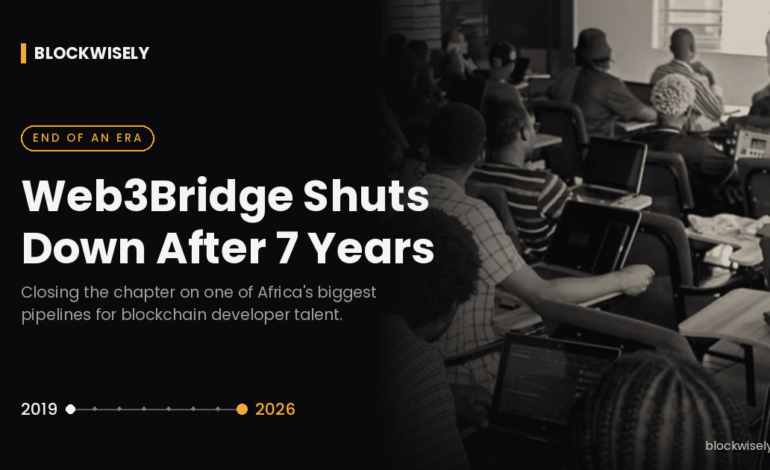
After seven years of training blockchain developers in Africa, Web3Bridge appears to be ending its flagship training model. But the evidence points less to a collapse than to a strategic reset from producing developers to helping those developers build founders, products and companies.
Web3Bridge says it has “closed up shop.”
For an organisation that has spent the last seven years building one of Africa’s most recognisable pipelines for Web3 developers, the wording sounds final.
But then came the question:
“Is training developers enough anymore?”
And then:
“Stay tuned.”
That last part matters.
Because the story of Web3Bridge in 2026 may not be about the end of an institution that trained African blockchain developers. It may be about the end of one particular model and the beginning of a much more ambitious one.
Web3Bridge was created in Lagos in 2019 with a straightforward mission: train African developers and help connect them to the emerging blockchain economy.
Over the years, it became much more than an online coding programme.
It built physical infrastructure. It hosted developers. It worked with protocols. It ran cohorts, hackathons, masterclasses and ecosystem programmes. Its alumni went on to work across Web3 and traditional finance.
Web3Bridge itself says it has introduced more than 3,000 people to Web3 and trained more than 1,000 developers directly and indirectly through its various programmes. Its training materials also point to alumni working with organisations including Consensys, Polygon, Nethermind and Aavegotchi.
So this is not simply a story about a blockchain academy shutting down.
It is a story about what happens after a talent pipeline has been built.
Web3Bridge did not fail
The easiest interpretation of the announcement is that Web3Bridge’s training model stopped working.
That is not supported by the evidence.
If anything, the organisation’s own history suggests the opposite.
Web3Bridge spent years solving a very specific African technology problem: how do you take people with technical potential and give them the skills, environment and ecosystem access needed to become blockchain builders?
It did that at significant scale.
The organisation’s public materials say more than 1,000 developers have been trained directly and indirectly, while its wider community has reached more than 3,000 people introduced to Web3.
Its founder, Ayodeji Awosika, has also said more than $4 million has flowed to Web3Bridge alumni through salaries, grants, retroactive rewards and other opportunities.
That is a useful way to think about the organisation’s impact.
Web3Bridge was never only selling education.
It was building economic pathways.
People entered with an interest in blockchain development. Some left with technical skills. Some found jobs. Some joined protocols. Some built products. Others became contributors, founders, researchers, community organisers and mentors.
That network does not disappear because a cohort model ends.
The alumni are still out there.
The developers are still building.
And the ecosystem relationships Web3Bridge spent years creating are still there.
That is why calling this a failure would miss the bigger picture.
Web3Bridge may have completed the first part of its mission.
The harder question is what comes next.
The old Web3Bridge model was built for a different problem
When Web3Bridge started in 2019, the African blockchain ecosystem had a very obvious bottleneck.
There were not enough people who understood how to build with the technology.
Blockchain was still relatively unfamiliar. Smart contract development was a specialised skill. Protocols needed developers. Communities needed technical talent. African developers who wanted to enter the industry often had very few structured pathways to do so.
Web3Bridge attacked that problem directly.
Its model combined education with community and, increasingly, physical infrastructure.
Its facilities expanded to accommodate large numbers of developers, while the organisation established the Lagos Ethereum Community Hub. Web3Bridge says its facilities can house up to 200 developers and support multiple learning sessions at once.
That physical layer is important.
Web3Bridge did not just teach people how to write Solidity.
It created a place where developers could meet other developers, work together, attend events, find mentors and become part of an ecosystem.
In other words, it was building developer density.
And that density eventually produced something more valuable than a list of graduates:
a network.
But the bottleneck is changing
The African Web3 ecosystem of 2026 is not the same ecosystem Web3Bridge entered in 2019.
The question is no longer simply:
“Where can Africa find developers?”
There are now thousands of developers across the continent experimenting with blockchain infrastructure, stablecoins, wallets, DeFi, payments, privacy technology, tokenisation and other applications.
The harder questions are increasingly:
- What are these developers building?
- Who is building companies around those products?
- Who will fund them?
- Who will help them find customers?
- Who will help them navigate regulation?
- Who will help them move from prototype to production?
- Who will keep talented builders in Africa long enough to create globally competitive companies?
That is a completely different problem.
And it is exactly where Web3Bridge appears to be pointing.
The biggest clue is already public
Days before the shutdown announcement, Awosika publicly described the organisation’s next chapter.
The language was striking.
For almost seven years, he said, Web3Bridge had focused on building the developer and builder pipeline.
Now, he said, the organisation wants to build the pipeline of founders and companies.
That is a significant change.
It suggests that Web3Bridge is not abandoning builders.
It is moving further down the value chain.
Instead of asking:
How do we train the next 100 developers?
The new question becomes:
How do we help the best 10 builders turn their ideas into companies?
That is a much more difficult problem.
But it could also be a much more consequential one for Africa’s technology ecosystem.
Enter the Web3Bridge Founder & Builder Residency
The clearest public signal of what is coming is the Web3Bridge Founder & Builder Residency.
Awosika said the residency is being designed as a physical environment where ambitious African builders can work, find collaborators, meet mentors, connect with investors and ecosystem partners, and turn ideas into companies.
Importantly, he explicitly described it as not simply another accelerator or coworking space.
That distinction matters.
Africa already has accelerators.
It has incubators.
It has coworking spaces.
It has hackathons.
The missing layer is often what happens between having a technically capable builder and having a functioning company.
That gap is enormous.
A developer can build a wallet but not know how to acquire users.
A team can build a stablecoin payment application but struggle with compliance.
A protocol contributor can identify a major African infrastructure problem but lack capital, distribution or commercial experience.
A hackathon winner can produce an impressive demo and still have no path to a sustainable business.
A residency that stays with builders beyond the code could attempt to solve precisely that problem.
Training is an input. Companies are the output.
This may be the most important shift in the Web3Bridge story.
For years, success could be measured through numbers such as:
How many developers were trained?
How many people graduated?
How many workshops were held?
How many people entered the ecosystem?
Those numbers mattered.
But eventually, an ecosystem has to move beyond training.
The more difficult metrics become:
How many companies were created?
How many products reached users?
How many founders raised capital?
How many African teams generated revenue?
How many developers became employers rather than employees?
How many companies built in Africa became global companies?
That is a very different scoreboard.
And it appears to be the scoreboard Web3Bridge is preparing to play on.
The Zcash experiment offers another clue
There is already evidence that Web3Bridge has been moving toward residency-style programmes that go beyond conventional developer education.
In September 2026, Web3Bridge was involved in a proposed Zcash Africa Privacy Engineering Residency Pilot.
The proposal described a pathway that would begin with online discovery and technical foundations, move into a Privacy Engineering Academy, then bring selected participants into a two-week physical residency in Nigeria followed by three months of post-residency builder support.
The proposed programme targeted 10–15 builder teams and focused on practical applications including mobile-money interoperability, remittances, merchant payments, freelancer payments and privacy-preserving aid.
That is not simply:
Learn blockchain → graduate.
It is closer to:
Learn → build → collaborate → ship → continue building.
And that distinction could be central to Web3Bridge’s next chapter.
The organisation has also been involved in other residency-style developer initiatives around African blockchain communities, showing that the physical infrastructure is already being used for concentrated building rather than only classroom-style training.
The building may be more important than the academy
This is perhaps the most overlooked part of the story.
Web3Bridge has spent years investing in something that is difficult to replicate quickly:
physical infrastructure for African builders.
Awosika has previously described the Web3Bridge Garage as having halls and offices capable of supporting hundreds of developers, builders and researchers, alongside accommodation for onsite participants.
The organisation’s current hub materials describe the Lagos Ethereum Community Hub as a physical gathering place for developers, researchers and people building Web3 companies.
That means the building does not suddenly become irrelevant because the training programme changes.
In fact, its value may increase.
A classroom needs students.
A builder residency needs builders.
A founder residency needs founders.
A research hub needs researchers.
An ecosystem hub needs density.
The same physical infrastructure can support all four.
This is why the idea that Web3Bridge has simply “closed” is potentially misleading.
The old production line may be closing. The factory itself is still there.
Africa’s next Web3 opportunity may be company creation
If Web3Bridge successfully executes its next phase, the most interesting outcome would not necessarily be another large training programme.
It could be a repeatable system for turning African technical talent into African technology companies.
Imagine a pipeline that looks like this:
Developer → Builder → Team → Product → Company → Capital → Customers → Scale
Africa has organisations working on almost every part of that chain.
But they are often fragmented.
Training organisations teach.
Hackathons activate.
Accelerators accelerate.
VCs invest.
Protocols run grants.
Coworking spaces provide offices.
Communities provide networks.
The interesting possibility is bringing several of those functions closer together.
That is what the Founder & Builder Residency could eventually become.
Not necessarily a traditional accelerator.
Not necessarily a venture fund.
Not necessarily a startup studio.
And certainly not yet something that should be described as any of those things as fact.
Those possibilities remain speculation until Web3Bridge announces the structure.
But the direction is becoming increasingly clear:
from talent creation toward company creation.
Stablecoins, payments and privacy could become important
The timing is also interesting.
Some of the most compelling blockchain opportunities in Africa are increasingly tied to problems the continent already has:
Cross-border payments.
Remittances.
Mobile money interoperability.
Dollar access.
Merchant payments.
Freelancer payments.
Financial privacy.
Digital identity.
Settlement infrastructure.
These are not purely speculative crypto use cases.
They are infrastructure problems.
The Zcash residency proposal, for example, explicitly referenced African payments, remittances and mobile-money interoperability as areas where privacy-preserving technology could be applied.
That provides a glimpse of a potentially different Web3Bridge philosophy.
Instead of teaching builders about blockchain and waiting to see what they create, the organisation could increasingly bring builders into environments focused on specific African problems.
That changes the question from:
“What can blockchain do?”
to:
“Which African problem can this technology solve well enough for somebody to build a company around it?”
That is a much more commercially relevant question.
AI makes the shift even more interesting
There is another reason the timing makes sense.
AI is rapidly changing software development.
The ability to write code is becoming cheaper and faster.
That does not make developers irrelevant.
It changes what valuable developers do.
If AI can increasingly help with boilerplate code, debugging, documentation and basic application development, the scarce skill may move further upstream.
Problem selection.
Product design.
Technical architecture.
Distribution.
Customer understanding.
Security.
Leadership.
Execution.
Company building.
In that world, teaching someone how to code is only one part of the equation.
Helping a talented technical person figure out what to build, why to build it, who needs it and how to turn it into a company becomes significantly more valuable.
That could make Web3Bridge’s proposed transition more relevant beyond crypto itself.
The alumni network could become the real asset
There is another advantage Web3Bridge already possesses that a new accelerator would have to spend years building.
Its alumni.
The organisation has spent seven years creating a network of developers who have gone into different parts of the technology ecosystem.
Those alumni can become:
- mentors;
- technical co-founders;
- startup founders;
- ecosystem contributors;
- protocol engineers;
- investors;
- researchers;
- community leaders;
- hiring managers.
That creates a flywheel.
The first generation of Web3Bridge developers can help the next generation.
The next generation can create companies.
Those companies can hire more developers.
Those developers can become founders.
Founders can return as mentors or investors.
Suddenly the organisation is no longer just a school.
It becomes an ecosystem network.
That may ultimately be more valuable than the original training programme.
What Web3Bridge could become next
The exact roadmap has not yet been publicly announced.
But based on what Web3Bridge and Awosika have already put into the public domain, several possibilities are visible.
1. A founder and builder residency
This is the clearest confirmed direction.
A physical environment where African builders can collaborate, access mentors, interact with investors and ecosystem partners, and develop ideas into companies.
2. A protocol-backed company-building pipeline
Web3Bridge already has experience working with blockchain protocols.
The next step could involve protocols identifying African problems and backing teams to build solutions around them.
The Zcash residency proposal provides an early example of how such a model could work.
3. A specialised research and product hub
Instead of broad developer training, Web3Bridge could increasingly focus on specific areas such as privacy, stablecoins, payments, DeFi infrastructure, AI and blockchain, or other emerging technologies.
4. A bridge between African builders and global capital
Awosika’s announcement specifically called on investors, VCs, protocols, founders, mentors and institutions interested in backing African builders to engage with the initiative.
That suggests capital access is likely to be part of the model, even though the precise structure has not yet been disclosed.
5. Something the market has not seen yet
This may be the most interesting possibility.
Web3Bridge spent seven years building a model that did not previously exist at scale in Nigeria.
There is no reason to assume its next model will fit neatly into an existing category.
The organisation may be building something between a residency, venture studio, protocol hub, research centre and founder network.
Until the formal announcement arrives, however, that remains an informed possibility rather than a confirmed description.
The real test begins now
The transition will not automatically work.
Training developers and building companies are two very different businesses.
Companies need customers.
Founders need capital.
Products need distribution.
Teams need commercial expertise.
Startups can fail even when the technology is excellent.
And Web3 companies have another layer of complexity: regulation, token economics, protocol dependency and a global market that can change quickly.
So the new Web3Bridge model will have to prove something its old model did not necessarily have to prove.
Can it turn technical talent into durable economic value?
That means the organisation’s future success may be measured less by how many people walk through its doors and more by what walks out of them.
A company.
A product.
A protocol contribution.
A new infrastructure layer.
A globally competitive African startup.
A founder who employs 50 people.
A developer who becomes an investor and funds the next generation.
That is a much bigger ambition.
Web3Bridge’s first seven years built the talent pipeline. The next seven could build the company pipeline.
This is why the “closed up shop” announcement deserves to be read carefully.
It would be easy to write an obituary for Web3Bridge.
But the public evidence points in another direction.
The organisation has spent seven years building developers, communities, infrastructure and ecosystem relationships.
Its alumni are still building.
Its physical facilities still exist.
Its Lagos Ethereum Community Hub remains positioned as a space for developers, researchers and Web3 companies.
And its founder has explicitly said the organisation wants to move from building the pipeline of talent to building the pipeline of founders and companies.
So perhaps the better way to describe this moment is not:
Web3Bridge is shutting down.
It is:
Web3Bridge is changing what it thinks Africa needs.
For seven years, the organisation helped answer one question:
Can Africa produce world-class Web3 developers?
The answer is increasingly clear.
Yes.
Now comes the harder question:
Can those developers build world-class African companies?
That may be the experiment Web3Bridge is preparing to run next.
And if that is what “stay tuned” means, then the most important part of the Web3Bridge story may not be ending.
It may just be starting.