









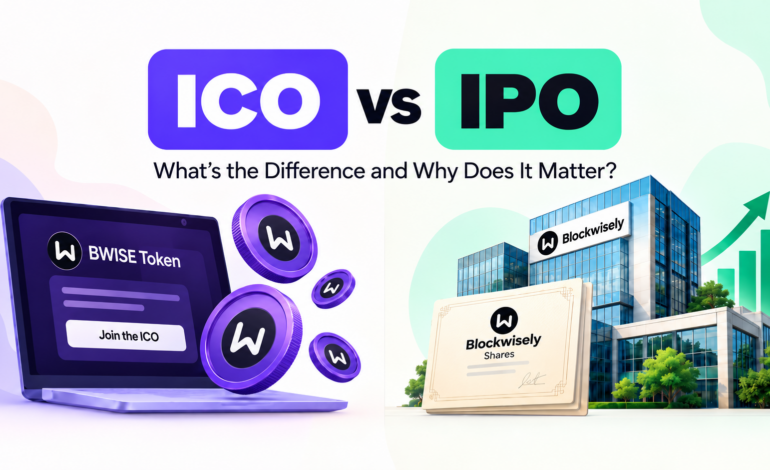
Imagine Blockwisely wants to raise money to expand.
One option would be to sell part of the company to investors. If you bought those shares, you would become a shareholder and own a small piece of Blockwisely.
Another option, at least in theory, would be for Blockwisely to create a digital token and sell those tokens to the public. The token might be used to access certain services, participate in a community, pay for products or simply trade on the market.
The first approach is closer to an IPO.
The second is closer to an ICO.
They may sound similar because both can be used to raise money from investors, but they work very differently. For anyone new to crypto, understanding that difference can prevent one of the most common mistakes in the market: assuming that buying a project’s token means you own part of the company behind it.
Usually, you do not.
What Does IPO Mean?
IPO stands for Initial Public Offering.
It happens when a privately owned company offers shares to the public for the first time. According to the US Securities and Exchange Commission, an IPO traditionally refers to the first time a company offers shares of its capital stock to the general public.
Let’s use Blockwisely as a simple example.
Suppose Blockwisely grows into a large media and technology company operating across several African markets. It wants to raise a significant amount of money to open new offices, build products and hire more people.
One option could be to sell shares to the public through an IPO.
If Blockwisely issued 10 million shares and you bought 1,000 of them, you would own a small percentage of the company.
You would be a shareholder.
Depending on the type of shares issued, you might also receive voting rights, dividends or other legal rights connected to your ownership.
The important word here is ownership.
Buying shares normally means buying an ownership interest in a company.
What Happens During an IPO?
A company cannot normally wake up one morning and decide to start selling shares to the public by lunchtime.
An IPO is a formal process.
In the United States, for example, a company conducting a registered public offering normally files a registration statement with the SEC. An important part of the process is the prospectus, which gives potential investors information about the company’s business, finances, management, risks and the shares being offered.
Investment banks may also act as underwriters, helping the company structure the offering and distribute the shares.
So if Blockwisely ever decided to list on a major stock exchange, investors would expect detailed information about the business before buying shares. They would want to understand its revenue, expenses, risks, leadership, strategy and financial position.
Once the company completes the regulatory process and meets the requirements of an exchange, its shares can begin trading publicly.
That does not mean the investment is safe.
A listed company can still perform badly. Its share price can fall, its business can struggle and investors can lose money.
The difference is that IPOs generally come with a much more established system of disclosure, regulation and investor protection.
What Does ICO Mean?
ICO stands for Initial Coin Offering.
Instead of selling company shares, a project sells crypto tokens.
Let’s imagine Blockwisely wanted to build a blockchain-based publishing and rewards platform.
It creates a token called BWISE.
The token might be used to reward writers, pay for premium articles, vote on community proposals or access certain services on the platform.
Blockwisely could decide to create 1 billion BWISE tokens and sell 200 million of them to early supporters.
You send money or cryptocurrency.
You receive BWISE tokens.
That would be an ICO-style fundraising model.
The SEC’s investor guidance on ICOs explains that companies and developers can use digital tokens to raise money for software, platforms and other projects.
But here is the important part:
Buying BWISE tokens would not automatically mean you own part of Blockwisely.
Buying a Token Is Not the Same as Buying a Share
This is the biggest difference between an IPO and an ICO.
Imagine Blockwisely offered both.
In the IPO, you buy Blockwisely shares.
In the ICO, you buy BWISE tokens.
Those are not the same thing.
If you own Blockwisely shares, you own part of the company.
If you own BWISE tokens, what you actually own depends entirely on how the token was designed.
Perhaps BWISE allows you to:
- unlock premium Blockwisely content
- vote on which educational topics should be covered
- pay for advertising
- reward writers
- access certain community features
You could own 100,000 BWISE tokens and still own 0% of Blockwisely Ltd.
That distinction is crucial.
A token may become valuable because people want to use it.
A share may become valuable because the underlying company becomes more valuable.
Those are two different economic relationships.
ICO vs IPO at a Glance
| IPO | ICO | |
|---|---|---|
| Full name | Initial Public Offering | Initial Coin Offering |
| What you buy | Shares | Crypto tokens |
| Do you own part of the company? | Usually yes | Usually not |
| Example | Blockwisely shares | BWISE tokens |
| Main market | Stock market | Crypto market |
| Regulation | Generally highly regulated | Depends on jurisdiction and token structure |
| Main document | Prospectus and regulatory filings | Often a whitepaper |
| What investors receive | Equity | Digital tokens |
| Where it may trade | Stock exchange | Crypto exchange or DEX |
| Risk | Can be high | Often considerably higher |
There are exceptions, especially when digital tokens are legally classified as securities. But for a beginner, this is the easiest way to understand the basic difference.
Why Did ICOs Become So Popular?
The biggest attraction was accessibility.
Traditional fundraising can take a long time. Companies may need venture capital firms, lawyers, regulators, investment banks and months of negotiations before receiving large amounts of capital.
ICOs offered something very different.
Imagine Blockwisely wanted to build a decentralised news-verification network.
Instead of approaching banks or venture capital firms, it could theoretically publish a whitepaper explaining the idea, create BWISE tokens and allow people around the world to buy them.
For startups, this opened a new way to raise capital.
For ordinary people, it created opportunities to invest in projects at a much earlier stage than they would normally see in traditional stock markets.
That sounds attractive.
It also created plenty of problems.
The ICO Boom Created Plenty of Scams
During the ICO boom, creating a token became surprisingly easy.
A team could build a professional website, write a whitepaper, open Telegram and X accounts, and begin asking people for money.
Some projects were legitimate.
Some had good ideas but poor execution.
Others were outright scams.
Imagine someone created a website called Blockwisely Global Token, copied the real Blockwisely logo, promised that BWISE would rise by 1,000% and claimed the token would be listed on every major exchange within weeks.
The website could look incredibly professional.
That would not make the project legitimate.
The SEC became so concerned about ICO scams that it created a fake token project called HoweyCoins as an educational exercise. The website deliberately used many of the tactics seen in questionable token sales, including exaggerated claims and promises of huge returns.
The lesson is simple:
A professional website is not proof that an ICO is trustworthy.
Neither is a glossy whitepaper.
Neither is a Telegram group with 100,000 members.
Are ICOs Unregulated?
Not necessarily.
You will sometimes hear people say:
“IPOs are regulated. ICOs are not.”
That is too simplistic.
How an ICO is regulated depends on the country, the structure of the token and how it is sold.
Imagine Blockwisely created BWISE tokens and marketed them like this:
Buy BWISE today. Blockwisely will use your money to grow, and your tokens will increase in value as our business expands.
A regulator might examine whether that token behaves more like an investment contract than a simple utility token.
Calling something a “utility token” does not automatically remove it from securities laws.
The SEC has repeatedly warned that digital assets may still fall under securities regulation depending on how they are structured and marketed.
Rules can also differ from one country to another.
A token sale that is allowed in one jurisdiction may require registration or approval elsewhere.
So the safer rule for beginners is simple:
Never assume a crypto investment is legal just because you found it online.
What Is a Whitepaper?
If you research an ICO, you will often encounter a whitepaper.
Think of it as the project’s explanation of what it plans to build.
If Blockwisely launched BWISE, its whitepaper might explain:
- why the token exists
- what users can do with it
- how many tokens will be created
- how tokens will be distributed
- how much the team wants to raise
- what the money will be used for
- who is building the project
- how the technology will work
A detailed whitepaper can be useful.
But it is not automatically proof that the information inside it is true.
That is an important difference from a regulated IPO prospectus.
An IPO prospectus forms part of a formal securities disclosure process. A crypto whitepaper may simply be a document written by the project itself.
A beautiful 60-page PDF can still describe a terrible investment.
What Are Tokenomics?
Another word you will often hear is tokenomics.
It simply means the economics of a token.
Suppose Blockwisely creates 1 billion BWISE tokens.
You should immediately ask:
Where are all those tokens going?
Perhaps the distribution looks like this:
- 200 million sold to the public
- 250 million held by the founders
- 150 million given to early investors
- 200 million reserved for community rewards
- 200 million kept for future development
That information matters.
Imagine you buy BWISE at $1.
Six months later, 150 million tokens owned by early investors become available for sale. If many of those investors sell at the same time, the increased supply could push the market price down.
That is why researching an ICO involves much more than asking:
“Will the token price go up?”
A better question is:
“How does the token economy actually work?”
Can an ICO Token Increase in Value?
Yes.
Imagine BWISE launches at $0.10.
Over time, Blockwisely builds a popular blockchain news ecosystem and millions of users need BWISE to access services on the network.
Demand for the token could increase.
If demand rises faster than supply, the token’s price could rise as well.
But none of that is guaranteed.
Perhaps users do not need BWISE after all.
Maybe another project builds a better product.
The developers could abandon the platform.
Regulators could intervene.
Major exchanges might refuse to list the token.
Early investors could dump their holdings.
A token can go from exciting to nearly worthless very quickly.
Can IPO Investors Lose Money Too?
Absolutely.
Now imagine Blockwisely conducts an IPO at $20 per share.
Investors are excited, and the shares begin trading publicly.
But suppose advertising revenue later drops, costs rise and the company misses its growth targets.
The share price might fall from $20 to $12.
The fact that Blockwisely went through an IPO would not prevent investors from losing money.
That is why it is misleading to think:
IPO = safe
and
ICO = dangerous
Both can involve substantial risk.
The key difference is that IPO investors generally have stronger disclosure requirements and a more established legal framework around their investment.
Regulation provides information and protections.
It does not guarantee profit.
Think of Blockwisely in Two Different Universes
Here is perhaps the easiest way to remember the difference.
Universe One: Blockwisely IPO
Blockwisely becomes a large media company and lists shares on a stock exchange.
You buy 100 Blockwisely shares.
You now own a tiny part of the company.
If Blockwisely becomes more profitable and valuable, your shares may rise in value.
Universe Two: Blockwisely ICO
Blockwisely launches BWISE, a token used inside a blockchain publishing ecosystem.
You buy 10,000 BWISE tokens.
You now own tokens.
You do not automatically own Blockwisely.
The token’s value will depend on demand, supply, utility, market conditions and how successful the ecosystem becomes.
That is the difference.
Shares represent company ownership. Tokens represent whatever rights or utility the token was designed to provide.
Why Would Blockwisely Choose an IPO Instead of an ICO?
It would depend on what Blockwisely was actually trying to achieve.
If Blockwisely wanted to sell ownership in the company and raise capital from traditional investors, an IPO could make sense once the business became large enough.
But imagine Blockwisely built a decentralised publishing network where writers, readers, advertisers and fact-checkers all interacted using BWISE.
Then having a token might serve a genuine purpose inside the network.
The important question would be:
Does this product actually need a token?
That is a useful question for almost every ICO.
If you remove the token and the project works exactly the same way, you should ask why the token exists in the first place.
Sometimes the answer is technology.
Sometimes the answer is fundraising.
Those are not always the same thing.
What Should Beginners Check Before Participating in an ICO?
Start with the most basic question:
What exactly am I buying?
Suppose Blockwisely launched BWISE.
Before buying it, you should understand what BWISE actually does. Does it provide access to a service? Does it give voting rights? Is it required for transactions? Does it represent ownership? How many tokens exist?
Then investigate the people behind the project.
If someone claimed they were launching an official Blockwisely token, you should verify that claim through Blockwisely’s actual website and official social accounts rather than trusting an advert or Telegram message.
You should also check how tokens are distributed, when insiders are allowed to sell and whether there is a working product.
Be especially careful when someone promises guaranteed profits.
Statements such as:
“Buy BWISE today and earn a guaranteed 20% every month”
should immediately make you suspicious.
Legitimate investments do not need guaranteed-profit promises to explain their value.
A useful rule is:
If you cannot explain how the token gets its value, you probably do not understand the investment yet.
ICO, IEO and IDO: Are They the Same Thing?
Crypto fundraising has evolved beyond traditional ICOs.
An IEO, or Initial Exchange Offering, involves a cryptocurrency exchange helping a project sell its tokens.
If Blockwisely created BWISE and a large crypto exchange handled the initial sale, that could be structured as an IEO.
An IDO, or Initial DEX Offering, normally happens through a decentralised exchange or decentralised fundraising platform.
If BWISE launched directly through a decentralised exchange, that could be an IDO.
The mechanics differ.
But the basic idea remains similar:
investors are receiving tokens rather than traditional company shares.
And the label alone tells you very little about whether the project is a good investment.
So, Which Is Better: ICO or IPO?
There is no universal answer because they are not really the same type of investment.
If you buy Blockwisely shares through an IPO, you are investing in Blockwisely the company.
If you buy BWISE through an ICO, you are buying a digital asset connected to an ecosystem.
One could perform better than the other.
Both could perform badly.
The more useful questions are:
What am I buying?
What gives it value?
What rights do I receive?
Who controls the supply?
What could cause me to lose my money?
If you can answer those questions clearly, you are already approaching the investment more carefully than many beginners.
Blockwisely Take
ICOs and IPOs are often compared because both can help organisations raise money from the public.
That is where much of the similarity ends.
If Blockwisely sold shares through an IPO, investors would generally be buying ownership in Blockwisely.
If Blockwisely created a BWISE token through an ICO, investors would be buying BWISE tokens, not automatically buying ownership in the company.
That difference sounds simple, but it is one of the most important concepts for anyone entering crypto.
A token can be useful.
It can become valuable.
It can provide voting rights or access to a growing ecosystem.
It can also become worthless.
Before putting money into either an IPO or an ICO, understand what you are actually receiving.
Because saying “I bought Blockwisely early” means very different things depending on whether you bought the company’s shares or simply bought a token with its name on it.
Frequently Asked Questions
What is the main difference between an ICO and an IPO?
An IPO normally sells shares that represent ownership in a company. An ICO sells digital tokens, which usually do not represent ownership unless they have specifically been structured that way.
Does buying a token make me a shareholder?
Usually not. If you bought a hypothetical Blockwisely BWISE token, you would not automatically own part of Blockwisely. Your rights would depend on the token’s design.
Are ICOs legal?
They can be, but the rules depend on the country and how the token is structured. Some token offerings may fall under securities laws.
Are IPOs safe?
No. IPO investors can still lose money if the company’s shares fall in value or the business performs badly.
What is a crypto whitepaper?
A whitepaper explains a crypto project’s technology, purpose, token economics and plans. It should not automatically be treated as independently verified information.
What does ICO stand for?
ICO stands for Initial Coin Offering.
What does IPO stand for?
IPO stands for Initial Public Offering.
Is Bitcoin an ICO?
No. Bitcoin did not launch through an ICO. There was no initial public token sale by a company or founding team.
Can an ICO token become worthless?
Yes. A token can lose most or all of its value if the project fails, demand disappears, liquidity dries up, insiders sell heavily or the project turns out to be fraudulent.
Which is riskier, an ICO or an IPO?
Both involve risk, but ICOs can expose investors to additional risks such as weak disclosure, token manipulation, smart-contract vulnerabilities, low liquidity, scams and regulatory uncertainty.