











Grassroots issues.
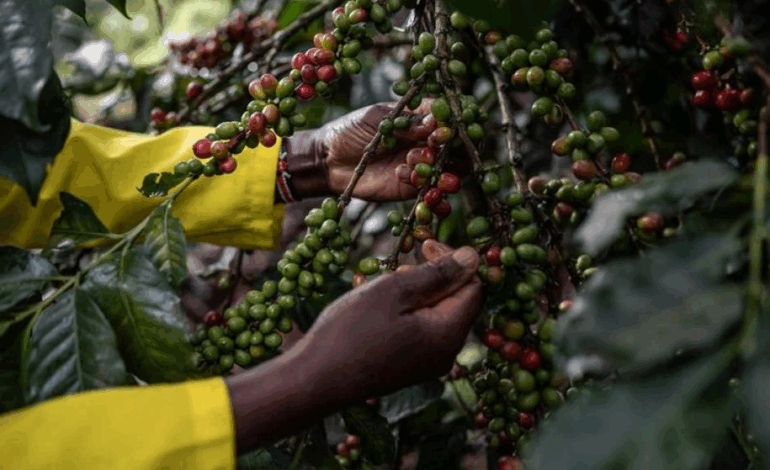
In Kirinyaga County, the sound of coffee beans being picked at night has become a sign of trouble. Farmers are waking up to find their ripe coffee cherries stripped from trees by organized thieves. The stolen cherries are quickly sold to unauthorized millers who blend them with legitimate produce. For many farmers, it means losing a season’s worth of labor and income.
This local crisis comes just as Kenya’s coffee sector is being reimagined as fertile ground for blockchain innovation.
What Tokenizing Coffee Actually Means
Tokenization, in its simplest form, means creating a digital certificate that represents ownership of a physical item. In the case of coffee, it involves issuing a blockchain-based “token” that corresponds to a specific batch or bag of beans. This digital twin records key details: origin, quality, and journey from farm to cup.
The vision is elegant. A buyer in Germany could scan a code and see the entire history of a 100-kilogram bag harvested in Kirinyaga. A farmer could use that verified digital record to attract international buyers or use it as collateral for financing. Tokenization also promises fairer pricing by cutting out middlemen and making every transaction visible on a shared ledger.
It sounds like the perfect fix for an industry long plagued by opacity and exploitation. But the reality, as Kirinyaga’s farmers are discovering, is more complicated.
The Digital Promise Meets Physical Risk
The thefts highlight a core blind spot in any tokenization system: physical security. Whereas blockchain can record ownership, but it cannot guard a tree.
When thieves harvest ripe cherries straight from the farm, they are taking coffee that has not yet been processed, graded, or registered on any blockchain. Tokenization typically happens later, at the cooperative or mill level, once the coffee has been verified. That means stolen cherries never enter the digital record. The farmer loses both the physical product and any chance of representing it as a tokenized asset.
The pre-tokenization risk. It is the gap between the physical and digital worlds. A reminder that while blockchain can prove authenticity, it cannot prevent theft.
Learning from Project Mocha
In this fragile space between promise and loss, Project Mocha stands out as one of Kenya’s most ambitious blockchain experiments. The initiative uses a multi-layer token system where land, trees, and yields are represented by distinct digital assets. IoT sensors and satellite imagery verify that the trees exist, are healthy, and are producing.
Mocha’s mission is clear: to help smallholder farmers access financing by turning their land and trees into auditable, on-chain balance sheets. While not a security platform, it’s a financial and accounting innovation that brings farmers into the global capital market through transparency and verified asset value.
And that distinction matters. What it ensures is that investors and buyers can trust what they’re funding or purchasing. The thefts in Kirinyaga show a parallel problem that sits outside its scope: keeping the coffee safe before it ever becomes a token.

Even with IoT sensors confirming a tree’s health, those tools can’t prevent someone from harvesting cherries under cover of darkness. The project’s Mocha Bean Token (MBT) only comes into existence after harvest and verification. If cherries are stolen before that stage, the process is simply bypassed, not because the system failed, but because it never got the chance to engage.
Yet Mocha’s technology could still become part of the solution. Its use of IoT sensors and environmental tracking gives it the potential to do more than measure yield. it could detect anomalies!
An unexpected drop in yield data, a sudden sensor disconnection, or irregular soil readings could all act as early indicators that something is wrong on the ground. If integrated into cooperative networks, local response systems, or insurance smart contracts, those signals could trigger alerts and create a digital trail of accountability.
Such an approach wouldn’t stop thieves. However, it would help farmers prove loss, trigger faster insurance payouts, and even qualify for emergency financing. In that sense, Mocha’s IoT infrastructure could quietly evolve into a data-driven watchdog for Kenya’s smallholder farmers, a bridge between blockchain transparency and real-world resilience.
Bridging the Farm and the Blockchain
If tokenization is to truly serve places like Kirinyaga, it needs a stronger bridge between digital innovation and on-the-ground realities. A few ideas could help close that gap:
- IoT-based security: Affordable motion sensors or acoustic monitors could alert cooperatives when theft occurs.
- Community verification: Farmer groups could use mobile-ledger tools to report and timestamp local incidents.
- Insurance automation: Smart contracts could compensate farmers automatically for verified losses.
- Regulatory tightening: Stricter licensing for millers could reduce the market for stolen cherries.
These steps wouldn’t eliminate theft overnight, but they would create accountability that stretches from the bush to the blockchain.
A Broader Reflection
Across Africa, similar experiments are underway. In Ethiopia, tokenized coffee exports have begun linking farmers directly to overseas buyers, while in Ghana, pilot projects are exploring cocoa traceability through blockchain. Each of these efforts faces the same challenge now visible in Kirinyaga: technology can digitize trust, but it cannot digitize security.
No protocol can yet digitize the risks of rural life.
When a sack disappears before sale, it’s not just produce that is lost but scarily enough, trust too. Mocha’s ledger can ensure that loss doesn’t vanish into silence.
Because maybe, in the end, the blockchain doesn’t need to stop crime. It just needs to make sure truth can’t be stolen too.