










Clay Tablets to Blockchain: How Ledgers Shaped Civilization

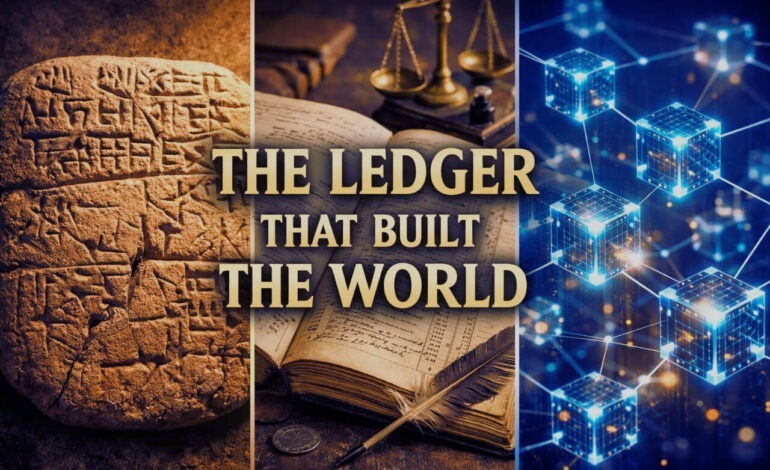
For as long as humans have traded, governed, and built civilizations, they have relied on records when memory failed . From the painstaking manual work of moulding clay tablets in ancient Mesopotamia to the modern sleek computer enabled blockchain networks, the ledger has remained humanity’s most faithful tool for tracking ownership, obligations, and value.
A ledger at its basics , is a system of record-keeping. It answers simple but critical questions: Who owns what? Who owes whom? What has already happened?
As societies advanced, complexity that comes with growth had to be dealt with,the need for better, more reliable ledgers grew with them.
The history of civilization is, in many ways, the history of how humans learned to record and preserve truth.
The earliest ledgers: when memory became permanent
For a moment let us time travel backwards ,the earliest known ledgers go way back to around 3000 BCE, when the Sumerians used clay tablets to record grain inventories, livestock counts, and trade transactions.
These records were simple: Were they effective? Yes . They reduced disputes, enabled taxation, and allowed trade beyond one person’s trust circle. For the first time, economic activity could be verified independently of memory or reputation.
As trade ballooned, so did the importance of accurate verifiable records. In ancient Egypt and Rome, scribes maintained centralized ledgers for land ownership, taxes, and public works. These systems strengthened empires by making governance more predictable and commerce more scalable.
Better records meant stronger trust ,and stronger trust meant growth.
Paper, bookkeeping, and the rise of global trade
The invention of paper marked a major leap in record-keeping. Paper was cheaper, lighter, and easier to store than stone or clay. This important development arose at the same time trade routes expanded across regions and continents.
A defining breakthrough arrived in 15th-century Italy when Luca Pacioli an Italian Mathematician introduced the double-entry bookkeeping. By recording every transaction as both a debit and a credit, merchants could detect errors, reduce fraud, and clearly understand their finances.
This method became the foundational rock of modern accounting. It enabled the rise of banks, corporations, and international trade.
Every improvement in ledger systems followed the same pattern:
better records → more trust → lower costs → larger markets.
Digital ledgers and the trust problem
The 20th century and its many inventions such as – Computers – introduced digital ledgers. Banks, governments, and corporations moved records into centralized databases. Transactions became faster and global, but new risks threats arose.
Centralized systems could be altered, hacked, or mismanaged. Trust was now vested on powerful intermediaries who acted as gods. Most users could no longer verify data themselves ,they had to trust institutions to do it for them.
For decades, this model worked. Then financial crises, data breaches, and opaque systems exposed its weaknesses.
The world needed a ledger that was digital, global, and trustworthy by design.
Blockchain: a new chapter in record-keeping
Blockchain is a ledger – but radically different from those that came before it.
Instead of being controlled by a single authority, blockchain ledgers are distributed across many independent participants. Transactions are verified through consensus, recorded in blocks, and cryptographically linked to previous records, forming an immutable chain.
Once information is confirmed on a blockchain, altering it becomes extremely difficult. Trust is no longer placed in a central institution. It is embedded directly into the system through mathematics and cryptography.
Blockchain introduces transparency, accountability, and verifiability into digital record-keeping. Anyone can audit the ledger. No single actor can quietly rewrite history.
For the first time, digital records cannot be easily tampered with and are permanent as clay tablets,while remaining globally accessible.
As history has clearly shown when the ledger evolves, the systems built on top of it,and the world that depends on them, evolve too







2 Comments
Very insightful piece. You’ve broken down ledgers into a simple concept with a great impact on humanity as it is.
Such a transition. We can only wait and see how this blockchain thing will go. A bit hard for me to understand yet.