









Beyond M-Pesa: The New Infrastructure Layer for Kenya’s AgriFinance

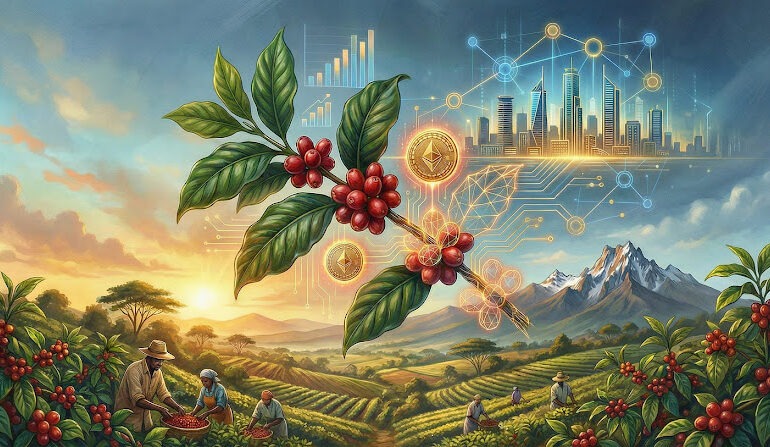
CBK’s latest data reveals a 4% lending ceiling for agriculture. Tokenised assets can offer a credible path to break it.
A sector that feeds our nation is still starving for capital. I normally go to the market on Saturday mornings. The stalls overflow with fresh produce, buckets of potatoes, crates of tomatoes, bundles of sukuma wiki still damp from the farm. Agriculture touches almost everything in our economy. It contributes over 22 % of Kenya’s GDP, a figure that climbed to roughly KSh 3.6 trillion in 2024. It employs over 40 % of the total population and up to 70 % of the rural workforce.
Now open the Central Bank of Kenya’s latest Bank Supervision Annual Report. Scroll to the sectoral distribution of gross loans. Agriculture’s share of total bank credit sits at 4.4 %. That is KSh 180.6 billion out of a total loan book of KSh 4,070.2 billion as of December 2024.
Thanks for reading! Subscribe for free to receive new posts and support my work.
Read that again. A sector responsible for nearly a quarter of the economy receives less than a twentieth of formal bank lending. “Agri-financing in Kenya sits at about four %, compared to agriculture’s 22 per cent contribution to GDP,” said Simon Kinuthia, Head of Agribusiness at Absa Bank Kenya, at a forum in Nairobi late last year. “That gap must close”.
He is right. And the data tells us exactly why the gap persists.
What the CBK Numbers Actually Say
The CBK’s 2024 Bank Supervision Annual Report, published with data through December 2024, paints a detailed picture of agricultural lending in Kenya.
Agriculture’s shrinking slice of the pie. Out of 11.7 million total loan accounts in the banking system, agriculture accounts for just 117,524, roughly 1% . Its share of gross loans has hovered below 5 % for years. In 2020, the figure was closer to 3.6 %. By December 2024, it had slowly gone up to 4.4 %, but the absolute amount, KSh 180.6 billion, remains small against the sector’s economic weight.
Credit growth is slowing down. Growth in credit to agriculture peaked at around 22.3 % year on year in 2022, driven partly by post-pandemic recovery and government push for food security. That growth has since fallen sharply. By 2025, the pace had slowed to single digits, roughly 9.7 %. Meanwhile, overall private sector credit growth stalled across the board, with total gross loans actually declining 2.7 % from KSh 4,183.4 billion in December 2023 to KSh 4,070.2 billion in December 2024.
The Non-Performing Loan ( NPL )story is more nuanced than banks admit. Agriculture accounted for 4.5 % of total NPLs, broadly in line with its 4.4 % share of the loan book. Compare that with real estate, which held 11.7 % of loans but a disproportionate 18.5 % of NPLs. Or manufacturing at 15.7 % of loans and 17.9 % of NPLs. The numbers suggest agriculture is not the riskiest sector on the books. Yet banks continue to treat it as if it were.
So why the reluctance to lend? The CBK’s own Agriculture Sector Survey from September 2025 revealed that only 31 % of farmers had borrowed to finance their activities, down from 41 % just two months earlier. The reasons are structural, not temporary. Lenders demand collateral of up to 120 % of loan value, effectively shutting out most smallholder farmers who lack formal land titles. Climate induced shocks, floods and droughts in the same year, make underwriting seasonal crops feel like guessing the weather. High lending rates, even after monetary policy easing, remain the most cited barrier to credit in the CBK’s own surveys. And the dominance of informal finance means that much of agricultural lending happens through SACCOs, family networks, and mobile platforms that never appear on a bank’s balance sheet.
The result is what experts call the “missing middle” in agricultural finance: loans too risky for commercial banks yet too large for microfinance institutions. Across Africa, this adds up to a $65 billion financing gap, according to the Alliance for a Green Revolution in Africa.
The Opportunity: Blockchain, Tokenisation, and Programmable Money
The constraints revealed in the CBK data are not mysteries. They are known problems with known characteristics: poor collateral, climate uncertainty, opaque supply chains, and high transaction costs for small loans. What has changed in recent years is that a set of technologies now exists that can address each of these pain points directly.
Programmable money solves the trust deficit in disbursement. Smart contracts can release funds automatically when pre-agreed conditions are met. Imagine a working capital loan to a maize farmer that disburses in tranches: the first when certified seeds are purchased, the second when satellite imagery confirms planting, the third when weather data shows adequate rainfall during the growing season. This is not theoretical. Safaricom’s DigiFarm platform, through its Jipange product, already extends cash advances to over one million tea farmers via M-PESA, with near-zero default rates in its pilot phase. The next step is embedding these conditions into programmable payment rails, where money moves only when real world conditions are verified.
Tokenisation turns illiquid agricultural assets into bankable collateral. The collateral problem is not that farmers have no assets. It is that their assets, standing crops, warehouse inventories, future harvests, even the trees themselves, are invisible to the formal financial system. Tokenisation changes that. Whrrl, a blockchain powered warehouse receipt platform, has tokenised over $800 million worth of commodities and facilitated more than $25 million in digital loans for 70,000 farmers across 7 countries, including Kenya. In Brazil, Agrotoken allows farmers to use tokenised soy, corn, and wheat as collateral for credit and trade, processing R$1.3 billion (roughly $250 million) in tokenised assets in 2024 alone, covering 616,000 hectares. These are not pilot projects anymore. They are operating at scale.
Closer to home, Kenya’s own Warehouse Receipt System Council launched its electronic warehouse receipt system (e-WRS) in 2025, integrating with the Nairobi Coffee Exchange. This is the foundational infrastructure that blockchain tokenisation can build on, turning a warehouse receipt from a piece of paper into a programmable, tradeable digital asset that any lender can verify in seconds.
Supply chain transparency lowers risk and cost for lenders. When a bank cannot trace what happens to a loan between disbursement and repayment, it prices in that uncertainty through higher interest rates. Blockchain based traceability, from farm to processor to exporter, gives lenders a real time view of the asset their loan is secured against. This is not about replacing human judgment. It is about giving lenders the data they need to say yes more often, at lower rates, to borrowers they currently refuse.
The net effect: expanding agriculture’s share of the loan book without increasing systemic risk. If tokenised warehouse receipts, programmable disbursement, and verified supply chain data can reduce information asymmetry and collateral gaps, banks can lend more to agriculture without taking on more risk. The CBK’s own data shows agriculture’s NPL ratio is already proportional to its loan share. The bottleneck is not repayment behaviour. It is underwriting infrastructure.
The Road Forward
The data is clear. Traditional credit models are not scaling fast enough for Kenya’s agricultural potential. The tools to change that already exist. Programmable payment rails are live on M-PESA. Tokenised warehouse receipts are operational across East Africa. Brazil and India have demonstrated that blockchain backed agricultural collateral works at national scale.
The question is no longer whether programmable money and tokenisation can help close the gap between agriculture’s 22 % GDP contribution and its 4.4 % share of bank credit. The question is how quickly regulators, banks, and AgriFinance founders will deploy them.
Kenya has every ingredient it needs: a world class mobile money ecosystem, a central bank that publishes granular agricultural data, a new electronic warehouse receipt system, and a generation of founders building at the intersection of blockchain and farming.
The next chapter of agricultural finance in this country will not be written by banks alone. It will be co-authored by the builders who understand that a coffee tree ( what we are building at Project Mocha ), a warehouse full of grain, or a season’s harvest is not just a liability to be managed. It is an asset waiting to be unlocked.
At Project Mocha, we started with a simple question:
If a coffee tree can produce cash flow for 10 years, why is it invisible to the financial system until the day the cherry is sold?
Our answer was to treat the tree itself as an asset.
On a small farm in Embu, we mapped and tagged the first 2,000 coffee trees, then put their economic rights on-chain so that each tree could be represented as a digital token backed by a real, living asset in the soil.
When someone buys that token, two things happen at once:
- The farmer gets upfront funding for rehabilitation, inputs, and labour instead of waiting for a delayed, uncertain payout.
- The buyer gets a share of the coffee income from that tree at the end of the full year harvest cycle
In other words, the tree becomes collateral with a visible cash flow, not just a plant in a ledger no bank ever sees.
We then layer traceability on top of that.
Every key step in the journey from cherry to export can be recorded and linked back to specific trees and farmers.
For a lender, this is the difference between “we think this farmer is productive” and “we can see exactly how much coffee came from these trees last season.”
The same logic that sits behind programmable loans and tokenised warehouse receipts is what we are testing at the tree level:
Turn a long-lived, productive asset into something visible and verifiable on-chain.
Link it to real data from the farm and the value chain.
Use that visibility to unlock better, faster, fairer capital for the people actually doing the work.
If agriculture is 22% of GDP but only 4% of credit, then projects like this are not nice experiments on the side.
They are prototypes for what the new credit infrastructure has to look like.
Because once a coffee tree in Embu can be recognised as an asset by someone in Nairobi, Lagos, or Lisbon with a few clicks, the idea that Kenyan farmers are “unbankable” stops being a fact.
It becomes a story we are actively rewriting.