








What Happens During a Bitcoin Halving?

If you spend enough time around Bitcoin, you will eventually hear people talking about the halving.
Someone might say:
“The halving is coming.”
“Bitcoin always goes up after a halving.”
“The halving reduces supply.”
If you are new to Bitcoin, this can sound mysterious or even dramatic.
But the idea is actually simple.
Bitcoin halving is one of the most important parts of how Bitcoin works. Once you understand it, many things about Bitcoin start to make more sense.
Let’s walk through it.
What Is Bitcoin Halving?
Bitcoin halving is when the reward that miners receive for creating new Bitcoin gets cut in half.
Miners are the people and companies that run powerful machines to secure the Bitcoin network. When they add a new block of transactions, they receive newly created Bitcoin as a reward.
Every few years, that reward gets reduced by half.
That event is called a halving.
It happens automatically. No one votes on it. No government decides it. It is written into Bitcoin’s code.
This predictable reduction in new Bitcoin supply is one of the key features that makes Bitcoin different from traditional money.
Why Does Halving Exist?
Bitcoin has a maximum supply of 21 million coins. No more than that can ever exist.
New Bitcoin enters circulation through mining. If miners kept receiving the same reward forever, the supply would grow too quickly and the 21 million limit would not work properly.
Halving slows down the creation of new Bitcoin over time.
Think of it like a gold mine.
In the beginning, gold is easy to find. Over time it becomes harder and slower to extract. Bitcoin works in a similar way.
Halving makes Bitcoin more scarce as time goes on.
How Often Does Halving Happen?
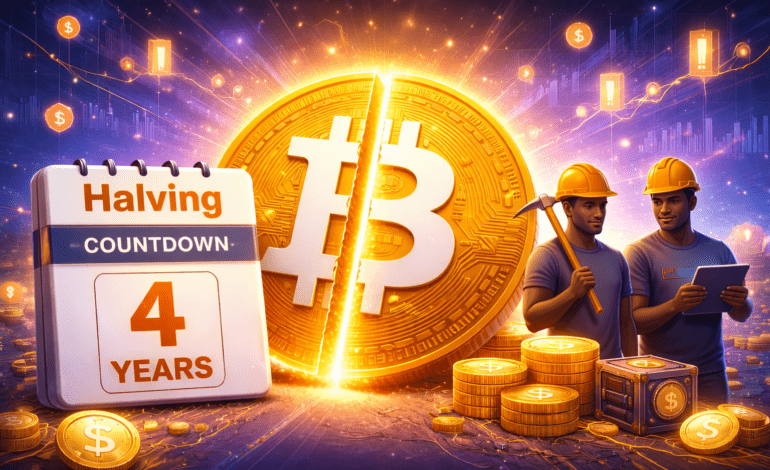
Halving happens roughly every four years.
More precisely, it happens every 210,000 blocks.
Since Bitcoin creates a block about every 10 minutes, this works out to about four years.
The schedule is fixed and predictable.
Nobody can speed it up or slow it down.
What Has Happened So Far?
When Bitcoin first started in 2009, miners received 50 Bitcoin per block.
Then the halvings began.
First halving
The reward dropped from 50 BTC to 25 BTC.
Second halving
The reward dropped from 25 BTC to 12.5 BTC.
Third halving
The reward dropped from 12.5 BTC to 6.25 BTC.
Fourth halving
The reward dropped again to an even smaller amount.
Each halving reduces the number of new Bitcoin entering the market.
Over time, this continues until no new Bitcoin is created.
The final Bitcoin is expected to be mined around the year 2140.
Does Halving Reduce the Total Bitcoin Supply?
No.
This is a very common misunderstanding.
Halving does not reduce the number of Bitcoin that already exist.
Instead, halving reduces the speed at which new Bitcoin is created.
Think of a water tap.
Bitcoin supply is like water flowing into a tank.
Halving does not remove water from the tank. It just slows the flow coming in.
Why Do People Care About Halving?
People care about halving because it affects supply.
When new Bitcoin enters the market more slowly, supply growth decreases.
If demand stays the same or increases while supply grows more slowly, prices often rise over time.
That is basic supply and demand.
This is why many Bitcoin investors pay close attention to halvings.
However, halvings do not guarantee price increases. Markets are influenced by many factors.
Halving is important, but it is not magic.
Does Bitcoin Price Always Go Up After Halving?
Historically, Bitcoin prices have increased in the years following past halvings.
This is why many people expect future halvings to have similar effects.
However, past performance does not guarantee future results.
Prices can move for many reasons, including:
- Market sentiment
- Global economic conditions
- Regulation
- Adoption
Halving is only one part of the picture.
It is better to think of halving as a long term influence rather than a short term price trigger.
What Happens to Miners During Halving?
Halving directly affects miners because their reward gets cut in half.
After a halving, miners earn fewer new Bitcoin for the same amount of work.
This can make mining less profitable, especially for miners with high electricity costs.
Some miners shut down after halvings if they cannot operate profitably.
However, Bitcoin has a built in adjustment system.
If miners leave, mining becomes easier. The remaining miners can earn more relative rewards.
Over time, the system balances itself.
Mining continues.
Does Halving Affect Regular Users?
For most people, halving does not change daily Bitcoin use.
You can still send and receive Bitcoin the same way.
Your wallet still works.
Transactions still get confirmed.
The main impact of halving is on the long term supply of Bitcoin rather than everyday use.
Why Was Halving Designed This Way?
Bitcoin was designed to have predictable supply.
Traditional currencies can be printed by central banks. The supply can increase quickly if governments decide to create more money.
Bitcoin works differently.
The halving schedule is fixed in advance.
Everyone knows roughly how many Bitcoin will exist at any point in time.
This predictability is one of Bitcoin’s strongest features.
It allows people to understand the monetary system without relying on trust.
Will Halving Continue Forever?
No.
Halvings will continue until new Bitcoin creation eventually reaches zero.
By around the year 2140, miners will no longer receive newly created Bitcoin.
At that point, miners will earn income mainly from transaction fees.
Bitcoin will continue to operate even after the final halving.
A Simple Way to Think About Halving
Here is a mental picture.
In the early years, Bitcoin created new coins quickly.
Over time, creation slows down.
Eventually, it stops.
Halving is the mechanism that makes this gradual slowdown possible.
It is like a clock counting down toward the final Bitcoin.