








The $50 Billion Stablecoin Death Spiral: Crypto’s Most Devastating Crash Four Years On

As discussions on stablecoins accelerate and major players push for wider adoption, one truth stands out: not all stablecoins are created equal. At their core, they are instruments of trust in digital form — and trust in human (and algorithmic) dealings can evaporate far faster than it is earned.
This period four years ago (May 7- 12, 2022), remains a painful reminder of that reality.
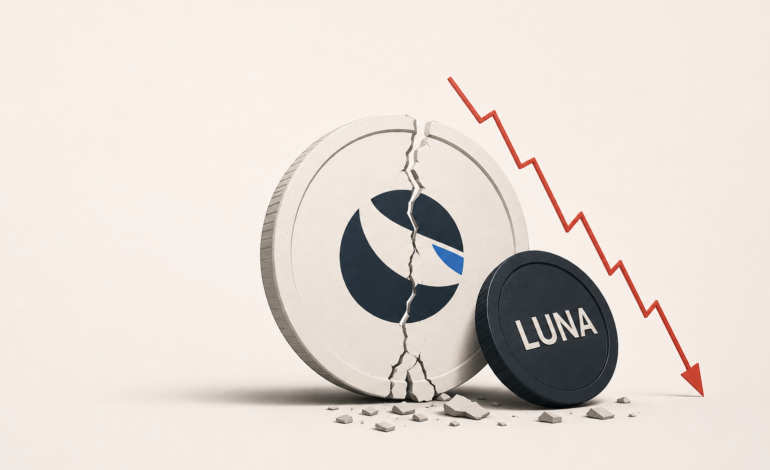
On that day, the Terra ecosystem, anchored by its algorithmic stablecoin TerraUSD (UST) and its native token LUNA, unraveled in one of crypto’s most dramatic meltdowns.
Unlike fully collateralized stablecoins such as USDT or USDC, UST relied on an arbitrage mechanism with LUNA rather than hard assets.
What began as a depegging event spiraled into the destruction of an estimated $40–50 billion in market value within days, with the broader contagion rippling far further.
Cracks had been visible for weeks.
Massive withdrawals from the Anchor Protocol, which had offered unsustainably high yields near 20%, drained liquidity. UST began slipping below its $1 peg.
But on May 9, confidence finally shattered.
Investors rushed to redeem UST for newly minted LUNA in an attempt to arbitrage back to peg.
Instead, the mechanism backfired spectacularly.
Billions in UST redemptions triggered the creation of trillions of new LUNA tokens, causing hyperinflation. LUNA’s price collapsed from over $80 to fractions of a cent in days.
The Luna Foundation Guard’s desperate deployment of billions in Bitcoin reserves failed to restore stability
What followed was the infamous “death spiral” — a brutal demonstration of how an uncollateralized algorithmic stablecoin can unravel when market panic overrides theoretical arbitrage assumptions.
In just days, UST collapsed toward zero, LUNA became virtually worthless, the Terra blockchain was halted, and shockwaves spread across the entire crypto market.
The fallout extended well beyond Terra.
The collapse accelerated the failures of major players including Three Arrows Capital, Celsius Network, and contributed to the conditions that later felled FTX.
It exposed deep vulnerabilities in DeFi yield chasing, over-reliance on uncollateralized mechanics, and the dangers of systemic contagion.
The human cost was devastating.
One victim, Ayyildiz Attila, who lost between $400,000 and $500,000, wrote in his court impact statement:
My savings, my future, and the results of years of sacrifice disappeared. I struggled to keep up with payments and responsibilities, and everything I had worked for was erased.”
A 58-year-old Russian woman told the court (via a translator in the courtroom) how she was now homeless and “wandering the streets” of Tbilsi, Georgia after losing all her assets in the collapse.
The $81,000 [invested in Terra/LUNA] turned into $13 that I could hold in the palm of my hand,” the woman said. “Do you understand the moral damage that has been done to me and the condition that I find myself in?
Four years later, the lessons remain urgent:
- Stablecoin design matters: Fully collateralized, transparent reserves (like those in USDT or USDC) differ fundamentally from algorithmic experiments.
- Reserve transparency and auditability are non-negotiable.
- Liquidity risk and run dynamics can overwhelm even well-intentioned mechanisms.
- DeFi yields must be sustainable, not promises that attract capital until they don’t.
Even Terraform Labs founder Do Kwon addressed the victims’ suffering in court during his sentencing:
All of their stories were harrowing and reminded me again of the great losses that I’ve caused. I want to tell these victims that I am sorry.
The original Terra vision is gone.
What remains is Terra Classic (LUNC/USTC), a community-driven project whose tokens now trade at negligible levels compared to their peak , more a memorial than a functioning ecosystem.