









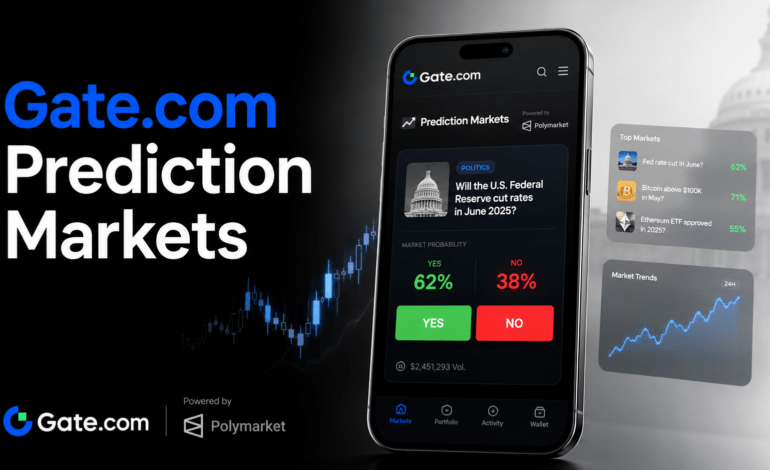
Gate.com added prediction market access earlier in 2026 when it integrated Polymarket into its app.
The move gave Gate users a simpler way to trade on real-world events from inside the Gate ecosystem. Instead of only trading crypto assets like Bitcoin, Ethereum, or Solana, users could also take positions on whether certain events would happen or not.
Although the integration happened months ago, it remains important because prediction markets are still becoming a bigger part of crypto trading. They are no longer only used by people who understand Web3 wallets and on-chain platforms. They are now moving closer to users who are already comfortable with centralized exchanges.
For many crypto users, Gate’s move showed how event-based trading could become part of the normal exchange experience.
What Happened?
In March 2026, Gate.com officially integrated Polymarket into its app.
Gate said users needed to update the app to version v8.12.5 or above to access the feature. The prediction market section was added through the Alpha page, where users could open the Polymarket module and trade event-based markets.
The feature launched in public beta. This meant Gate was still testing and improving the product while allowing users to try it.
During the beta period, users could use USDT from their spot accounts as trading capital. That made the process easier for people who already had funds on Gate and did not want to move assets into a separate Web3 wallet.
What Is a Prediction Market?
A prediction market is a platform where people trade based on the outcome of future events.
For example, a market may ask:
Will Bitcoin reach $100,000 before the end of the year?
Users can then buy a “Yes” or “No” position.
If more traders believe the event is likely to happen, the price of “Yes” usually rises. If traders believe the event is unlikely, the price of “Yes” usually falls.
This is what makes prediction markets different from normal crypto trading. In normal trading, users buy and sell assets. In prediction markets, users trade the probability of an event happening.
That is why prediction markets are often seen as a way to turn public expectations into prices.
Why Polymarket Is Important
Polymarket had already become one of the most recognized crypto prediction market platforms before Gate integrated it.
It allows users to trade on real-world questions involving crypto, politics, sports, macroeconomic events, business news, and global developments.
Its appeal comes from a simple idea: markets can show what people are willing to pay for a certain outcome.
For example, if a “Yes” outcome trades at 70 cents, many users interpret that as the market giving the event around a 70 percent chance of happening.
That does not mean the market is always correct. It only shows what traders are pricing at that moment.
This is why prediction markets are interesting but risky. They can reflect crowd expectations, but they can also be wrong.
Why Gate’s Move Is Significant
Gate’s integration matters because it brings prediction markets closer to ordinary exchange users.
Before this kind of integration, many users who wanted to use prediction markets had to understand wallets, on-chain transactions, gas fees, bridging, and decentralized applications.
That was not easy for beginners.
By adding Polymarket inside the Gate app, Gate reduced some of that friction. Users who already have a Gate account can access prediction markets in a more familiar environment.
This is important because centralized exchanges already have large user bases. When an exchange adds a new product category, it can introduce that product to millions of users more quickly than a standalone Web3 platform can.
How Gate’s Prediction Market Works
Gate’s prediction market gives users access to event-based trading from inside the app.
The basic process is simple:
- Users update the Gate app.
- They log in to their Gate account.
- They go to the Alpha section.
- They open the Polymarket or prediction market module.
- They select an event.
- They choose “Yes” or “No.”
- They enter the amount they wanted to trade.
This is easier than the usual on-chain process.
For users who are already familiar with crypto exchanges, the experience feels closer to normal trading. But the product itself is still different because users are trading outcomes, not crypto tokens.
What Types of Events Can Users Trade?
Prediction markets usually cover real-world events across different categories.
These can include crypto price events, macroeconomic events, sports events, breaking news, political developments, company announcements, and market sentiment.
A market could be about whether Bitcoin will hit a certain price, whether a team will win a match, whether a central bank will cut interest rates, or whether a major crypto event will happen before a specific deadline.
The key idea is that users are not buying the underlying asset. They are taking a position on the outcome of a specific question.
The Risks Users Still Need to Understand
Gate’s integration made prediction markets easier to access, but easier access does not remove the risks.
The first risk is losing money. If a user chooses the wrong outcome, they can lose part or all of their position.
The second risk is misunderstanding probability. A market showing a 70 percent chance does not mean the outcome is guaranteed. It only shows the market price at that moment.
The third risk is liquidity. Some markets may have fewer buyers and sellers, which can make it difficult to exit at a good price.
The fourth risk is settlement. Users need to understand how the final result will be decided before entering a market.
The fifth risk is regulation. Prediction markets are treated differently across countries. In some places, they may be viewed as betting, financial derivatives, or restricted products.
This is why user education remains important.
FAQ
Does Gate.com have prediction markets?
Yes. Gate.com added prediction market access through its Polymarket integration.
When did Gate.com introduce Polymarket prediction markets?
Gate announced the Polymarket integration in March 2026.
Why was Gate’s Polymarket integration important?
It brought prediction markets into a centralized exchange app, making them easier for ordinary crypto users to access.
What can users trade on prediction markets?
Users can trade outcomes of real-world events, including crypto prices, sports, macroeconomic events, breaking news, and public events.
Is prediction market trading the same as normal crypto trading?
No. Normal crypto trading involves buying and selling assets. Prediction market trading involves taking positions on whether an event will happen.
Are prediction markets risk-free?
No. Users can lose money. They also need to understand market odds, liquidity, event settlement, and regulatory restrictions.