








Wall Street on Blockchain by 2030?

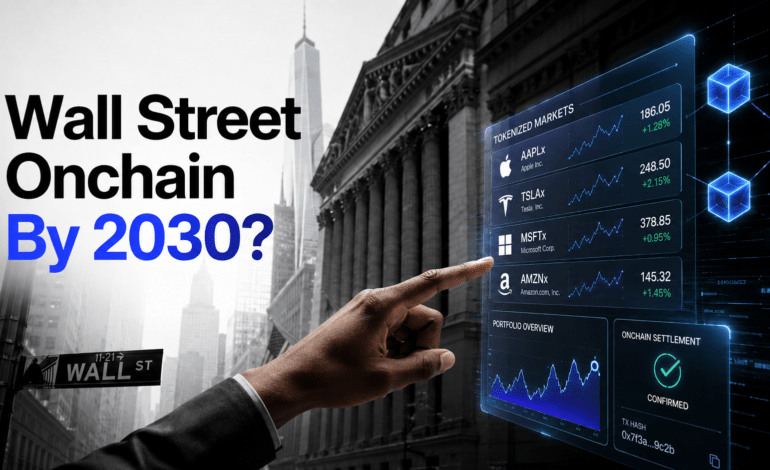
Wall Street could be heading for one of its biggest technology shifts yet.
Edwin Mata, the CEO and founder of tokenization platform Brickken, has predicted that Wall Street could run entirely on blockchain technology by 2030. That is a bold statement. Wall Street is not just one stock exchange. It includes banks, brokers, clearing houses, asset managers, payment systems, regulators, and decades of old financial infrastructure.
So, is the prediction realistic?
The answer is more balanced than a simple yes or no.
Wall Street may not become fully onchain by 2030, but the direction of travel is clear. Traditional finance is moving closer to blockchain. Tokenized stocks, tokenized bonds, tokenized treasuries, stablecoins, and blockchain-based settlement systems are no longer fringe ideas.
They are becoming part of the serious conversation about the future of finance.
What Did Brickken’s CEO Say?
According to CoinDesk, Edwin Mata believes Wall Street will soon move entirely onchain as more financial institutions explore tokenized assets.
This means that assets such as stocks, bonds, funds, and other financial products could be represented on blockchain networks. Instead of relying only on traditional databases and settlement systems, financial markets could use blockchain rails to record ownership, transfer value, and settle trades.
This does not mean every investor will suddenly become a crypto trader.
In fact, the biggest shift may happen quietly in the background. People may still use normal banking apps, brokerage accounts, and investment platforms. But behind the scenes, more of the financial infrastructure could run on blockchain technology.
That is why tokenization is becoming one of the most important trends in finance.
What Is Tokenization?
Tokenization means turning ownership of a real-world asset into a digital token on a blockchain.
That asset could be a stock, bond, fund, property, commodity, or even government debt. Once tokenized, it can potentially be traded, transferred, settled, or used in financial products more efficiently.
For example, a tokenized stock is a blockchain-based token that tracks or represents exposure to a real stock. A tokenized treasury product may represent exposure to U.S. government debt. A tokenized fund may represent shares in an investment product.
This is why tokenization is often linked to real-world assets, or RWAs.
RWAs are traditional assets brought onto blockchain rails.
Why Wall Street Is Paying Attention
The traditional financial system works, but it has limits.
Markets close. Settlement takes time. Cross-border transfers can be slow. Some assets are hard to access. Some investment products are limited to certain regions or investor categories. Many systems still depend on layers of intermediaries.
Blockchain promises a different structure.
It can support 24/7 markets, faster settlement, programmable assets, fractional ownership, and easier global access.
This is why tokenization is attractive to both crypto companies and traditional financial institutions.
The idea is not just to make finance look modern. The idea is to make markets faster, more accessible, and more efficient.
Tokenized Stocks Show Where This Is Going
One of the clearest examples of this shift is tokenized stocks.
Tokenized stocks allow users to gain exposure to traditional shares through blockchain-based tokens. In some cases, these products track the price of popular companies or ETFs. They can also make it easier for users to buy smaller portions instead of needing enough money for a full share.
This is especially important for global users.
A person outside the United States may not have easy access to U.S. stock markets. Opening a foreign brokerage account can be difficult. Moving money through banks can be slow or expensive. Tokenized stock products try to solve part of that problem by making traditional market exposure available through crypto-style platforms.
For example, an exchange like Gate.com offers tokenized stock products that allow users to trade exposure to global stocks and ETFs using USDT. This shows how crypto exchanges are becoming bridges between traditional finance and blockchain-based finance.
The point is not that Gate.com alone will move Wall Street onchain. The point is that exchanges offering tokenized assets are showing how traditional markets may become more accessible through blockchain rails.
Stablecoins Are Also Part of the Story
Tokenized stocks are only one part of the bigger picture.
Stablecoins may be even more important.
A stablecoin is a crypto asset designed to track the value of a normal currency, such as the U.S. dollar. USDT and USDC are among the best-known examples.
Stablecoins are already widely used in crypto trading, cross-border payments, remittances, and dollar access in countries where banking systems are limited or expensive.
If tokenized assets are the new financial products, stablecoins may become the money layer that helps users move in and out of them.
This is why stablecoins and tokenized assets often grow together.
A user can hold stablecoins, buy tokenized stocks, move into tokenized treasury products, and settle transactions without always returning to traditional banks. That is a major change in how financial access works.
Why 24/7 Finance Matters
Traditional markets still operate on schedules.
Stock markets open and close. Banks have working hours. Some transfers take longer during weekends or holidays. Settlement systems also follow specific rules and timelines.
Crypto markets do not work that way.
Bitcoin, Ethereum, stablecoins, and many other crypto assets trade all day, every day. This 24/7 culture has changed user expectations. Many younger investors now expect markets to be always available.
Tokenized finance brings that expectation into traditional assets.
If stocks, bonds, and funds can be represented on blockchain rails, then the idea of always-on finance becomes more realistic.
This is one of the main reasons people believe Wall Street will become more blockchain-connected over time.
But There Are Still Big Challenges
The prediction that Wall Street will be entirely onchain by 2030 should be treated carefully.
It is possible that many parts of finance will use blockchain by then. But “entirely onchain” is a very big claim.
There are still major challenges.
The first challenge is regulation. Tokenized securities must follow securities laws. Different countries have different rules. What is allowed in one market may not be allowed in another.
The second challenge is investor rights. A token that tracks a stock is not always the same as directly owning that stock. Users need to understand whether they have voting rights, dividend rights, redemption rights, or only price exposure.
The third challenge is liquidity. Putting an asset onchain does not automatically make it easy to sell. Some tokenized assets may exist on a blockchain but still have low trading activity.
The fourth challenge is trust. Traditional finance depends on legal systems, custodians, auditors, brokers, and regulators. Blockchain can improve transparency, but many real-world assets still depend on offchain legal structures.
The fifth challenge is infrastructure. Wall Street is huge. Rebuilding or connecting its systems to blockchain will take time, testing, and coordination.
So the better view is this: Wall Street may not be fully onchain by 2030, but more of its infrastructure is likely to become blockchain-connected.
FAQ
What does it mean for Wall Street to go onchain?
It means that financial assets, transactions, settlement systems, or ownership records could use blockchain technology instead of relying only on traditional databases and intermediaries.
Did Brickken’s CEO say Wall Street will run on blockchain by 2030?
Yes. Edwin Mata, CEO and founder of Brickken, predicted that Wall Street could run entirely on blockchain technology by 2030.
Is Wall Street fully onchain today?
No. Traditional finance still depends heavily on banks, brokers, clearing houses, custodians, regulators, and legacy settlement systems.
What are tokenized stocks?
Tokenized stocks are blockchain-based tokens that track or represent exposure to real stocks or ETFs.
Are tokenized stocks the same as normal shares?
Not always. Some tokenized stocks may only provide price exposure and may not give the same rights as directly owning shares through a traditional broker.
Why are stablecoins important for tokenized finance?
Stablecoins can act as the settlement and payment layer for tokenized assets. They make it easier to move between crypto assets and tokenized versions of traditional financial products.
Will Wall Street be fully on blockchain by 2030?
It is possible that more of Wall Street will use blockchain by 2030, but a fully onchain Wall Street remains an ambitious prediction.