







Nigeria’s AI Paradox: A Workforce Ready for the Future, but Businesses Are Falling Behind

Nigeria AI readiness: Nigeria is emerging as one of the world’s most unexpected artificial intelligence success stories.
Not because of massive corporate AI investments. Not because of government-led AI programs. And not because of a mature technology ecosystem.
Instead, Nigeria’s AI momentum is being driven from the ground up by ordinary people.
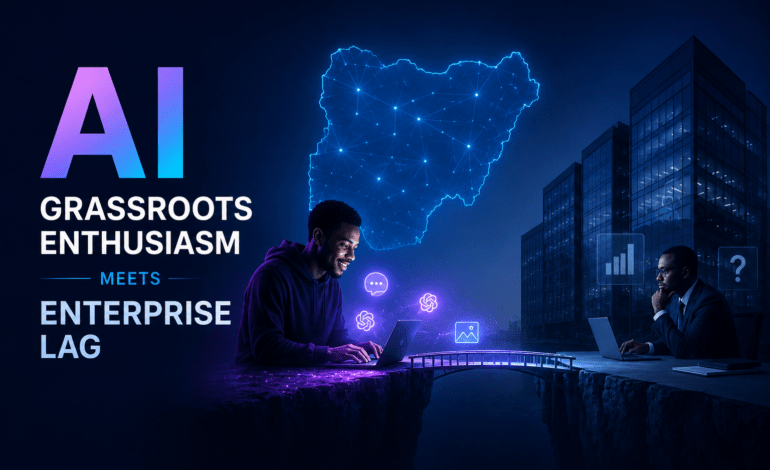
According to the 2026 Global Outsourcing AI Readiness Index published by Ataraxis, Nigerian workers rank sixth globally in workforce AI literacy, scoring 66 out of 100. The country outperforms many established digital economies and leads Africa on this metric, trailing only India, Brazil, the Philippines, Poland, and Malaysia.
For a country often associated with infrastructure challenges and economic uncertainty, the ranking highlights a remarkable reality: Nigerians are embracing artificial intelligence faster than many of the institutions around them.
The Rise of Nigeria’s Self-Taught AI Workforce
Across Nigeria, developers, marketers, designers, writers, analysts, entrepreneurs, and customer support professionals are increasingly integrating AI into their daily work.
Many have become early adopters of tools such as ChatGPT, Claude, Midjourney, Gemini, and other AI-powered platforms. They use these technologies to improve productivity, learn new skills, automate routine tasks, and compete more effectively in global freelance and outsourcing markets.
Unlike many developed economies where AI adoption is often driven by corporations, Nigeria’s AI movement is largely grassroots.
Young professionals are teaching themselves prompt engineering, content generation, coding assistance, research workflows, and automation techniques through online communities, YouTube tutorials, and practical experimentation.
Economic necessity has become an unexpected catalyst.
In a highly competitive labor market, AI offers individuals a way to produce more, learn faster, and access opportunities that previously required larger teams or specialized expertise.
This culture of self-learning is rapidly transforming Nigeria into one of the world’s most AI-curious workforces.
The Enterprise Adoption Problem
Yet behind this encouraging story lies a significant challenge.
While Nigerian workers rank among the most AI-literate globally, businesses have been much slower to embrace the technology.
Nigeria’s enterprise AI adoption score stands at just 34, placing it 19th globally in the same index. The gap between workforce capability and organizational implementation reaches 32 points—the largest disparity among the 25 outsourcing destinations evaluated.
In simple terms, Nigerian workers are ready for AI, but many Nigerian companies are not.
This disconnect represents one of the country’s biggest digital transformation challenges.
Employees are experimenting with AI every day, while many organizations remain stuck in the planning stage.
The result is a growing mismatch between workforce potential and institutional readiness.
Why Businesses Are Struggling to Keep Up
Several factors contribute to the gap.
Infrastructure Constraints
Artificial intelligence thrives on reliable electricity, affordable internet access, cloud computing resources, and consistent connectivity.
Nigeria continues to face challenges in all four areas.
While broadband penetration is improving and recently surpassed 120 million subscribers, businesses still contend with power outages, high energy costs, expensive internet access, and limited enterprise-grade infrastructure.
For many organizations, deploying AI at scale remains more difficult than using AI as an individual.
Limited AI Investment
Many small and medium-sized businesses operate under tight budgets.
Economic uncertainty, inflationary pressures, and rising operating costs have forced companies to prioritize short-term survival over long-term innovation.
As a result, AI training programs, software subscriptions, cloud infrastructure, and automation projects often remain low on the list of spending priorities.
Leadership Readiness
Another challenge is strategic awareness.
While employees may already be using AI tools informally, senior decision-makers often lack a clear understanding of how AI can transform operations, improve efficiency, or create new business opportunities.
Without executive buy-in, enterprise adoption tends to remain fragmented and experimental.
Governance and Security Concerns
Organizations also face legitimate concerns around data privacy, cybersecurity, intellectual property, compliance, and responsible AI use.
Many businesses remain uncertain about how to implement AI safely while protecting customer data and maintaining regulatory compliance.
These concerns often slow decision-making and delay adoption.
Education System Gaps
Interestingly, Nigeria’s AI talent pipeline is developing faster outside traditional institutions than within them.
Much of the country’s AI literacy growth is being driven by self-learning rather than formal education.
Universities and training institutions are still adapting curricula to reflect the rapidly changing demands of the AI economy.
Why the Gap Matters
The divide between workforce readiness and enterprise adoption is more than a statistical curiosity.
It has real economic consequences.
Global outsourcing clients increasingly evaluate countries based not only on labor costs and talent availability but also on how effectively businesses leverage artificial intelligence.
Countries that successfully integrate AI into business processes can offer greater efficiency, faster delivery, and improved service quality.
If Nigerian businesses fail to capitalize on their AI-ready workforce, they risk losing competitive advantages in sectors such as outsourcing, software development, customer support, fintech, and digital services.
At the same time, the country’s strong workforce literacy presents a unique opportunity.
Few nations possess a workforce that is already this comfortable with emerging technologies.
The foundation exists. What remains is scaling that capability across institutions.
Reasons for Optimism
Despite the challenges, there are signs that the gap can be closed.
Nigeria already outperforms several major outsourcing destinations, including Pakistan, Bangladesh, and Kenya, in overall AI readiness.
Affordable AI tools are lowering barriers to experimentation for businesses of all sizes.
Platforms such as TikTok’s Symphony AI suite, AI-powered commerce solutions like ShopAza, and a growing number of locally developed AI products are helping businesses explore practical use cases without significant upfront investment.
At the same time, increasing broadband penetration and expanding digital infrastructure are creating the conditions necessary for wider adoption.
As connectivity improves and AI tools become more accessible, the transition from individual usage to enterprise deployment may accelerate.
The Road Ahead
Nigeria’s greatest advantage in the AI era is not technology.
It is people.
The country’s young, adaptable, and highly motivated workforce has already demonstrated an ability to learn and adopt new technologies at remarkable speed.
The next phase of growth will depend on whether businesses, educational institutions, policymakers, and investors can match that same level of urgency.
If they succeed, Nigeria could move from being a nation of AI users to a nation of AI builders, innovators, and global service providers.
The country’s AI future is already visible in the creativity and ambition of its workforce.
The challenge now is ensuring that its institutions catch up.
Because in Nigeria’s AI story, the talent is ready.
The question is whether the ecosystem is ready too.