








Nigeria’s broadband subscribers: Nigeria has reached a major milestone in its digital transformation journey.
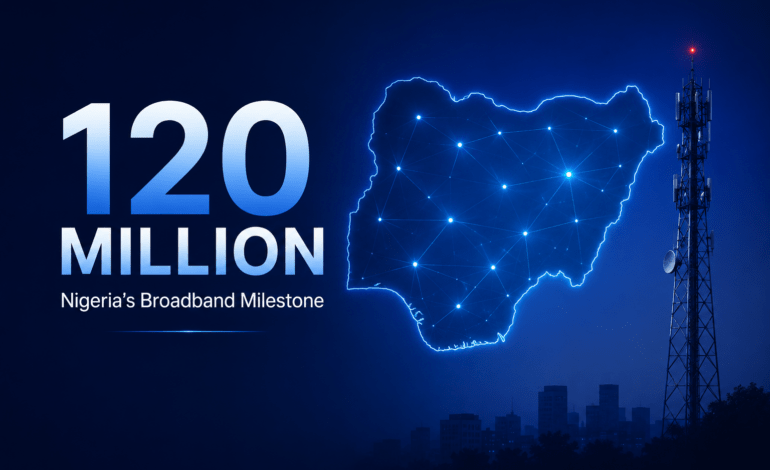
According to the latest figures released by the Nigerian Communications Commission (NCC), broadband subscriptions climbed to 120 million in April 2026, pushing broadband penetration to 55.6% of the population. The achievement represents one of the strongest growth periods in recent years, with approximately three million new broadband subscribers added in a single month.
For Africa’s largest economy, the milestone reflects years of investment in telecommunications infrastructure and growing demand for digital services.
A Win for Digital Inclusion
The growth did not happen overnight.
Over the past several years, telecom operators have expanded 4G and 5G coverage, deployed new network sites, and accelerated fiber infrastructure projects under Nigeria’s National Broadband Plan.
Industry leaders such as MTN, Airtel, and Globacom have played a significant role in extending internet access to millions of Nigerians, particularly in underserved areas.
The result is a country where more people than ever can access online education, digital payments, healthcare services, e-commerce platforms, and emerging AI-powered tools.
At the same time, total active telecom subscriptions rose to 188 million, highlighting the increasing importance of connectivity in everyday life.
The Surprising Disconnect
While the broadband subscriber count is encouraging, another metric tells a more complicated story.
Despite adding millions of new users, overall data consumption declined slightly in April, falling to 1.414 million terabytes from 1.422 million terabytes recorded in March.
The contrast suggests that more Nigerians are getting connected, but many are not using the internet as extensively as expected.
Economic realities appear to be driving this trend.
Persistent inflation, rising living costs, and recent increases in telecom tariffs have forced many households to become more selective about how they use mobile data. Consumers are increasingly prioritizing essential activities such as messaging, online banking, and basic browsing while cutting back on bandwidth-heavy services like video streaming and large downloads.
The result is what some analysts describe as a growing population of “connected but constrained” users — people with internet access but limited capacity to fully participate in the digital economy.
4G Leads While 5G Gains Ground
Nigeria’s broadband landscape remains heavily driven by 4G technology, which accounts for the majority of broadband connections nationwide.
Meanwhile, 5G adoption continues to grow steadily, although it remains a relatively small share of total subscriptions.
The expansion of next-generation networks is expected to support future demand for cloud services, AI applications, digital commerce, and other data-intensive technologies.
However, operators continue to face significant challenges, including infrastructure vandalism, fiber cuts, power costs, and the high capital expenditure required to expand network coverage.
These pressures make affordability a critical factor in sustaining broadband growth.
Why 120 Million Subscribers Still Matters
Despite the slowdown in data consumption, reaching 120 million broadband subscribers is a significant achievement.
The infrastructure now exists to support the next phase of Nigeria’s digital economy.
From fintech platforms and online marketplaces to creator tools and AI-driven services, millions of Nigerians now have the connectivity required to participate in an increasingly digital world.
Platforms like ShopAza, digital payment services, remote work opportunities, and online learning initiatives all depend on reliable internet access. As economic conditions improve and operators introduce more flexible pricing models, usage levels could rise substantially.
The Road Ahead
The real significance of this milestone goes beyond the headline number.
Nigeria has largely solved the challenge of expanding access. The next challenge is ensuring that connectivity translates into meaningful economic participation.
Broadband subscriptions may have reached 120 million, but the country’s digital future will ultimately be measured by how effectively those connections create jobs, support businesses, drive innovation, and improve lives.
The infrastructure is in place. What comes next will determine the true value of Nigeria’s broadband revolution.