









Bank of Tanzania Finalising Regulations for Crypto and Stablecoins

Imagine a young Tanzanian who buys USDT through an online platform to preserve part of their savings. The transaction appears simple until the platform freezes the account, a seller disappears or the user sends money to a fraudulent wallet.
Who should the user report the problem to? Does the platform require a Tanzanian licence? Must it keep customer funds separate from company money? What happens if the stablecoin issuer cannot honour withdrawals?
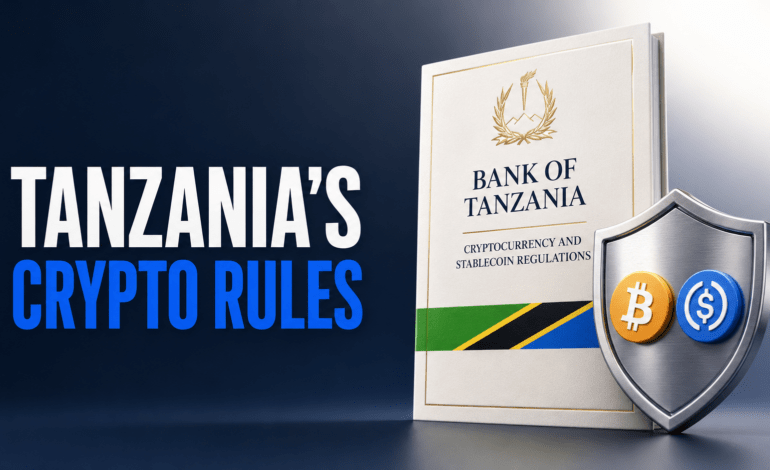
Tanzania’s current laws do not provide clear answers to many of these questions. The Bank of Tanzania is now working to change that by finalising laws and regulations covering cryptocurrencies, stablecoins and other virtual assets.
The planned framework could mark a significant shift from Tanzania’s previous approach, which largely warned people against using cryptocurrency.
Bank of Tanzania Confirms Work on Crypto Regulations
Bank of Tanzania Governor Emmanuel Tutuba said the central bank is in the final stages of preparing laws and regulations for digital assets.
The proposed framework is expected to cover:
- Cryptocurrencies such as Bitcoin
- Stablecoins
- Other virtual assets
- Businesses providing virtual asset services
Tutuba made the announcement during the 50th Dar es Salaam International Trade Fair in July 2026.
Local reports said the central bank had prepared a concept note and draft legislation that would be reviewed by institutions including the Ministry of Finance, the Attorney General’s Office, Cabinet and, where legislation is required, Parliament. [1]
The governor said the rules were intended to strengthen oversight, protect Tanzanian investors and address the potential use of digital assets in money laundering and terrorist financing. [1][2]
However, Tanzania has not yet published the final framework, licensing requirements or implementation date. The announcement therefore does not mean that comprehensive crypto regulations are already in force.
What Is a Stablecoin?
A stablecoin is a type of digital asset designed to maintain a relatively stable value by tracking another asset.
For example:
- USDT and USDC are designed to track the US dollar.
- A shilling-backed stablecoin would aim to maintain the value of one Tanzanian shilling.
- Other stablecoins may be linked to commodities or baskets of assets.
Stablecoins are commonly used for crypto trading, cross-border payments, remittances and holding digital dollars.
Unlike Bitcoin, whose price can change significantly within a short period, dollar-backed stablecoins aim to remain close to one dollar. This does not make them risk-free. Their reliability depends on factors such as the assets backing them, the issuer’s financial condition, redemption arrangements and regulatory oversight.
These issues could become part of Tanzania’s planned framework.
Tanzania Is Moving Away From Its Earlier Crypto Position
The planned regulations represent a notable change in direction.
In November 2019, the Bank of Tanzania warned the public against trading, marketing and using cryptocurrencies. It said such activity was contrary to existing foreign exchange regulations and stressed that the Tanzanian shilling was the country’s only recognised legal tender. [3]
The notice also said virtual currencies were not legally authorised in Tanzania.
However, cryptocurrency activity did not disappear. Tanzanians continued accessing digital assets through international exchanges, peer-to-peer markets and informal trading channels.
The absence of a dedicated framework meant that this activity developed without clear rules governing exchanges, custodians, stablecoin issuers or other virtual asset service providers.
The new approach suggests Tanzania is considering regulated participation instead of relying mainly on public warnings.
Tanzania Has Been Studying Crypto Regulation for Several Years
The latest announcement is not Tanzania’s first step towards developing crypto oversight.
The Bank of Tanzania’s 2023 Annual Financial Inclusion Report said government stakeholders had established a National Cryptocurrency Steering Committee and a National Cryptocurrency Technical Committee.
The committees were tasked with exploring appropriate approaches to monitoring and regulating cryptocurrencies. The Financial Intelligence Unit was also preparing a national risk assessment covering virtual assets and virtual asset service providers in line with Financial Action Task Force standards. [4]
The central bank’s 2024 financial inclusion report said the national risk assessment was still being conducted and was expected to be completed in 2025. [5]
These developments show that the planned framework is the result of a longer policy process involving financial regulators, law enforcement and other government institutions.
Why Tanzania Is Regulating Crypto Now
Several factors appear to be driving the regulatory shift.
1. Tanzanians are already using cryptocurrency
The FinScope Tanzania 2023 survey found that 9.7% of Tanzanian adults were aware of cryptocurrency, while 1.7% reported using it as an investment. The survey also identified limited use of cryptocurrency for purchasing goods. [6]
These figures may not capture every peer-to-peer or offshore transaction, but they demonstrate that crypto activity exists despite the absence of comprehensive regulations.
Tutuba also said the central bank had received complaints from people who lost money through crypto-related transactions. [2]
2. The government wants to protect users
A regulated market could provide clearer rules for how platforms handle customer money, market their products and respond to complaints.
Depending on the final framework, virtual asset companies could be required to:
- Verify customer identities
- Monitor suspicious transactions
- Explain investment risks
- Protect customer information
- Keep proper transaction records
- Maintain complaint-handling procedures
- Separate customer assets from company funds
- Report security incidents to regulators
The final requirements remain unknown because the draft regulations have not been published.
3. Stablecoins are becoming more important
Stablecoins are increasingly used for cross-border settlement, trading and access to digital dollars.
Their growth also creates new regulatory questions. Authorities must determine who may issue stablecoins, what reserves issuers must maintain and whether users have a legal right to redeem their tokens.
Regulators may also need to address foreign stablecoin issuers that serve Tanzanian users without a physical presence in the country.
4. Tanzania is responding to international standards
The Financial Action Task Force requires countries to assess risks associated with virtual assets and subject virtual asset service providers to appropriate registration, licensing, monitoring and anti-money laundering controls.
Its 2026 review found that more countries were developing regulatory approaches, but significant gaps remained in licensing, supervision, enforcement and implementation of the Travel Rule. [7]
The Travel Rule generally requires regulated providers to collect and transmit certain information about the sender and recipient of qualifying crypto transactions.
Tanzania’s national virtual asset risk assessment and proposed framework are part of this wider international compliance effort.
What Could Be Included in Tanzania’s Crypto Framework?
The final regulations have not been released. It is therefore too early to state exactly how Tanzania will regulate the sector.
Based on the governor’s comments and common regulatory approaches, the framework could address:
- Licensing or registration of crypto exchanges
- Regulation of wallet and custody providers
- Know Your Customer requirements
- Anti-Money Laundering controls
- Counter-Terrorist Financing measures
- Stablecoin issuance and reserve requirements
- Consumer disclosures
- Cybersecurity standards
- Transaction monitoring
- Record keeping and regulatory reporting
- Rules for offshore platforms serving Tanzanians
- Procedures for handling customer complaints
- Advertising and marketing standards
- Tax reporting responsibilities
These remain possible policy areas, not confirmed provisions.
Important questions also remain unanswered. Tanzania has not said which regulator will licence crypto companies, whether existing foreign exchanges will require local entities or how peer-to-peer trading and decentralised platforms will be treated.
Crypto Taxation Is Also Under Consideration
Tanzania’s Medium-Term Revenue Strategy for 2025/26 to 2027/28 recognises the growing use of digital assets.
The strategy proposes conducting further research and introducing a 3% withholding tax on certain business transactions involving cryptocurrencies and non-fungible tokens. [8]
A proposal in a government strategy should not automatically be treated as an active tax requirement. Its implementation depends on the relevant tax legislation, regulations and guidance.
The interaction between taxation and the planned regulatory framework will be important. Crypto businesses will need clarity on which transactions are taxable, who must withhold the tax and how gains or income should be valued in Tanzanian shillings.
What the Regulations Could Mean for Crypto Companies
A clear framework could make Tanzania more attractive to compliant crypto and fintech companies.
Businesses considering entry into the Tanzanian market may gain clearer answers on:
- The licences they require
- Which regulator supervises them
- Minimum capital requirements
- Local incorporation requirements
- Compliance staffing
- Customer protection obligations
- Stablecoin reserve and redemption rules
- Transaction-reporting requirements
- Tax responsibilities
Regulation could also improve opportunities for partnerships with banks, mobile money providers and payment companies.
However, licensing costs or overly restrictive requirements could make it difficult for smaller startups to enter the market. The final impact will depend on whether Tanzania adopts proportionate rules that reflect the different risks presented by exchanges, custodians, payment providers and blockchain software companies.
What the Regulations Could Mean for Users
For ordinary Tanzanians, regulation could make it easier to identify legitimate providers.
A licensed platform may be required to follow rules on customer verification, security, record keeping and complaint resolution. Users could also receive clearer warnings about volatility, scams and the possibility of losing money.
Regulation will not eliminate every risk.
A licensed exchange can still experience a cyberattack. A stablecoin can lose its peg. Bitcoin’s price can fall. Transactions sent to the wrong blockchain address may remain irreversible.
Users will still need to verify platforms, protect their passwords and recovery phrases, and understand the products they are buying.
Africa’s Crypto Activity Is Growing
Tanzania’s move comes as cryptocurrency activity grows across Sub-Saharan Africa.
Chainalysis estimated that the region received more than $205 billion in on-chain crypto value between July 2024 and June 2025. This represented an increase of approximately 52% from the previous year. [9]
The $205 billion figure measures cryptocurrency transaction activity. It is not the valuation or revenue of Africa’s crypto industry.
Nigeria accounted for the largest share of the regional activity, followed by South Africa, Ethiopia, Kenya and Ghana. Stablecoins were particularly important in high-value transactions connected to trade and cross-border settlement. [9]
As usage increases, more African countries are moving from informal or restrictive approaches towards licensing and supervision.
Blockwisely Take
Tanzania’s decision to prepare dedicated rules is a meaningful policy shift, but it should not yet be described as full crypto legalisation.
The central bank is still finalising the framework, and the final rules have not been published or approved. Critical details such as licensing, stablecoin reserves, taxation, custody standards and treatment of offshore exchanges remain unknown.
The strongest outcome would be a framework that protects consumers and addresses financial crime without pushing ordinary users and local startups back into informal peer-to-peer markets.
For international crypto companies, Tanzania could become a new East African market-entry opportunity. However, businesses should wait for the final legislation and regulatory guidance before assuming that they can operate, advertise or offer stablecoin services freely.
Frequently Asked Questions
Is cryptocurrency now legal in Tanzania?
Tanzania is preparing regulations for cryptocurrencies and stablecoins, but the final framework has not yet been published or implemented. The announcement should not be interpreted as confirmation that every crypto activity is now legally authorised.
Is Bitcoin legal tender in Tanzania?
No. The Tanzanian shilling remains the country’s legal tender. Regulating Bitcoin would not necessarily make it legal tender.
Will crypto exchanges need licences?
The final licensing requirements have not been published. However, licensing or registration of exchanges and other virtual asset service providers is likely to be considered.
Will stablecoins be regulated?
Yes. Governor Emmanuel Tutuba specifically included stablecoins among the digital assets that the planned laws and regulations are intended to cover.
Has Tanzania introduced a 3% crypto tax?
The government’s Medium-Term Revenue Strategy proposes a 3% withholding tax on certain cryptocurrency and NFT business transactions. Users and companies should wait for applicable legislation and official tax guidance before treating the proposal as an active general tax.
When will the regulations take effect?
The Bank of Tanzania has not announced a final publication or implementation date.
Sources
- MSUMBA News: Bank of Tanzania governor discusses the planned digital-asset framework
- Bitcoin.com: Bank of Tanzania finalising crypto and stablecoin oversight
- Bank of Tanzania: 2019 Public Notice on Cryptocurrencies
- Bank of Tanzania: Annual Financial Inclusion Report 2023
- Bank of Tanzania: Annual Financial Inclusion Report 2024
- Financial Sector Deepening Tanzania: FinScope Tanzania 2023
- Financial Action Task Force: 2026 Targeted Update on Virtual Assets and VASPs
- Tanzania Ministry of Finance: Medium-Term Revenue Strategy 2025/26–2027/28
- Chainalysis: Sub-Saharan Africa’s Crypto Activity in 2025