










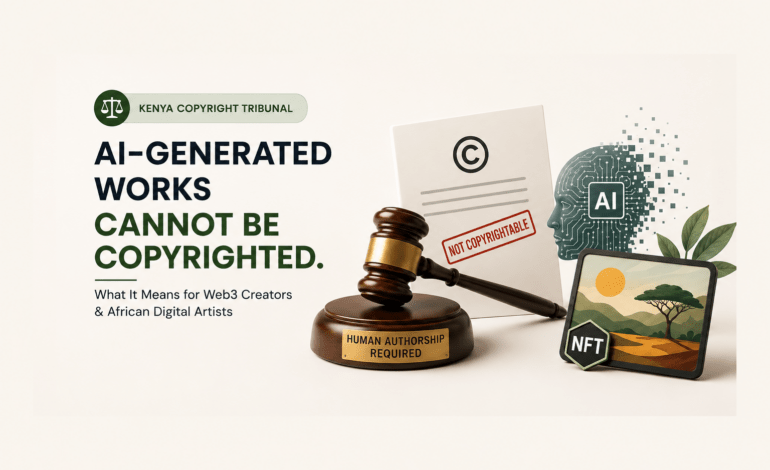
Kenya AI Copyright Ruling is one of Africa’s most significant legal decisions on artificial intelligence and digital creativity. The Kenya Copyright Tribunal has ruled that works created entirely by AI cannot receive copyright protection, raising important questions for NFT creators, digital artists, writers, musicians, and Web3 builders across the continent.
Kenya has now taken a significant step toward answering that question.
In a landmark ruling, the Kenya Copyright Tribunal held that works generated entirely by artificial intelligence, without meaningful human creative input, do not qualify for copyright protection under Kenyan law.
While the decision is rooted in copyright law, its implications extend far beyond legal circles. It has important consequences for Africa’s rapidly growing Web3 ecosystem, where AI-generated artwork, NFT collections, generative music, and on-chain content are becoming increasingly common.
Here’s what happened and why every digital creator should pay attention.
What Did the Tribunal Decide?
The case centered on an attempt to register copyright for content produced entirely by an AI system.
The Tribunal rejected the application, reaffirming a long-standing principle of copyright law: copyright protects human creativity, not machine-generated output.
In practical terms, this means that simply prompting an AI model such as ChatGPT, Midjourney, or another generative tool does not automatically make the resulting work eligible for copyright protection.
However, the ruling leaves room for works where substantial human creativity is involved. If a creator meaningfully edits, curates, transforms, or builds upon AI-generated material, those human contributions may still qualify for copyright protection.
Rather than banning AI-assisted creativity, the Tribunal drew a distinction between AI-assisted work and AI-created work.
Why the Kenya AI Copyright Ruling Matters for Web3
For many Web3 builders, AI is becoming part of the creative workflow.
NFT collections use generative algorithms. Independent artists rely on AI for concept art. Musicians experiment with AI-generated vocals and instrumentals. Writers use language models to accelerate content creation.
Kenya’s ruling introduces an important legal consideration for all of these use cases.
NFTs Are Not the Same as Copyright
One common misconception is that minting an NFT automatically grants legal ownership over the underlying artwork.
It doesn’t.
An NFT records ownership of a blockchain asset and provides immutable provenance, but it does not create copyright where copyright doesn’t already exist.
If an image is entirely AI-generated and isn’t eligible for copyright protection, owning the NFT doesn’t necessarily prevent others from copying or reusing that image outside the blockchain ecosystem.
This distinction could become increasingly important as AI-generated NFT collections continue to grow.
Greater Value on Human Creativity
The decision may encourage creators to move away from simple AI prompting toward more intentional creative processes.
Artists who combine AI with illustration, photography, animation, storytelling, cultural references, or manual editing are more likely to produce works that demonstrate genuine human authorship.
Instead of replacing artists, AI increasingly becomes another creative tool similar to Photoshop, Blender, or music production software.
Why This Matters Across Africa
Kenya is among the first African jurisdictions to clearly address AI authorship through a legal decision.
Its ruling could influence future policy discussions across the continent, particularly in countries such as Nigeria, South Africa, Ghana, Rwanda, and Egypt, where governments are beginning to develop AI governance frameworks.
Africa’s creator economy is expanding rapidly.
Digital artists, filmmakers, musicians, designers, and game developers are increasingly monetizing their work through blockchain technology, NFTs, creator tokens, and decentralized platforms.
As AI adoption accelerates, regulators will likely face similar questions:
- Who owns AI-assisted creative work?
- How much human input is enough?
- Can AI-generated content be licensed?
- How should copyright law evolve for the AI era?
Kenya’s decision may serve as an early reference point for those conversations.
What This Means for Web3 Builders
Rather than slowing innovation, the ruling highlights new opportunities for blockchain infrastructure.
On-Chain Provenance Becomes More Valuable
Even where copyright protection is uncertain, blockchain can still provide transparent proof of authorship, timestamps, version history, and creative evolution.
Creators can document when work was produced, how it evolved, and what human contributions were made throughout the process.
This strengthens authenticity, even when legal ownership remains complex.
Hybrid Human-AI Workflows May Become the Standard
The most defensible creative process may no longer be “AI does everything.”
Instead, creators who combine AI with original artistic direction, cultural storytelling, research, editing, and design decisions will likely have stronger claims to authorship while producing more distinctive work.
For African creators, local culture, language, history, and lived experiences remain powerful advantages that AI alone cannot replicate.
Smart Contracts Can Unlock New Licensing Models
Traditional copyright isn’t the only way to create economic value.
Web3 enables programmable licensing through smart contracts, automated royalty distribution, decentralized marketplaces, and community ownership models.
As legal systems adapt to AI-generated content, blockchain-native monetization could become an increasingly important alternative.
Practical Advice for Creators
If you’re using AI in your creative process, consider these best practices:
- Keep records of your prompts, revisions, sketches, and editing process.
- Document the creative decisions you made throughout production.
- Add meaningful human input rather than publishing raw AI outputs.
- Use NFTs and blockchain metadata to establish provenance and authenticity.
- Stay informed as copyright and AI regulations continue to evolve across different jurisdictions.
Good documentation may become just as valuable as the final artwork itself.
The Bigger Picture
Around the world, governments are racing to modernize intellectual property laws for the age of artificial intelligence.
The United States, European Union, United Kingdom, Japan, and several other jurisdictions continue to debate where AI fits within existing copyright frameworks.
Kenya’s decision places Africa firmly within that global conversation.
Rather than waiting for international standards, African institutions are beginning to define how innovation, creativity, and intellectual property should coexist on the continent.
For Web3, this reinforces a broader trend: blockchain and AI are becoming increasingly interconnected not just technologically, but legally as well.
Final Thoughts on the Kenya AI Copyright Ruling
Kenya’s ruling is not a rejection of artificial intelligence.
Instead, it reinforces a principle that has long underpinned copyright law: creativity deserving legal protection must ultimately come from human authorship.
For Africa’s Web3 community, the message is clear.
AI can accelerate creativity, but human imagination, cultural context, and original expression remain the foundation of lasting value.
Creators who successfully combine AI’s efficiency with authentic human creativity and use blockchain to prove provenance and enable new forms of monetization will be best positioned for the next era of the digital economy.
The Kenya AI Copyright Ruling shows that while AI can accelerate creativity, meaningful human authorship remains central to copyright protection.
As AI and Web3 continue to converge, the future won’t belong to AI alone. It will belong to creators who know how to use AI as a tool, not a substitute for creativity.