








Cold Storage Is Not Invincible: Lessons From the Coldcard Wallet Exploit

For many Bitcoin holders, buying a hardware wallet is the moment they feel they have finally “done security properly.”
The Bitcoin leaves the exchange. The recovery phrase is written down. The device stays offline in a drawer, safe from hackers, phishing links and exchange collapses.
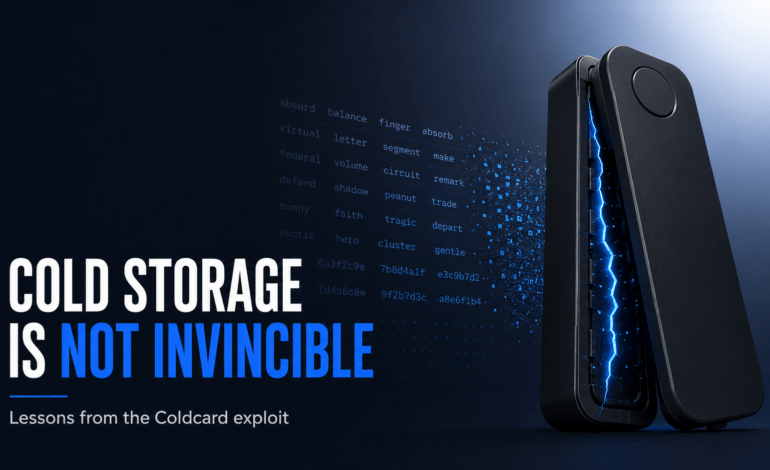
That approach is still far safer than leaving a large balance on a trading platform. But the recent Coldcard wallet incident is an important reminder: cold storage is not a magic shield. A hardware wallet can keep keys offline, yet the wallet is only as secure as the way those keys were created.
In this case, an issue in Coldcard firmware weakened the randomness used to generate some wallet recovery seeds. Researchers later linked a coordinated sweep of Bitcoin from affected addresses to the flaw. Galaxy Research said 1,196 addresses were emptied of a combined 1,082.65 BTC, worth about $70.2 million at the time, in a 41-minute period on July 30.
The incident is not a reason to abandon self-custody. It is a reason to understand it better.
What happened with Coldcard?
Coldcard is a Bitcoin-focused hardware wallet made by Coinkite. It is designed to keep private keys offline, so a person does not need to connect their wallet keys directly to an internet-connected phone or computer to approve a transaction.
The problem was not that hackers broke into thousands of devices remotely. Nor was it a case of users being tricked into typing their recovery phrases into fake websites.
Instead, the issue affected how some Coldcard devices generated new wallet seeds.
When a wallet creates a 12- or 24-word recovery phrase, it needs a very large amount of unpredictable randomness. That randomness is what makes it practically impossible for another person to guess the seed and take control of the Bitcoin.
Coinkite said certain affected firmware versions could generate seeds with less entropy, or randomness, than intended. This made the possible seed combinations far easier to search than a properly generated Bitcoin wallet seed.
An attacker did not need physical access to the hardware wallets. If they could recreate a vulnerable seed, they could derive the same Bitcoin addresses and move funds from an entirely separate device.
That is what makes the event so concerning. The wallets could remain offline and untouched, yet the Bitcoin could still be stolen.
The important distinction: the wallet was not “hacked” in the usual sense
Headlines saying “Coldcard hacked” are understandable, but they can give the wrong impression.
The incident was not a universal remote takeover of every Coldcard device. It was a seed-generation vulnerability affecting wallets created under particular firmware conditions.
Coinkite’s advisory says the risk applies to seeds generated on:
- Coldcard Mk3 firmware versions 4.0.1 through 4.1.9
- Mk4 and Mk5 devices running versions before the fixed releases
- Coldcard Q devices running versions before the fixed releases
The company has released corrected firmware. However, the most important point for affected users is this: updating the wallet does not repair a seed that was already generated on vulnerable firmware.
A user with an affected seed must create a completely new seed after updating, then carefully move their Bitcoin to addresses controlled by that new seed.
Why cold storage alone is not enough
Cold storage solves a major security problem: it reduces exposure to malware, exchange failures and online attackers.
But Bitcoin security has several layers. A holder also needs:
- A seed created with strong randomness
- A private backup that nobody else can access
- Correct wallet setup and verification
- Safe transaction habits
- A recovery plan that does not introduce new risks
The Coldcard incident shows that a hardware wallet protects Bitcoin only if the underlying keys are secure from the start.
Think of it like a high-security safe. It does not matter how thick the safe’s walls are if the key was made from a small, predictable set of combinations that somebody can reproduce.
A lesson for people who self-custody Bitcoin
For everyday holders, the biggest lesson is not that self-custody has failed. It is that self-custody requires active attention.
A wallet is not something to buy once and forget forever. Firmware updates, security advisories and the way a seed was created all matter, especially for people holding Bitcoin over many years.
This also underlines why users should buy hardware wallets directly from the manufacturer or verified sellers, verify the device setup process, and avoid shortcuts shared in random social-media posts.
A genuine hardware wallet can still be undermined by a weak seed, a leaked backup, a fake setup app or an insecure passphrase.
What Coldcard users should do now
Coldcard users should first identify their device model, the firmware version used when their current seed was created, and whether they added independent dice rolls during setup.
Coinkite says users who added at least 50 fair, independent and private dice rolls when creating their seed are not considered exposed to this specific randomness issue. A strong, unique BIP-39 passphrase also adds meaningful protection, although Coinkite still advises users with affected seeds to migrate when practical.
For users who may be affected, the safer path is:
- Confirm the official fixed firmware for your specific Coldcard model.
- Update the device using instructions from Coinkite’s official website.
- Create a new seed only after the fixed firmware is installed.
- Write down and verify the new backup securely.
- Verify a new receive address on the wallet screen.
- Send a small test transaction first.
- Move the remaining Bitcoin only after the test is confirmed.
Do not rush the migration. A panicked move, a copied wrong address or a compromised computer can create a new and more immediate loss.
Users should also be extremely cautious of scammers. A security incident usually leads to fake “support” accounts, phishing links and recovery scams. No legitimate wallet company needs a user to submit their seed phrase online.
The wider lesson for hardware-wallet makers
The event is also a reminder that wallet security is not only about keeping a product offline or adding more features.
Key generation needs deep technical review. A small implementation mistake in randomness can have consequences years later, especially when a device is used by long-term Bitcoin holders who may not move their funds frequently.
Open-source code, independent security audits, clear vulnerability disclosures and prompt remediation all matter. Hardware wallet manufacturers are trusted with one of the most sensitive parts of a person’s financial life: the creation and protection of private keys.
That trust has to be earned continuously.
Blockwisely Take
The Coldcard exploit does not prove that hardware wallets are unsafe or that users should return their Bitcoin to exchanges. In fact, self-custody remains one of Bitcoin’s strongest advantages.
But it does show that “offline” should not be confused with “invulnerable.”
The best approach is layered security: use a reputable hardware wallet, keep firmware current, generate strong and private seeds, protect backups, consider a carefully managed passphrase where appropriate, and stay alert to official security notices.
Bitcoin gives users more control. It also makes security a responsibility that cannot be outsourced completely.
Sources: Coinkite’s Coldcard Security Advisory; Galaxy Research’s on-chain analysis; CoinDesk’s initial reporting.