








Kenya Anchors 15 Million Academic Records on Avalanche, Targets 35 Million

Kenya has introduced a blockchain-backed academic certificate system that could significantly change how students, employers and educational institutions access and verify examination records.
Through the new KNEC E-Certificate Platform, candidates can obtain digital copies of their examination certificates, while employers, universities, professional bodies and government agencies can verify whether the documents are genuine.
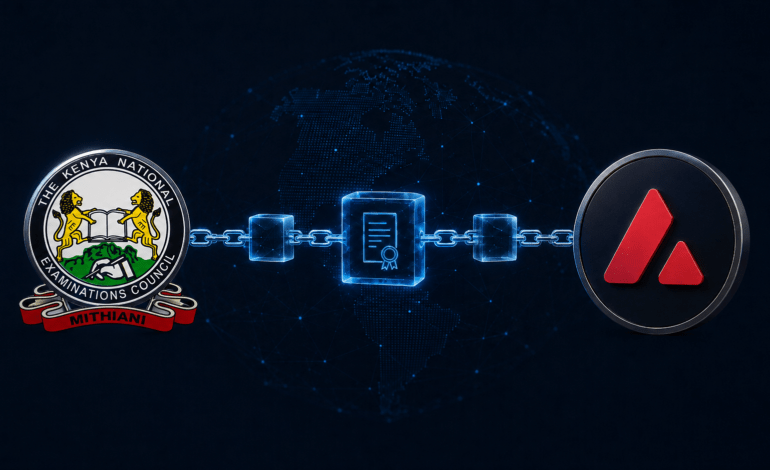
According to an announcement published by Ava Labs, the Kenya National Examinations Council has initially anchored more than 15 million academic records on the Avalanche C-Chain. The records date back to 1989, and the system is expected to grow to approximately 35 million verifiable records.
The rollout represents one of Kenya’s largest public-sector uses of blockchain technology. Unlike cryptocurrency trading or token speculation, the system applies blockchain infrastructure to a service that directly affects students, job applicants, employers and educational institutions.
From paper certificates to digital verification
Academic certificates play an important role when Kenyans apply for jobs, university admission, professional licences, immigration services and other opportunities.
However, verifying a certificate has traditionally required an employer or institution to contact KNEC and wait for confirmation. Ava Labs says individual verification requests previously took approximately one month, while large recruitment exercises could take as long as six months.
The new platform is intended to reduce that waiting period by allowing institutions to check certificates digitally.
The official KNEC platform describes the service as a real-time system through which candidates can access, download and verify certificates. It also identifies Avalanche as the blockchain supporting the platform.
Ava Labs says the first phase covers more than 15 million records, with the longer-term rollout expected to include approximately 35 million records across different levels of Kenya’s education system. These are expected to include primary and secondary examination records, advanced diploma programmes and government teacher certification programmes.
It is important to distinguish between the two figures. The available announcement says more than 15 million records were anchored during the initial deployment, while 35 million is the projected scale of the system. It would therefore be inaccurate to report that all 35 million records are already on-chain.
How the blockchain verification works
The phrase “putting certificates on-chain” may create the impression that students’ names, national identification numbers, grades and complete certificates are publicly visible on Avalanche.
KNEC’s documentation describes a more controlled system.
According to the KNEC E-Certificate System User Guide, every certificate is anchored to a blockchain using Merkle-tree cryptographic proofs. Each certificate is also assigned a unique blockchain hash that can be used for independent verification.
A hash can be understood as a unique digital fingerprint created from a document. Changing even a small part of the certificate, such as the candidate’s name, examination year or grade, would result in a different fingerprint.
During verification, KNEC’s system performs three main checks:
- It checks the index number, examination year and examination type against KNEC’s database.
- It compares the identity on the uploaded certificate with the official KNEC record.
- It hashes the certificate and compares the result with the blockchain anchor.
The KNEC user guide says the blockchain tamper check normally takes a few seconds for each candidate. A certificate is then classified as genuine or referred to KNEC when the system cannot confirm the database information or when the blockchain check fails.
This suggests that Avalanche is being used primarily as a tamper-evident verification layer. KNEC’s main databases still hold and manage the underlying examination information.
The publicly available documentation does not provide a complete technical breakdown of exactly what data or metadata is recorded on Avalanche. It would therefore be premature to conclude that full certificates or personal student information are being stored publicly on-chain.
Students do not need cryptocurrency or a crypto wallet
Although the platform uses Avalanche, students do not need to understand cryptocurrency, create a blockchain wallet or purchase AVAX.
The blockchain operates in the background.
Candidates interact with a normal government portal, where they register using an email address and verify their identity. Kenyan citizens are required to provide their national identification information, which the system checks against the Integrated Population Registration System.
To generate a certificate, the user enters their examination index number, selects the examination type and provides the year in which they sat the examination.
The KNEC E-Certificate guide lists the certificate generation fee as KSh1,200, excluding VAT and eCitizen charges. Payment can be made through M-Pesa or other payment methods offered by eCitizen.
After payment is confirmed, the certificate becomes available as a PDF. The downloaded document includes a blockchain verification hash that can be used to confirm its authenticity.
KNEC says generated certificates remain available for free re-download through the portal for six months. After that period, the candidate may need to generate a fresh copy and pay the applicable fee again. The certificate itself does not expire.
Employers can verify certificates in bulk
The platform is not limited to individual students. It also provides separate accounts for organizations that regularly need to check academic qualifications.
These may include:
- Employers
- Universities and colleges
- Professional bodies
- Government agencies
- Immigration organizations
Organizations must register as verifiers and submit their incorporation or registration documents to KNEC. Once approved, they can submit individual or bulk verification requests.
According to the official KNEC instructions for verifier organizations, institutions can upload as many as 1,000 certificates in a single bulk request. The organization provides a CSV file containing candidate information together with a ZIP folder containing the certificate PDFs.
The system then checks each document against KNEC’s database and its corresponding blockchain anchor.
KNEC estimates that verifying a batch of 1,000 certificates normally takes between six and ten minutes. Once the process is complete, the institution receives a consolidated report and individual reports for each candidate.
This could be particularly valuable during large recruitment exercises, university admissions or government hiring programmes where institutions may need to check hundreds or thousands of qualifications.
Why blockchain could help reduce certificate fraud
Academic certificate fraud can be difficult to detect through visual inspection alone.
A forged certificate may contain convincing logos, signatures, stamps and examination details. Modern editing software also makes it easier to alter grades or candidate information on an authentic-looking document.
QR codes can simplify verification, but they are not automatically secure. A fraudulent document could include a QR code directing users to a fake website designed to imitate an official platform.
Blockchain anchoring creates an additional verification layer. A modified document would produce a different digital hash from the one linked to the original certificate.
This does not eliminate every possible form of academic fraud. Criminals could still create fake websites, use stolen identities, manipulate applicants or submit documents that were never issued by KNEC.
However, the system should make it easier to detect cases where an authentic certificate has been altered after issuance.
Candidates can access older examination records
The KNEC E-Certificate Platform currently says KCSE certificates from 1989 to 2024 are available for download.
KNEC’s user guide also says the system contains certificates dating from 1989 onwards.
Ava Labs, however, says certificates for nearly one million candidates from the 2025 KCSE cohort are exclusively available through the e-certificate platform. The KNEC public landing page currently lists KCSE 2025 as “coming soon.”
The difference may be the result of a phased rollout or a delay in updating the public-facing portal, but neither source currently explains the discrepancy. Candidates should therefore check the live KNEC platform to confirm whether their examination year and certificate category are available.
The system still depends on KNEC’s records
Blockchain can help prove that a document has not changed since its digital fingerprint was recorded. It cannot independently determine whether the original information entered into the system was correct.
If a candidate’s name, examination number or results were recorded incorrectly before the blockchain anchor was created, the blockchain would preserve evidence of that record without correcting the original mistake.
KNEC will therefore still need effective systems for:
- Correcting inaccurate candidate information
- Resolving disputed examination records
- Protecting personal information
- Recovering accounts
- Maintaining platform availability
- Handling certificates that cannot be verified automatically
The success of the project will depend on more than the number of records anchored. It will also depend on whether students can access the system reliably, whether employers accept the reports and whether verification remains affordable.
A major public-sector blockchain deployment
The scale of the KNEC project makes it one of Africa’s more notable government-backed blockchain deployments.
Ava Labs has pointed to other public-record projects using Avalanche, including the digitisation of vehicle titles in California and blockchain-backed land records in India and the United States.
Kenya’s implementation is different because it directly connects national examination records with employment, education and economic opportunities.
For many users, the most important feature will not be the blockchain itself. It will be the ability to obtain a certificate online and have an employer verify it without waiting weeks or months for a manual response.