








NoOnes to Shut Down, Disrupting P2P Livelihoods Across Africa

For many people, a peer-to-peer crypto platform is just another place to buy or sell Bitcoin or USDT.
For others, especially across parts of Africa, it can be something much more important: a source of income.
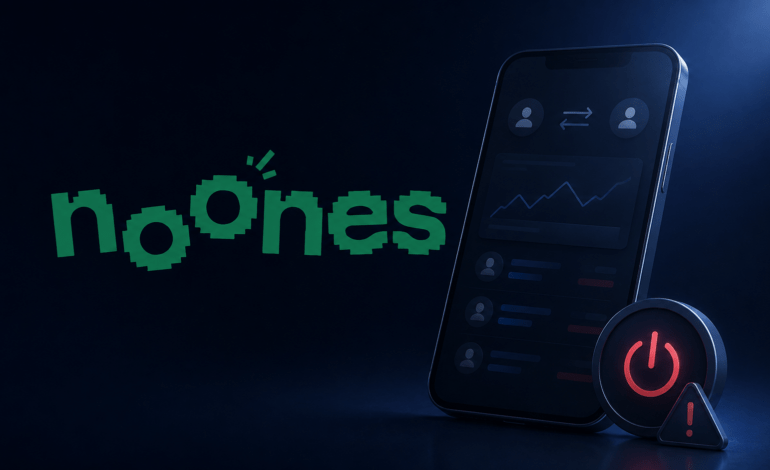
NoOnes, one of the most prominent P2P crypto marketplaces serving users in markets including Nigeria, Ghana and Kenya, has announced that it is winding down operations, with its P2P marketplace scheduled to close on August 21, 2026 at 23:59 UTC.
The shutdown will bring an abrupt end to a platform that allowed traders to buy and sell crypto directly with one another using hundreds of payment methods, including bank transfers, mobile wallets, gift cards and African payment options such as M-Pesa and Chipper Cash. NoOnes itself has described Nigeria, Ghana and Kenya as some of the markets where it maintains strong support.
For casual users, the closure means finding another place to trade.
For professional P2P vendors, it can mean losing a marketplace on which they built a daily business.
And for Africa’s P2P crypto ecosystem, the shutdown has a familiar feeling.
NoOnes is following a path already travelled by LocalBitcoins and Paxful, two platforms that once played enormous roles in helping African traders turn peer-to-peer Bitcoin trading into both a business and an alternative financial infrastructure.
NoOnes Is Winding Down Operations
Reports published on August 18 said NoOnes had informed users that it would begin phasing out its services after more than three years of operation.
According to the shutdown announcement reported by KuCoin, the company said attempts to resolve sanctions-related difficulties had been unsuccessful, resulting in the loss of important partners and transaction-monitoring systems increasingly treating NoOnes-linked activity as high risk.
The company is therefore winding down different parts of the business rather than switching everything off at once.
The P2P marketplace is scheduled to stop operating at:
23:59 UTC on August 21, 2026.
Other products, including Swap and Visa-related services, are being phased out around the shutdown, while users with frozen accounts are being given a limited opportunity to log in and withdraw funds.
Users should therefore treat the announcement as a withdrawal event rather than simply assuming their balances will remain accessible indefinitely.
The Sanctions Story Is Complicated
The sanctions issue deserves some context.
Earlier, NoOnes published an official clarification concerning an EU sanctions listing.
The company said the European Union’s sanctions documents named NoOneCrypto Inc., which it described as a separate legal entity that was not involved in operating the current NoOnes platform. NoOnes said neither the platform nor its then-current operating entity had been named in the measure.
At that point, the company told users that funds were safe and that the platform continued to operate normally.
The subsequent shutdown reporting, however, says NoOnes ultimately decided to wind down after sanctions-related complications affected partnerships and the way transactions connected with the platform were being assessed.
The company’s own earlier position was that the sanctioned entity and the operating platform were legally separate.
The later problem appears to have been the broader practical consequences created by sanctions exposure and associated compliance concerns.
NoOnes Had Become a Significant P2P Marketplace
Just days before the shutdown news, NoOnes’ own transparency data showed a platform that was still processing substantial activity.
Its transparency dashboard showed approximately $2.66 million in P2P trading volume over 24 hours, with Bitcoin accounting for about 58% and USDT about 41%.
The platform reported more than 2.5 million global users.
More importantly for Africa, Nigeria was its largest trading country in that snapshot, generating more than $830,000 in 24-hour P2P volume.
Ghana was third with roughly $352,000.
Nigeria and Kenya were also among the platform’s leading sources of website traffic.
Those numbers help explain why the closure matters beyond the company itself.
It had active liquidity and a meaningful African trading community immediately before the shutdown.
P2P Trading Can Be a Business
To someone who has never actively traded P2P, it may sound strange to describe the closure as a threat to people’s livelihoods.
But a professional P2P trader operates differently from someone occasionally buying $50 of Bitcoin.
A vendor may advertise offers throughout the day and continuously buy and sell cryptocurrency.
For example, a trader might:
- buy USDT for one price,
- sell it slightly higher,
- earn a small margin,
- then repeat the process dozens of times.
Others specialise in particular payment systems.
Some handle bank transfers.
Others work with mobile money.
Some make markets in gift cards.
The individual profit on one transaction might be small.
The business comes from volume and repetition.
A trader making a 1% margin on a single $100 trade earns very little.
But a trader moving thousands of dollars every day can potentially turn small spreads into meaningful income.
That is why a P2P account can become more than a crypto account.
It can function as someone’s shop.
NoOnes Was Designed Around This Type of Trading
NoOnes built much of its product around peer-to-peer traders.
Its marketplace offered hundreds of payment methods, with users able to create offers and trade using bank accounts, mobile wallets, gift cards and other payment systems.
The company also supported several payment methods particularly relevant to African users.
Its payment-method documentation, for example, lists Chipper Cash for currencies including Ghanaian cedi, Kenyan shilling, Nigerian naira, Ugandan shilling and South African rand. M-Pesa was also supported across a wide range of currencies.
That flexibility is one of the reasons P2P marketplaces became important in regions where international payment infrastructure can be fragmented.
A trader did not necessarily need an international credit card.
They needed a payment method another person was willing to accept.
Nigeria Was Especially Important
The latest NoOnes data makes Nigeria’s role particularly clear.
Before the shutdown, Nigeria was its largest P2P market by daily trading volume according to the company’s transparency dashboard.
This follows a much longer history of P2P adoption in the country.
For years, Nigerian crypto users have relied on P2P marketplaces to move between naira and digital assets.
Part of that activity came from traders seeking profits.
But P2P also became a practical way to access stablecoins, receive payments, move money internationally and obtain dollar exposure.
For professional traders, that created another layer:
providing liquidity to everyone else.
Every time someone urgently wanted to turn naira into USDT, another person had to be willing to take the other side.
Those vendors became informal market makers.
And many earned their income from the spread.
Ghana Was Also One of NoOnes’ Largest Markets
Ghana was another major source of activity.
NoOnes’ transparency dashboard showed Ghana generating more than $350,000 in daily P2P trading volume immediately before the shutdown.
NoOnes itself listed Ghana among its key supported markets alongside Nigeria and Kenya.
For Ghanaian P2P vendors who established reputation, trade history and recurring customers on the platform, migrating is not necessarily as simple as opening another account elsewhere.
A successful P2P vendor builds something similar to a business reputation.
Buyers look at:
- completed trades,
- feedback,
- account history,
- response speed,
- available limits,
- and the number of successful transactions.
When a marketplace disappears, much of that accumulated platform reputation disappears with it.
Kenya Matters Too
Kenya did not rank as highly as Nigeria or Ghana in trading volume on the snapshot available before the shutdown, but Kenyan users were among NoOnes’ most active website visitors.
The platform’s support for local and mobile-payment methods also made it practical for users accustomed to mobile money.
That is especially relevant in a market where M-Pesa already provides the everyday financial rails people understand.
P2P marketplaces effectively allow crypto to sit on top of those existing local payment systems.
A seller can release USDT after receiving a local payment.
The blockchain handles the crypto side.
The domestic payment system handles the fiat side.
NoOnes provided the marketplace and escrow connecting the two.
When the marketplace disappears, that connection has to be rebuilt somewhere else.
The Shutdown Comes After LocalBitcoins
Africa’s P2P community has experienced this before.
LocalBitcoins, one of the earliest major peer-to-peer Bitcoin marketplaces, shut down its trading service in February 2023 after roughly a decade in operation.
In its official closure notice, LocalBitcoins said it suspended new registrations on February 9, 2023 and stopped trading on February 16, leaving the platform primarily available for withdrawals.
The company blamed difficult market conditions during what it described as a prolonged crypto winter.
LocalBitcoins had been one of the platforms that helped establish the idea that two individuals could directly exchange local currency for Bitcoin without going through a conventional exchange order book.
In markets with limited exchange infrastructure, this was particularly valuable.
African traders were among those who embraced that model.
Its closure therefore removed one of the oldest pieces of global P2P infrastructure.
Then Came Paxful
Only weeks later, another shock arrived.
In April 2023, Paxful temporarily suspended its marketplace, with then-CEO Ray Youssef citing key staff departures and regulatory challenges.
Paxful later returned.
But the story did not end there.
In 2025, the company announced that it would wind down operations completely.
Paxful’s official closure announcement said the company would cease operations by November 1, 2025, citing the lasting effects of historic misconduct by former co-founders and high costs associated with compliance remediation.
Today, Paxful’s remaining service is essentially withdrawal-only. Its own site states that buying, selling and trading have been discontinued.
That closure was especially significant for Africa.
Paxful had built a substantial business on the continent.
Before its initial 2023 shutdown, Nigeria and Kenya were among its leading markets by trading volume. Reporting on the company noted that Nigeria, China, India, Kenya and the United States were its top five countries by volume at one point.
For some African traders, Paxful was where they learned P2P trading.
For others, it was where they built businesses.
NoOnes Emerged in the Shadow of Paxful
There is another reason the NoOnes closure feels significant.
NoOnes became closely associated with Ray Youssef, Paxful’s former CEO.
Youssef became NoOnes CEO in 2023 following the turmoil around Paxful’s initial shutdown.
At the time, he described the company’s mission in terms of giving people in the Global South greater access to financial tools and economic opportunity.
That made NoOnes feel to some former Paxful users like a continuation of the P2P philosophy they already understood.
The interface was different.
The company was different.
But the idea was familiar: create a marketplace, allow people to trade directly, use escrow, support many payment methods, and let traders build businesses around liquidity.
Now that marketplace is disappearing too.
Three Major P2P Platforms Have Now Fallen Away
The timeline is striking.
LocalBitcoins trading ended – 2023.
Paxful first suspended its marketplace – 2023.
Paxful permanently wound down – 2025.
NoOnes announced its shutdown – 2026.
These closures happened for different reasons.
It would be misleading to suggest one single problem caused all three.
LocalBitcoins cited difficult market conditions.
Paxful’s initial suspension involved internal and regulatory problems, while its eventual wind-down cited compliance-remediation costs and the legacy of misconduct under former leadership.
NoOnes’ closure is being connected to sanctions-related difficulties, lost partners and compliance-risk flags.
But for a P2P trader, the cause may matter less than the consequence:
another marketplace disappears.
Reputation Is a Form of Capital in P2P Trading
This is one of the most overlooked aspects of P2P.
A trader’s reputation can be economically valuable.
Imagine two people both offering to sell $1,000 worth of USDT.
Trader A has:
5 completed trades.
Trader B has:
8,000 completed trades and 99.9% positive feedback.
Many buyers will choose Trader B even if the price is slightly worse.
That trust allows established vendors to receive more trades.
More trades generate more feedback.
More feedback generates more trust.
It becomes a flywheel.
When a platform shuts down, the trader can withdraw the crypto.
They cannot necessarily withdraw the reputation.
Some Traders Also Depend on Repeat Customers
Experienced P2P traders often develop recurring business relationships.
A small importer might need USDT every week.
A freelancer might regularly sell stablecoins for local currency.
A remittance customer may continuously need liquidity between two markets.
A vendor who reliably completes those transactions can become the person those customers return to.
Platforms such as NoOnes made it easier for those parties to find each other while providing escrow and dispute resolution.
The closure may push some relationships onto other marketplaces.
Others may move off-platform entirely.
That introduces another risk.
The Temptation to Trade Directly Will Increase
When a trusted P2P platform disappears, traders sometimes move transactions to WhatsApp, Telegram or other private channels.
That can reduce fees and preserve relationships.
But it also removes some of the protections built into a marketplace.
NoOnes’ own trading rules required trades to stay within its escrow system and explicitly warned users against moving transactions off-platform.
Escrow matters because neither party needs to blindly trust the other.
The seller’s crypto is temporarily locked.
The buyer sends payment.
The crypto is released once payment is confirmed.
Without that intermediary structure, the counterparty risk becomes much higher.
A shutdown therefore creates a secondary challenge:
the people losing access to a marketplace should avoid replacing platform risk with fraud risk.
Nigeria Could Feel the Impact Most
Based on NoOnes’ own recent data, Nigeria appears likely to experience the biggest immediate disruption.
The country accounted for around $830,000 of a roughly $2.66 million daily P2P volume snapshot.
That means almost a third of the volume shown on the dashboard came from Nigeria.
Not every person behind that volume depended on the platform for income.
Many were ordinary buyers and sellers.
But professional vendors typically provide a disproportionate amount of marketplace liquidity.
Those are the users who now have to decide where their business goes next.
Users Should Prioritise Withdrawals
The immediate priority for anyone still holding funds on NoOnes is not finding the next marketplace.
It is securing their assets.
Users should follow official NoOnes instructions and complete withdrawals within the windows provided.
That means verifying destination addresses carefully and avoiding people who contact them claiming they can “help” withdraw funds.
Shutdown events often create opportunities for scammers.
Users should not hand over:
- passwords,
- two-factor authentication codes,
- seed phrases,
- or private keys.
No legitimate support process should require a wallet seed phrase.