










Bitget Helps UNICEF Add Blockchain Education to New Financial Literacy Course

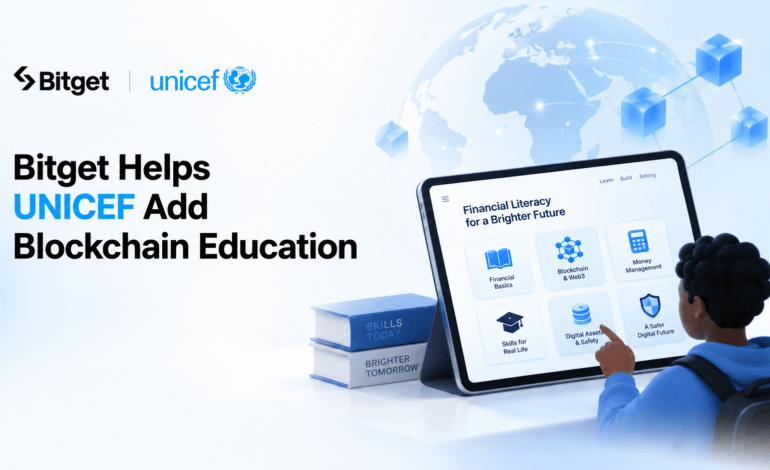
UNICEF has added blockchain education to a new financial literacy course for young people, with crypto exchange Bitget contributing expertise to the blockchain section of the curriculum.
The new Introduction to Financial Literacy course covers familiar money topics such as budgeting, credit, loans, interest rates and basic economics. It then goes a step further by introducing learners to blockchain and how the technology fits into the changing financial system.
According to Bitget’s September 8 announcement, the company worked with UNICEF to develop the blockchain chapters of the course and help explain the technology in a practical and accessible way.
UNICEF’s own Game Changers Coalition curriculum confirms that its financial literacy programme now includes blockchain alongside traditional money-management skills.
So yes, young people can now learn about budgeting and blockchain in the same course.
Your school economics teacher probably did not see that combination coming.
What Does the Course Cover?
The course is hosted on Agora, UNICEF’s online learning platform, and is available for free.
According to the official UNICEF course page, it takes about four hours to complete and is designed for adolescents and young adults.
The programme is divided into three main modules:
- Financial Literacy
- Financial Safety
- Blockchain and the New Financial System
Learners are introduced to personal money management, basic economics and financial safety before moving into blockchain concepts and their applications.
The course uses videos and other self-paced learning materials. Participants can enrol online and work through the lessons at their own speed.
Bitget Helped Develop the Blockchain Section
Bitget says its main contribution was helping UNICEF develop the blockchain chapters.
In its announcement of the new course, the exchange said it contributed industry knowledge to help present blockchain and digital assets in a way that is practical, balanced and easy for younger learners to understand.
Bitget CEO Gracy Chen also appears in parts of the programme to explain blockchain concepts and how they connect to the wider financial system.
The important distinction is that this is not a crypto trading course.
UNICEF’s curriculum focuses on understanding financial systems and emerging technology rather than teaching young people how to speculate on tokens.
The UNICEF curriculum description puts the blockchain material alongside questions such as why prices rise, how people should manage money and how they can stay financially safe.
That makes the course closer to financial education for the digital age than “How to Become a Crypto Millionaire Before Lunch.”
Probably for the best.
There Is Even a Financial Literacy Game
UNICEF has also added a game-based element to the programme.
The course includes Neon Paycheck, a short online game that introduces some of the financial decisions covered in the lessons.
Players take the role of a student and courier living in a futuristic city. They have limited money and must make decisions about earning, spending, planning and avoiding scams.
UNICEF describes the game as an entry point into its financial literacy curriculum. The idea is to let young people experience financial choices before digging deeper into the theory.
This follows the wider approach of the Game Changers Coalition, which uses games and game development to teach digital and technical skills.
So somewhere between managing your fictional paycheck and avoiding suspicious offers, you may accidentally learn something useful about money.
Sneaky.
What Is UNICEF’s Game Changers Coalition?
The course is part of UNICEF’s Game Changers Coalition, a programme that uses gaming and technology education to help young people develop skills for the digital economy.
According to UNICEF’s overview of the initiative, the programme teaches skills across areas such as coding, game development, artificial intelligence, digital literacy, teamwork, entrepreneurship and financial literacy.
The coalition launched in 2023.
UNICEF says it has since reached more than 642,000 young people, parents and teachers across eight countries, with girls making up around 52% of participants.
The organisation plans to expand the programme further in 2026 and says the coalition and its partners are targeting 1.1 million people across 12 countries by 2027.
South Africa and Morocco Are Part of the Initiative
The programme also has a direct African connection.
When Bitget joined the coalition through a three-year partnership with UNICEF Luxembourg in June 2025, the initiative included eight countries:
Armenia, Brazil, Cambodia, India, Kazakhstan, Malaysia, Morocco and South Africa.
Bitget said at the time that its support would help provide blockchain and digital skills to around 300,000 people, including young people, parents, teachers and mentors.
The original Bitget-UNICEF partnership announcement specifically identified Morocco and South Africa among the participating countries.
UNICEF also confirms that South Africa and Morocco were among the countries involved in the coalition’s earlier global Game Jam activities.
That makes the blockchain component particularly interesting from an African perspective.
Both countries have growing digital-asset industries, while regulators and traditional financial institutions are increasingly trying to understand how blockchain technology should fit into existing financial systems.
Giving young people basic knowledge of the technology before they encounter crypto through social media, trading apps or questionable WhatsApp groups may not be the worst idea.
The Partnership Started in 2025
The financial literacy course is the latest development in a partnership that began more than a year ago.
Bitget joined UNICEF’s Game Changers Coalition in June 2025 through a three-year partnership with UNICEF Luxembourg.
At the time, Bitget Academy was expected to support the development of blockchain training for young people and educators.
The partnership also fits into the coalition’s broader goal of improving access to digital skills, especially for girls and young women.
UNICEF says the digital skills gap continues to limit economic opportunities for young people in emerging economies.
The organisation’s Game Changers Coalition programme therefore combines technical skills with areas such as leadership, financial literacy and career development.
Bitget is one of several private-sector organisations supporting the initiative.
Blockchain Is Becoming Part of Basic Digital Literacy
The interesting part of this development is not simply that UNICEF is teaching blockchain.
It is where blockchain is being taught.
The technology is not sitting inside a standalone crypto course.
Instead, it appears alongside budgeting, interest rates, credit, economics and financial safety.
That reflects a broader shift in how blockchain is being discussed.
For years, many people’s introduction to crypto started with a price chart.
Bitcoin goes up.
Bitcoin goes down.
Someone on the internet explains why both outcomes prove they were right.
But blockchain is increasingly being used for payments, stablecoins, tokenised assets and other financial infrastructure.
Understanding how these systems work may therefore become part of understanding finance itself.
The goal does not have to be turning every student into a blockchain developer.
Sometimes knowing what a wallet is, how transactions work and why someone promising a guaranteed 400% return should be avoided is already progress.
Financial Safety Matters Too
Including blockchain alongside financial safety is particularly important.
Young people increasingly encounter digital payments, online investment platforms, crypto assets and financial promotions through apps and social media.
That exposure creates opportunities, but it also creates risks.
Scams, phishing attacks, fake investments and misleading financial claims can spread quickly online.
UNICEF’s financial literacy course therefore includes financial safety as one of its three main modules rather than focusing only on how financial products work.
That broader approach matters.
Learning how blockchain works is useful.
Learning that someone asking for your seed phrase is probably not trying to help is arguably even more useful.
This Is Education, Not an Endorsement of Crypto
There is also an important distinction to keep in mind.
UNICEF working with Bitget does not mean UNICEF is recommending a particular cryptocurrency, exchange or investment product.
The partnership is focused on education and digital skills.
UNICEF’s own materials describe Bitget as one of several partners supporting the Game Changers Coalition, alongside organisations from the technology and gaming industries.
The curriculum itself covers broad financial and digital concepts rather than promoting crypto trading.
That is an important line, especially when the audience includes younger learners.
From Pocket Money to Blockchain
Financial literacy used to mean understanding savings, budgets and maybe how interest works.
Those lessons still matter.
But the financial world around young people is changing.
Stablecoins can move across borders in seconds. Tokenised assets are entering traditional finance. Digital wallets are becoming more common. And blockchain networks increasingly sit behind financial products that users may not even realise are using blockchain.
UNICEF’s decision to include blockchain in its financial literacy curriculum reflects that change.
With Bitget providing blockchain expertise and UNICEF placing the material inside a wider course on money management and financial safety, the programme attempts to teach the technology without separating it from the financial basics that matter more.
Because before learning how money moves on-chain, it probably helps to learn how not to spend all of it.
Some financial lessons remain timeless.








1 Comment
I’m also interested to join it