









Africa’s Next Payment Customer May Be an AI Agent

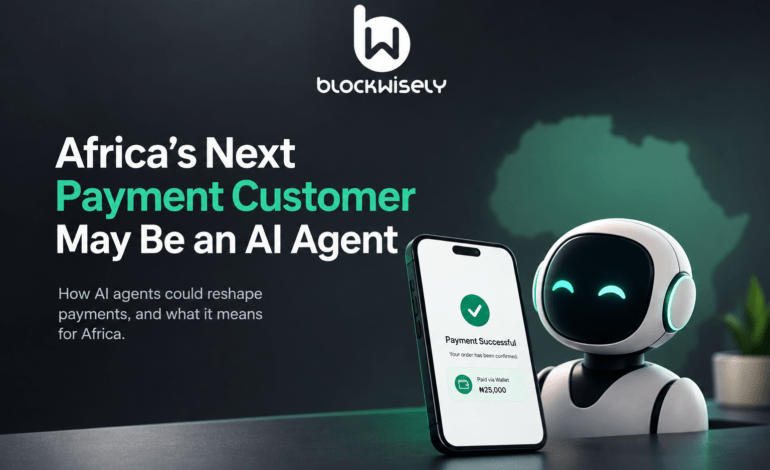
AI agents in payments could become the next major shift in Africa’s digital economy, changing how consumers shop, send money and manage everyday transactions.
AI is moving beyond chatbots that answer questions. New AI agents can search, compare options, make decisions and increasingly act on a user’s behalf. In payments, that could eventually mean telling an AI assistant what you want and allowing it to complete the transaction for you.
For Africa, the opportunity is particularly interesting. The continent has already built a mobile-first financial ecosystem around mobile money, instant transfers, digital wallets and fintech APIs. The next question is whether those payment rails are ready for a new kind of customer: an AI agent acting on behalf of a human.
The continent has spent the past decade building payment systems around mobile phones rather than traditional banking infrastructure. Mobile money, instant transfers, digital wallets and fintech APIs have made it possible for consumers and businesses to move money without relying on the legacy card infrastructure that dominates many developed markets.
Now AI agents could become another layer on top of that infrastructure.
Instead of opening a shopping app, searching for a product, comparing prices, entering payment details and confirming a transaction, a consumer could simply tell an agent what they want—and let software handle the rest.
The question is no longer whether AI can make a recommendation.
It is whether Africa’s payment infrastructure is ready to let an AI spend money.
AI Agents in Payments Are Changing the Rules
Traditional AI assistants largely stop at information.
An agentic system is different. It can pursue a goal by interacting with other software and services, potentially completing a transaction with limited human intervention.
That distinction is becoming increasingly important in payments.
Mastercard says agentic commerce is moving from experimentation toward commercial infrastructure, with the industry working on standards for agent identity, secure credentials and clear evidence of a user’s intent.
In June, Mastercard, Worldline and ING announced a live end-to-end agentic payment in Europe, demonstrating that an AI agent could move beyond recommending a purchase and actually participate in completing it.
Mastercard has also expanded its work into machine payments, supporting automated, high-frequency transactions across payment types including cards and stablecoins.
The industry is therefore beginning to solve a problem that conventional payment systems were not designed for:
How do you authorize a machine to spend a human’s money?
That is a fundamentally different problem from authenticating a person.
Africa has an unusual starting point
Africa’s opportunity is that much of its payment evolution happened without consumers becoming heavily dependent on physical bank branches or traditional card networks.
Mobile money demonstrated that a phone could become a financial account.
Fintechs then built APIs, wallets, payment gateways and digital banking products around that infrastructure.
In markets such as Nigeria, Kenya, Ghana and South Africa, consumers increasingly interact with financial services digitally, while businesses use APIs to collect payments, send money, reconcile transactions and manage customers.
An AI agent could sit on top of those systems.
Imagine a small business owner telling an AI agent:
“Find the cheapest reliable supplier for 500 units, keep the total below ₦2 million, pay only after confirming delivery terms, and send me the invoice.”
The agent could potentially search suppliers, compare prices, check conditions, negotiate within predefined limits and initiate payment.
For an individual, the instruction could be even simpler:
“Pay my electricity bill when it comes due, but only if the amount is below ₦50,000.”
The consumer does not need to think about which app to open or which payment method to select.
The agent becomes the interface.
The payment rail becomes the plumbing.
The biggest challenge is trust
This is where the technology becomes much more complicated.
A human making a payment can authenticate themselves, inspect the amount and deliberately press “pay.”
An AI agent can make decisions probabilistically.
That creates an uncomfortable mismatch with financial infrastructure, where transactions generally need to be deterministic.
The International Monetary Fund has highlighted this tension as agentic AI begins interacting with payment systems, pointing to challenges around authorization, liquidity, settlement, compliance and resilience.
If an agent buys the wrong product, who is responsible?
If it misunderstands an instruction, does the customer get a refund?
If an attacker manipulates an agent’s instructions, is that fraud, a cybersecurity incident or an unauthorized payment?
And if an AI agent is allowed to make hundreds of small transactions without human approval, how does a bank distinguish legitimate automation from an automated fraud attack?
These questions become even more important in Africa, where payment systems can involve banks, fintechs, mobile-money operators, payment processors, merchants and third-party technology providers.
The more layers involved, the more complicated accountability becomes.
The rise of the “agent identity”
The emerging solution is to treat the AI agent itself as an entity that needs to be identified and controlled.
That is why the global payments industry is increasingly focused on concepts such as verifiable agent identity, user intent, delegated authority and spending controls.
In September, Visa, Mastercard and Ant International announced an initiative aimed at developing common standards for identifying and verifying AI agents capable of making purchases.
India is pursuing a similar direction. Its payments ecosystem is developing a registry for AI agents that transact through UPI, with the initial use cases expected to focus on small, frequent purchases.
The lesson for African payment providers is clear.
The winning infrastructure may not simply be the payment processor with the fastest transaction time.
It could be the platform that can answer four questions every time an agent pays:
Who is the agent?
Who authorized it?
What was it authorized to do?
Did the transaction stay within those limits?
Africa’s mobile-money advantage
There is another reason Africa could become an interesting testing ground for agentic payments.
Mobile money already normalized the idea that financial transactions can happen through simple interfaces rather than conventional banking experiences.
That makes an AI-driven payment experience less radical from a consumer perspective.
An agent could eventually sit above a wallet, bank account or mobile-money account and provide a conversational layer over existing financial infrastructure.
The user might never need to know whether the underlying transaction travelled through a card network, bank transfer, mobile-money switch or another payment rail.
They simply give the agent permission.
This could also make cross-border commerce more interesting.
An African freelancer, for example, could instruct an agent to find the cheapest way to receive payment from an international customer. The system could compare available rails, fees, exchange rates and settlement times before choosing an option.
Stablecoins could become part of that underlying infrastructure.
Mastercard’s own machine-payment initiatives already contemplate transactions involving stablecoins alongside traditional payment methods, illustrating how AI-driven commerce could eventually blur the boundary between conventional and blockchain-based payment rails.
But agents could also expose Africa’s payment weaknesses
The opportunity comes with a warning.
Agentic commerce will increase the value of good payment infrastructure—but it could magnify the consequences of bad infrastructure.
An AI agent can potentially execute transactions much faster than a human.
That is useful when the transaction is legitimate.
It is dangerous when the system has been compromised.
A fraudulent human may make a handful of payments before being detected. A compromised agent could potentially make thousands of transactions automatically.
That means fraud detection will have to evolve alongside agentic payments.
Banks and fintechs may need to monitor not only who is making a payment, but also the behaviour of the software making it.
An agent suddenly purchasing from an unfamiliar merchant category, exceeding its normal transaction frequency or attempting to bypass established limits could trigger additional verification.
In other words, the future payment stack may need an entirely new layer of machine behaviour monitoring.
Regulation will have to catch up
African regulators also face a difficult question: should an AI agent be treated as a new type of payment actor?
Existing financial regulations generally assume identifiable humans and legally accountable companies are ultimately responsible for transactions.
AI complicates that model.
An agent can act autonomously, but it is not a legal person.
The company that built it may not be the company that deployed it.
The financial institution processing the payment may not control the agent.
And the consumer who authorized it may not have understood exactly how it would behave.
Regulators will therefore need to think about more than AI safety.
They will need rules covering delegated financial authority.
That could include transaction limits, identity standards, audit trails, disclosure requirements, consumer protection and clear liability when automated systems make mistakes.
For African fintechs, this could become a competitive issue.
Companies that build strong controls early may find it easier to win regulatory approval and consumer trust when agentic commerce moves into mainstream payments.
The opportunity for African fintechs
The biggest opportunity may not belong to the companies building the smartest AI models.
It could belong to the companies connecting those models to money.
African fintechs could build agent-ready payment APIs that allow authorized AI systems to:
- initiate payments;
- check balances;
- verify merchants;
- compare transaction fees;
- enforce spending limits;
- handle recurring payments;
- manage invoices;
- reconcile transactions; and
- provide a complete audit trail.
That creates a new category of infrastructure.
Think of it as payments-as-an-agent-service.
Instead of building a financial app for a human customer, the fintech builds financial infrastructure that another software agent can safely operate.
The interface changes, but the underlying need remains the same: reliable movement of money.
The consumer experience could become almost invisible
If agentic commerce works, the biggest change may be how little consumers notice it.
People may not talk about “agentic payments” any more than they currently talk about APIs when sending money through a fintech app.
They will simply tell their digital assistant what they want.
“Buy the cheapest flight that gets me there before 6pm.”
“Pay this invoice when the balance is due.”
“Order groceries every Saturday, but don’t spend more than ₦80,000.”
“Find a supplier and negotiate the price.”
The agent handles the search and decision-making.
The payment system handles settlement.
The user remains in control through rules, permissions and limits.
That is the vision.
But getting there requires the financial system to trust software with something humans traditionally guard very carefully:
the ability to spend money.
Africa should start preparing now
Agentic commerce is still early, and there is no guarantee that today’s predictions will become tomorrow’s consumer behaviour.
But the infrastructure race is already underway.
Mastercard, Visa, Google, Microsoft, financial institutions and technology companies are working on protocols and payment systems designed to let AI agents interact with commerce securely.
Africa should not wait until those systems are fully mature before deciding how they fit into its own digital economy.
The continent already has the payment rails.
It has a large population of mobile-first consumers.
It has a rapidly expanding fintech sector.
And it has increasingly sophisticated digital financial infrastructure.
The next question is whether those systems can safely serve a new kind of customer—one that does not have a face, does not sleep and can potentially make thousands of decisions in seconds.
The next African payments revolution may therefore not begin with another wallet.
It may begin when a user tells an AI agent:
“Go ahead and pay.”