









Kenya CMA Flags Just Markets, QVSE, CBEX and 12 Others in Investment Scam Warning

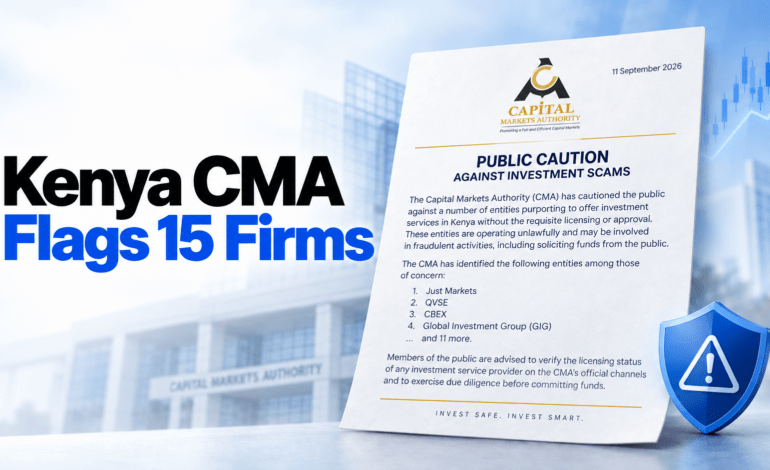
Kenya’s Capital Markets Authority has warned the public against 15 entities it says are offering investment services without the required licences or approvals, including Just Markets, QVSE, CBEX and Ultima Cryptocurrency. Several of the names have already attracted regulatory scrutiny elsewhere in Africa.
Kenya’s Capital Markets Authority (CMA) has issued a sweeping warning against 15 investment entities, saying they are operating without the licences or approvals required to offer investment services in the country.
The public caution, dated September 11, 2026, says the entities are “operating unlawfully and fraudulently soliciting funds from the public.” The regulator also said they are now the subject of active investigations involving the Directorate of Criminal Investigations (DCI), the CMA and other law-enforcement agencies.
Among the better-known names are Just Markets, QVSE, Global Investment Group, CBEX and Ultima Cryptocurrency.
The full list named by the CMA is:
- Global Investment Group (GIG)
- QVSE
- Kore Exchange
- Abacus Wealth Management
- Brown Advisory Group
- B Invest
- Bitblock Capital Limited
- Maliwave Investments
- Monetrix Capital Investments
- Twenty-four Hours Pro Expert Trader
- Wealth Sharing Group (Opticoin)
- CBEX
- Just Markets
- Ultima Cryptocurrency
- Lukman-trust fund
The CMA urged Kenyans not to deal with people or organisations presenting fraudulent activity as an investment opportunity. It also asked anyone affected by the listed entities to cooperate with investigators by reporting to their nearest DCI office.
QVSE was already on Parliament’s radar
For QVSE and Global Investment Group, the CMA warning comes after weeks of growing scrutiny.
On August 12, Matungulu MP Stephen Mule formally raised the operation of QVSE in Kenya in the National Assembly. According to the parliamentary record, Mule asked the Finance and National Planning Committee to establish whether QVSE and Global Investment Group were licensed to operate in Kenya, who controlled the operation and what safeguards existed for investors. the August 12 parliamentary proceedings
Mule told Parliament that reports suggested the platform was targeting ordinary Kenyans, including small-scale traders and economically vulnerable groups, with an initial investment of around KSh65,000 and promises of fixed daily returns.
He also raised allegations that investors could not withdraw their original capital and were allowed to execute trades only after receiving instructions from the company. Speaker Moses Wetang’ula subsequently directed Parliament’s Finance and National Planning Committee to investigate QVSE’s activities.
By early September, reports emerged that some QVSE users were having difficulty accessing their money. An investigation by Kenyan technology publication Techish reported that Quant Vest Stock Exchange Limited had been incorporated in Colorado in June 2025 and possessed a US Financial Crimes Enforcement Network money-services-business registration. However, that registration did not amount to authorisation to operate a securities exchange.
That distinction is important. A company registration, certificate of incorporation or money-services registration may prove that an entity exists, but it does not automatically give that company permission to offer investments in every country where it finds customers.
Ghana had already warned about QVSE and Ultima
Kenya is also not the first African market where QVSE has attracted regulatory attention.
On July 22, 2026, the Securities and Exchange Commission of Ghana published an official notice naming 23 entities that it said were carrying out capital-market activities without a licence.
Both Quant Vest Stock Exchange (QVSE) and Ultima Cryptocurrency Group appeared on the list.
Ghana’s SEC said it had not licensed any of the named entities and was working with law-enforcement agencies against the people behind the operations. Ghana SEC’s July warning
QVSE has therefore moved from being questioned in the Kenyan Parliament to being explicitly named by Kenya’s capital-markets regulator, after previously appearing on another African regulator’s unlicensed-entities list.
That is a rather uncomfortable regulatory hat-trick for any investment platform.
CBEX has an even longer regulatory history
Another name on the Kenyan list, CBEX, will be familiar to investors who followed one of West Africa’s most prominent investment-platform controversies in 2025.
Nigeria’s Securities and Exchange Commission issued an official warning against CBEX, or Crypto Bridge Exchange, in April 2025.
The Nigerian regulator said CBEX had presented itself as a digital-asset trading platform offering high returns. Crucially, the SEC said neither CBEX nor its associated entities had ever been registered to operate as a digital-asset exchange, solicit investments or perform other capital-market functions in Nigeria. Nigeria SEC’s CBEX warning
Nigeria’s SEC said its preliminary investigation found that the platform used promotional activity to create an impression of legitimacy while promising what the regulator described as implausibly high guaranteed returns.
It also said CBEX had failed to honour some withdrawal requests and had abruptly closed physical offices following complaints.
Then in June 2025, Nigeria’s SEC issued another illegal operator alert after reports that CBEX had resumed operations. The regulator said promoters were reportedly asking some customers to make additional payments before withdrawals could be processed. the SEC’s follow-up CBEX alert
Its appearance in Kenya’s September 2026 warning therefore suggests that the CBEX name has continued to surface across borders despite earlier regulatory action.
Being registered abroad is not the same as being licensed in Kenya
The warning exposes a problem that has become increasingly common in online investing.
A platform can have a polished website, company-registration documents, an overseas office address and even registrations with foreign agencies while still lacking permission to offer a particular financial service in Kenya.
Investors therefore need to distinguish between “registered” and “regulated.”
A business-registration certificate generally establishes that a company has been incorporated. A financial-services licence goes considerably further. It determines what financial activities that business is actually authorised to conduct and under whose supervision.
That is especially relevant to platforms combining crypto, forex, US stocks, copy trading or investment products in a single app. The more acronyms displayed at the bottom of the website, the more useful it becomes to check what those acronyms actually permit.
The safest starting point for Kenyan investors remains the CMA’s own licensing database rather than screenshots of foreign certificates supplied by an investment promoter.
A warning Kenyan investors should take seriously
The latest notice arrives as investment schemes increasingly move through social media groups, Telegram channels, WhatsApp communities and slick trading applications rather than traditional offices.
That makes verification more important, not less.
Promises of fixed daily returns, guaranteed profits, pressure to recruit friends, deposits through crypto, restrictions on withdrawals and demands for additional payments before money can be released should all trigger further scrutiny.
And the most important question is often the simplest one:
Who regulates this company in Kenya, and can I independently verify the licence?
For QVSE, that question reached Parliament in August. Ghana’s regulator had already provided its answer in July. Kenya’s CMA has now added its own warning.
For CBEX, Nigeria’s regulator sounded the alarm more than a year ago.
And for all 15 entities on the latest Kenyan list, CMA is now telling the public to stay away while law-enforcement investigations continue.
For investors who believe they have been affected, the Authority has asked them to report the matter to their nearest Directorate of Criminal Investigations office and cooperate with the ongoing investigations.