







Ghana Tests Tokenised Gold Inside SEC Virtual Asset Sandbox

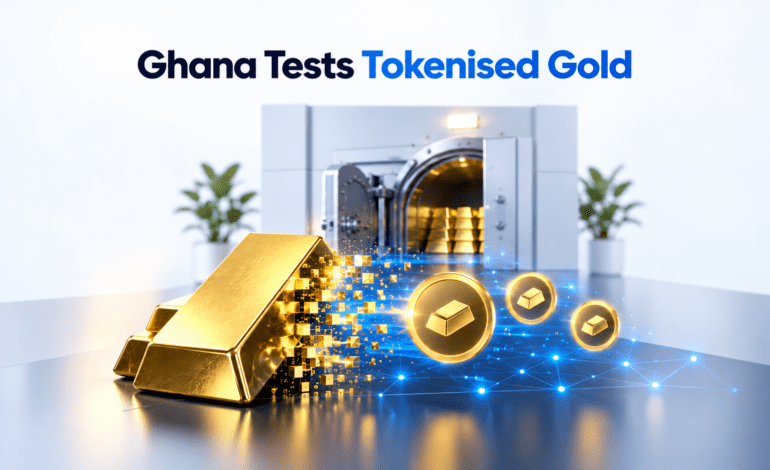
Ghana is taking another step toward putting one of its most valuable natural resources on blockchain rails.
The country’s Securities and Exchange Commission has confirmed that gold tokenisation and gold-backed real-world asset services are being tested inside its Virtual Asset Sandbox, alongside exchanges, brokers and other digital-asset businesses.
According to the Ghana SEC’s full sandbox participant list, Africoin Ghana Limited has been approved to pilot gold asset tokenisation, while the Ghana Gold Board, or GoldBod, is participating as a real-world asset custodian for gold. The Ghana Commodity Exchange is also inside the sandbox as a virtual asset exchange for commodities.
Together, these activities suggest Ghana is testing several of the building blocks needed for a regulated market where physical gold can be represented, held and potentially traded digitally.
Ghana’s Crypto Sandbox Started in March
The gold pilots form part of a much wider effort to build Ghana’s regulatory framework for virtual assets.
The SEC formally launched its Virtual Asset Sandbox in March 2026, after Ghana passed the Virtual Asset Service Providers Act in 2025.
In its March announcement of the first sandbox participants, the regulator said the programme would allow selected companies to test products and services in a controlled environment under SEC supervision.
The sandbox is designed to run for 12 months.
Companies whose products are considered market-ready and compliant after the first six months may be moved toward activity-based licences or registration. Others can remain in testing for the rest of the sandbox period.
The SEC says the purpose is not simply to give crypto companies somewhere to experiment.
It wants to collect real-world data before finalising detailed rules for exchanges, tokenisation platforms, brokers and other virtual-asset businesses.
Gold Tokenisation Is Now Explicitly Part of the Sandbox
The clearest evidence came on August 19, 2026, when the SEC published the complete list of 20 sandbox participants and their approved activities.
The official SEC notice names Africoin Ghana Limited under the category “Asset Tokenization (GOLD)”.
Africoin describes itself as a blockchain-powered platform for tokenising real-world assets. Earlier this year, the company said its admission into Ghana’s sandbox would allow it to test regulated infrastructure for fractional ownership and trading of physical assets.
Tokenisation, in simple terms, means creating a digital token that represents ownership or an economic claim on a real-world asset.
For gold, that could mean one digital token represents a defined quantity of physical gold held somewhere off-chain.
That sounds straightforward.
The complicated part is proving that the gold actually exists, keeping it secure, allowing holders to redeem or trade their claims and making sure no one accidentally tokenises the same bar twice.
That is where custody and regulation become important.
GoldBod Is Testing the Custody Side
The Ghana Gold Board is one of the most significant names on the SEC’s list.
The regulator has approved GoldBod as a Real World Asset Custodian for gold within the sandbox.
GoldBod is not an ordinary crypto startup.
It is Ghana’s statutory gold authority. GoldBod says it has exclusive authority to buy, sell, assay, value and export gold and other precious minerals in the country.
Its involvement could therefore provide an important link between blockchain tokens and the physical gold those tokens are supposed to represent.
GoldBod already provides secure vaulting and assay services. It also regulates parts of Ghana’s refining and gold-trading ecosystem.
More importantly, GoldBod openly lists tokenisation among its activities.
Its website says that through blockchain technology it plans to convert physical gold into digital tokens for clients globally.
So this is not simply a case of crypto companies deciding that gold would look nice on a blockchain.
Ghana’s actual gold authority is involved.
Ghana Commodity Exchange Is Also Inside the Sandbox
Another important participant is the Ghana Commodity Exchange, or GCX.
The SEC has approved GCX to pilot a Virtual Asset Exchange for commodities.
GCX is itself closely linked to the state. Its own corporate information describes it as a public-private partnership in which the Government of Ghana is currently the sole shareholder.
The exchange was originally created to provide a regulated marketplace for commodities and connect producers with buyers.
Adding virtual assets potentially opens the door for commodities to be represented and traded in digital form.
And the gold connection did not suddenly appear in August.
In September 2025, GoldBod and GCX announced discussions about bringing gold trading onto the commodity exchange. According to the GoldBod announcement, the organisations specifically said they would explore tokenisation and exchange-traded funds as potential ways to broaden access to gold investment.
The SEC sandbox now gives those ideas a regulated environment in which to be tested.
Why Tokenise Gold?
Gold already works quite well as gold.
But it has some limitations as an investment product.
Physical gold needs to be stored. It needs to be verified. Buying small amounts can be inconvenient, and moving ownership between investors often requires several intermediaries.
Tokenisation can potentially change that.
Instead of transferring the physical metal every time ownership changes, a blockchain token can represent a claim on gold stored securely with a custodian.
That could make fractional ownership easier.
Someone might eventually be able to own the digital equivalent of a fraction of an ounce of gold rather than buying an entire coin or bar.
Blockchain records could also make ownership transfers easier to track.
However, putting gold on a blockchain does not magically remove the risks.
A gold token is only as reliable as the gold reserves, custodian, legal structure and redemption process behind it.
If there are 1,000 tokens claiming to represent 1,000 grams of gold, somebody still needs to confirm that those 1,000 grams actually exist.
Blockchain can record the token.
It cannot climb into the vault and count the bars.
From Gold Bars to Digital Tokens
Ghana is one of the world’s major gold-producing countries.
For decades, most discussions around its gold industry have focused on mining, exports, reserves and foreign exchange.
Tokenisation introduces a different question:
What if ownership of Ghanaian gold could also become a digital financial product?
The pieces are beginning to appear.
Africoin is testing gold tokenisation.
GoldBod is approved to test real-world gold custody.
The Ghana Commodity Exchange is testing virtual-asset trading for commodities.
And GoldBod says a wider gold tokenisation programme is planned for 2027.
It is too early to say exactly what the final system will look like, who will be allowed to invest, what blockchain it will use or how redemption will work.
But Ghana has moved beyond simply discussing tokenised gold.
It is now allowing parts of the infrastructure to be tested under regulatory supervision.
For a country whose economy has been tied to physical gold for generations, the next chapter may involve something much lighter: a token representing the gold instead.