








Dangote IPO Rush Exposes the Next Problem for Nigeria’s Fintech Boom

Nigeria’s biggest-ever public offer turned investment apps into the front door of the capital market. Then some of those doors struggled to open.
Nigeria’s retail-investing moment arrived with a familiar digital-economy problem: too many people showed up at once.
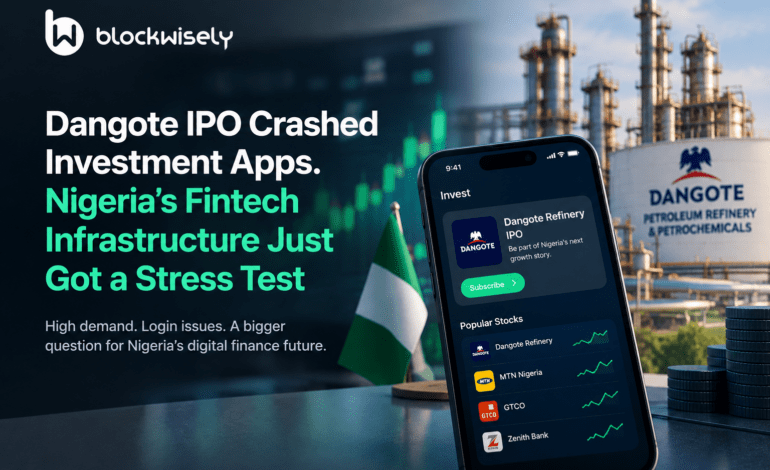
When the Dangote Petroleum Refinery and Petrochemicals IPO opened on Monday, September 14, thousands of Nigerians rushed to buy shares through digital investment platforms. The demand was strong enough to cause access problems on platforms including Bamboo and Cowrywise, with Bamboo acknowledging that unusually high traffic was making it difficult for some users to log in.
That might look like a routine technology outage.
It is more important than that.
The disruption offers an early stress test of a fundamental shift taking place in Nigeria’s financial system: retail investors are increasingly accessing the capital market through fintech apps rather than traditional stockbrokers.
And when Africa’s largest IPO arrives, those apps suddenly become critical financial infrastructure.
The IPO that turned fintech apps into stockbrokers’ front doors
The Dangote Refinery offer is unlike an ordinary Nigerian equity offering.
The company is offering 4.1 billion shares at ₦525 each, seeking to raise about ₦2.15 trillion ($1.6 billion). The minimum subscription is 10 shares, or ₦5,250, deliberately lowering the barrier for ordinary investors. The offer is scheduled to remain open until October 13.
Dangote has marketed it as a people’s IPO.
But the more interesting development for the technology sector is how people are accessing it.
Instead of visiting a broker’s office or navigating a traditional dealing platform, investors can use digital channels, including fintech and investment apps.
That changes the economics and the expectations of investing.
A consumer who is accustomed to opening an app to transfer money, buy airtime or invest savings expects the stock market to work in much the same way.
One tap.
Instant confirmation.
Clear status.
No queues.
No phone calls.
No paperwork.
The fintech industry has spent years training Nigerians to expect financial services to work this way.
The Dangote IPO exposed what happens when millions of those expectations converge on a single financial event.
Demand arrived faster than the infrastructure expected
The scale of the response was striking.
Reports indicated that about ₦1.5 trillion in subscriptions had been recorded within the first several hours of the offer opening already representing a substantial portion of the ₦2.15 trillion target.
That kind of demand is precisely what digital platforms are supposed to absorb.
Instead, some users encountered login difficulties.
Bamboo said it was experiencing much higher-than-expected traffic from investors attempting to access the Dangote IPO and that its technical team was working to resolve the problem. Cowrywise also acknowledged unusually heavy traffic.
The important point is that these platforms were not merely entertainment apps experiencing a bad day.
For users attempting to participate in a time-sensitive financial transaction, availability is part of the product.
If an investment app is inaccessible, the problem is not simply that a website is slow.
The user’s ability to transact is affected.
That makes resilience a financial-services issue.
Nigeria has created a new retail investor
There is a broader story underneath the outage.
Nigeria’s fintech boom has changed who interacts with financial markets.
For years, stock-market participation was largely associated with brokers, institutional investors and financially sophisticated individuals.
Digital investment platforms have lowered the friction.
A younger consumer can download an app, complete onboarding and begin interacting with financial products without ever having a relationship with a physical brokerage office.
Recent market data points to the growing importance of this group. Retail investors accounted for roughly one in four trades on the Nigerian Exchange between January and July 2026, while Bamboo-linked activity was a major contributor to retail trading volumes.
The Dangote IPO is therefore arriving at a market that has already been partially digitised.
The refinery is simply providing the event capable of testing how far that digitisation has gone.
The real fintech question: Can the infrastructure scale?
Fintech companies have become very good at handling everyday transactions.
But an IPO creates a different type of traffic.
Instead of thousands of customers making different transactions throughout the day, a major public offering can generate huge, highly concentrated bursts of activity.
Everybody wants to log in at roughly the same time.
Everybody wants to see the same offer.
Everybody may need to complete similar onboarding, payment and confirmation processes.
That creates a classic infrastructure challenge.
The system isn’t necessarily failing because it cannot handle millions of transactions.
It may fail because millions of people are trying to perform the same action simultaneously.
For fintech infrastructure, those are very different problems.
This is where Nigeria’s digital finance sector will increasingly have to think like critical infrastructure.
Capacity planning matters.
Cloud architecture matters.
Database performance matters.
API resilience matters.
Queue management matters.
Disaster recovery matters.
And, perhaps most importantly, communication with customers matters.
An outage can become a trust problem
Financial technology has an unusual relationship with trust.
If a social-media platform goes down for an hour, users complain.
If an investment platform goes down while a major public offer is underway, users may wonder whether they missed their opportunity to invest.
That distinction matters.
The SEC itself warned prospective Dangote IPO investors to use only officially designated and approved subscription channels and to verify platforms before providing personal or financial information. It also warned against unsolicited offers and transfers to unauthorised entities.
That warning becomes particularly relevant when demand is high.
A legitimate platform struggling with traffic can create confusion.
Confusion creates an opening for scammers.
An investor who cannot access Bamboo, for example, might search social media for another way to subscribe. A fraudster can then present a fake “Dangote IPO” link, WhatsApp account or investment platform.
The technology problem can therefore become a cybersecurity problem.
This is also a test for Nigeria’s capital-market ambitions
Nigeria wants deeper participation in its capital markets.
That requires more than getting companies to list.
It requires ordinary Nigerians to believe that they can participate safely and conveniently.
The Dangote offering is unusually important because the minimum investment is just ₦5,250, making the offer accessible to a much wider group of potential investors. Reuters described the offer as targeting ordinary Nigerians, with the refinery seeking roughly $1.6 billion from the public.
If millions of Nigerians begin investing through fintech platforms, those companies effectively become part of the country’s capital-market infrastructure.
That means regulators may eventually need to think more carefully about technology resilience at investment platforms.
Not every outage needs regulatory intervention.
But platforms handling large volumes of financial transactions may need increasingly sophisticated expectations around:
- uptime;
- capacity testing;
- incident response;
- customer communication;
- cybersecurity;
- transaction reconciliation; and
- business continuity.
The industry is moving toward a world where the app is the branch.
That means an app outage is increasingly comparable to a branch being closed.
The fintech industry should see the warning and the opportunity
There is an obvious criticism to make after the Dangote IPO disruption.
If an investment platform cannot handle a sudden surge of users, how ready is it for Nigeria’s next major capital-market event?
But there is another way to look at it.
The traffic itself is evidence that fintech has succeeded in making investing more accessible.
People came.
They tried to invest.
They expected to do it from their phones.
That is a significant change in consumer behaviour.
The infrastructure now has to catch up with the behaviour.
And that creates opportunities for companies building the less visible layers of fintech: cloud infrastructure, fraud detection, identity verification, payment orchestration, brokerage APIs, customer verification and financial-market technology.
The next billion-dollar fintech company may not be another consumer wallet.
It may be the company making sure every consumer wallet keeps working when everybody logs in at once.
The bigger lesson from the Dangote IPO
The most important thing about the Bamboo and Cowrywise disruptions may not be that two investment platforms experienced heavy traffic.
It is that Nigeria’s financial system is becoming increasingly dependent on consumer technology.
The Dangote IPO has effectively brought three worlds together:
Capital markets.
Fintech.
Mass-market digital consumers.
That combination is powerful.
It can bring millions of new participants into investing.
But it also means that the technology connecting those participants to the market must be as dependable as the financial institutions behind it.
Nigeria has spent the past decade building digital rails for payments.
The next phase is building equally resilient rails for wealth creation and investment.
The Dangote IPO may ultimately be remembered not just as Africa’s biggest public offer, but as the moment Nigeria discovered how much of its capital market now runs through a smartphone.
And when that happens, keeping the app online is no longer just a product feature. It is part of the market infrastructure.
Sources