









Ethiopia Cuts Bitcoin Miners’ Power to 23% as Hydropower Shortage Bites

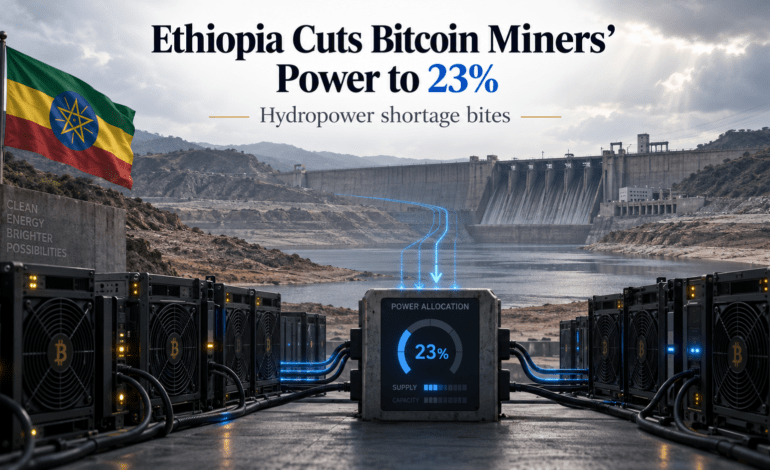
Ethiopia has sharply reduced electricity supplied to Bitcoin mining companies as falling water inflows put pressure on the country’s hydropower system.
Miners are now receiving only 23% of their contracted electricity, according to Ethiopian Electric Power CEO Ashebir Balcha.
The cuts did not happen all at once. Balcha said the state-owned utility first reduced supply to 75% of contracted levels. When conditions failed to improve, it cut miners to 50%. Electricity deliveries have now fallen to 23%.
The restrictions were introduced after water inflows into Ethiopia’s hydroelectric reservoirs fell by around 20%, with El Niño worsening the dry conditions.
For Bitcoin miners that moved to Ethiopia for cheap hydropower, the equation has suddenly changed.
Ethiopia Is Prioritising Homes and Industry
Ethiopian Electric Power, or EEP, says the decision is meant to protect electricity supply for households and manufacturing.
Hydropower dominates Ethiopia’s electricity system, which means changes in rainfall and reservoir levels can have a direct effect on how much power the country can generate.
Local reporting from StockMarket.et on EEP’s annual performance briefing says hydropower provides roughly 95% of EEP’s generation mix.
That dependence has helped Ethiopia produce relatively low-cost renewable electricity.
It has also made the system vulnerable when water levels fall.
EEP says incoming water levels were running at least 20% below expectations. As reservoir levels declined, some generating units were also losing output.
Faced with less electricity than expected, the utility decided that domestic consumers and strategic industries would come before data-mining operations.
Miners Were Promised Almost Full Supply
The current reduction is particularly significant because Bitcoin miners entered Ethiopia under power agreements that offered much higher reliability.
According to the Bloomberg reporting, EEP had committed to supplying miners with at least 98% of their contracted electricity.
They are currently getting about 23%.
Ethiopia has power-purchase agreements with 39 Bitcoin mining companies, and 31 are already operational, according to EEP figures reported by Bloomberg.
The miners were attracted by inexpensive electricity and the availability of hydropower that Ethiopia could monetise through energy-intensive data centres.
Now those same miners have discovered another feature of depending on a national grid: when electricity becomes scarce, the grid decides who gets it.
Bitcoin Mining Has Become Big Business for EEP
The power cuts create an unusual problem for Ethiopia.
Bitcoin miners are not just heavy electricity users.
They are also extremely important customers.
Mining companies accounted for about 35% of Ethiopian Electric Power’s revenue during the previous financial year, according to the Bloomberg report.
At the same time, they consumed almost one-third of Ethiopia’s electricity production, which Bloomberg put at 9,730 megawatts.
Local reporting provides another indication of just how valuable the sector has become.
StockMarket.et reports that data-mining customers generated around 50.37 billion birr for EEP during the previous financial year, making them its largest revenue-generating customer category.
So Ethiopia is effectively reducing electricity to one of its best-paying customers.
That sounds strange until the alternative is considered.
A Bitcoin mining machine can be switched off.
A city full of homes, hospitals and factories is slightly harder to put on pause.
The Hydropower Advantage Has a Catch
Hydropower is often attractive to Bitcoin miners because it can provide relatively cheap electricity without relying directly on fossil fuels.
However, hydroelectric generation still depends on something rather fundamental:
water.
If rainfall drops and reservoirs receive less water, electricity production can fall.
That is now happening in Ethiopia.
The same energy source that helped make the country attractive to miners has become the reason their machines are receiving less power.
EEP’s decision therefore provides an interesting reminder that renewable electricity does not automatically mean unlimited electricity.
Solar depends on sunlight.
Wind depends on wind.
Hydro depends on water.
Bitcoin miners depend on whichever one is cheapest.
The Cuts Could Get Worse
The current 23% allocation may not be the final number.
EEP plans to reassess water levels and electricity availability in October 2026.
Balcha said the utility could reduce electricity to miners even further if conditions fail to improve.
Electricity exports to neighbouring countries could also face additional restrictions.
That makes October an important month for mining operators that have invested in Ethiopian facilities.
If reservoir inflows recover, some of the lost electricity could return.
If they do not, miners could spend even more time looking at expensive machines that are very good at mining Bitcoin when somebody remembers to plug them in.
Ethiopia’s Bitcoin Experiment Faces Its First Big Water Test
Ethiopia’s mining boom demonstrated how countries with abundant renewable electricity can turn spare power into foreign-currency revenue.
The current shortage shows the other side of that model.
Bitcoin miners can be useful customers when electricity is plentiful because they can absorb huge amounts of power.
They can also become useful customers to disconnect when electricity is scarce because their operations are easier to interrupt than households or factories.
That flexibility may eventually become part of the value miners provide to electricity grids.
But it is probably less exciting when you are the miner being flexible.
For now, Ethiopian Bitcoin miners are receiving only 23% of the electricity they contracted for, while the government waits to see whether reservoir conditions improve.
The country will review the situation in October.
Until then, Ethiopia’s Bitcoin mining industry has learned a fairly old lesson about hydropower:
you can have all the mining machines in the world, but you still need the rain.