










Hyperbridge Exploit: $1.19B Minted… But the Attacker Only Got $237K

Hyperbridge Exploit: All you need to know.
Crypto never runs out of irony.
Just days after positioning itself as “unhackable,” Hyperbridge became the latest protocol to remind the industry of a hard truth: no system is immune to implementation flaws.
On April 13, an attacker exploited Hyperbridge’s Ethereum gateway and minted roughly 1 billion bridged Polkadot (DOT) tokens worth a notional $1.19 billion.
And yet, after all that?
They walked away with just ~$237,000.
Let’s break down what actually happened and why this bizarre outcome matters.
First, What Is Hyperbridge?
Hyperbridge, built by Polytope Labs, is designed to connect Polkadot with ecosystems like Ethereum.
Unlike traditional bridges that rely on multisigs or validators, Hyperbridge leans on cryptographic proofs specifically something called Merkle Mountain Range (MMR) proofs.
The idea is simple (at least in theory):
Instead of trusting people, you trust math.
That’s what made this exploit especially interesting.
So… What Went Wrong?
At the heart of the attack was a classic issue in a very modern system:
the code didn’t fully enforce what the cryptography promised.
1. A Fake Proof Slipped Through
Hyperbridge’s contracts are supposed to verify cross-chain messages using MMR proofs.
But due to weak input validation, the attacker was able to submit a forged proof that the system accepted as legitimate.
In other words:
The bridge believed something that wasn’t true.
2. That Was Enough to Take Control
Once the fake message was accepted, it triggered internal contract logic that wasn’t meant to be exposed.
Specifically, it executed a changeAdmin function on the bridged DOT token contract.
Now the attacker wasn’t just interacting with the system they were in control of it.
3. Then Came the Billion-Dollar Mint
With admin privileges secured, the attacker did the obvious:
- Minted 1,000,000,000 bridged DOT
- Sent the tokens through routing contracts
- Tried to dump them on the market via Uniswap V4 and Odos
You can literally see it happen on-chain:
0x240aeb9a8b2aabf64ed8e1e480d3e7be140cf530dc1e5606cb16671029401109
Why This Didn’t Turn Into a Billion-Dollar Hack
Here’s where things get interesting.
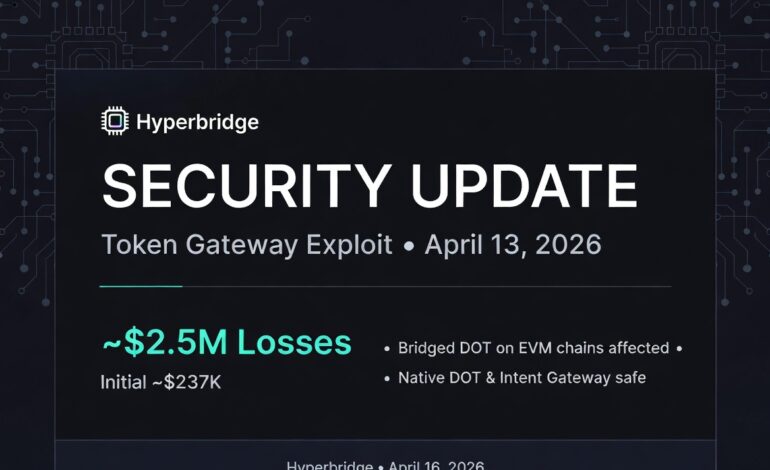
Even though the attacker minted tokens worth over $1 billion (on paper), they only managed to extract about 108 ETH (~$237K).
Why?
Liquidity.
The bridged DOT market on Ethereum was thin. Very thin.
So when the attacker started dumping:
- The price instantly collapsed
- Slippage skyrocketed
- The token effectively went to zero
At that point, continuing to sell was pointless.
So they stopped.
What Was Actually Affected?
This is important and easy to misunderstand.
The damage was completely contained:
- Native DOT on Polkadot → safe
- Parachain assets → safe
- Other bridges → unaffected
This wasn’t a failure of Polkadot itself.
It was a failure in how Hyperbridge implemented its Ethereum-side contract logic.
How Hyperbridge Responded
To their credit, the team moved quickly:
- Bridging was paused almost immediately
- They clarified the limited scope of the exploit
- Security partners were brought in to investigate
As of now, bridging is still suspended while fixes and reviews are underway.
What This Says About Crypto Infrastructure
This incident isn’t just about Hyperbridge, it’s about a broader pattern.
1. Bridges Are Still Fragile
Even with advanced designs, bridges remain one of the most attack-prone parts of crypto.
Why? Because they sit at the intersection of:
- Multiple chains
- Complex verification logic
- High-value assets
That’s a dangerous combination.
2. Cryptography Isn’t the Problem, Implementation Is
Hyperbridge didn’t fail because MMR proofs are weak.
It failed because the implementation around them wasn’t strict enough.
That distinction matters.
3. Liquidity Saved the Day (This Time)
Ironically, poor liquidity prevented a much bigger disaster.
But that’s not something protocols should ever rely on.
Next time, the pool might be deeper.
So… What Should You Take Away?
If you’re a user:
Avoid interacting with Hyperbridge-bridged DOT on Ethereum until everything is fully restored and audited.
If you’re a builder:
- Treat verification logic as critical infrastructure
- Lock down admin pathways
- Assume anything that can be abused eventually will be
If you’re just watching the space:
This is another reminder that interoperability is powerful, but still risky.
Final Thought
The attacker created over a billion dollars out of thin air and still couldn’t cash it out.
That’s crypto in a nutshell.
Brilliant systems. Fragile edges. And outcomes no one would predict.
And once again, a simple truth holds:
Nothing is unhackable.








1 Comment
It’s wild to think that despite minting $1.19B worth of tokens, the attacker only walked away with ~$237K — really highlights how exploit outcomes aren’t always proportional to the scale of the vulnerability. The use of MMR proofs was clever in theory, but this incident serves as a stark reminder that even math-based security can fail if implementation details are overlooked. The irony of a protocol calling itself ‘unhackable’ falling victim to such a flaw is pretty fitting for the crypto space.