




Nigeria Virtual Assets Executive Order Ushers in Coordinated Crypto Regulation

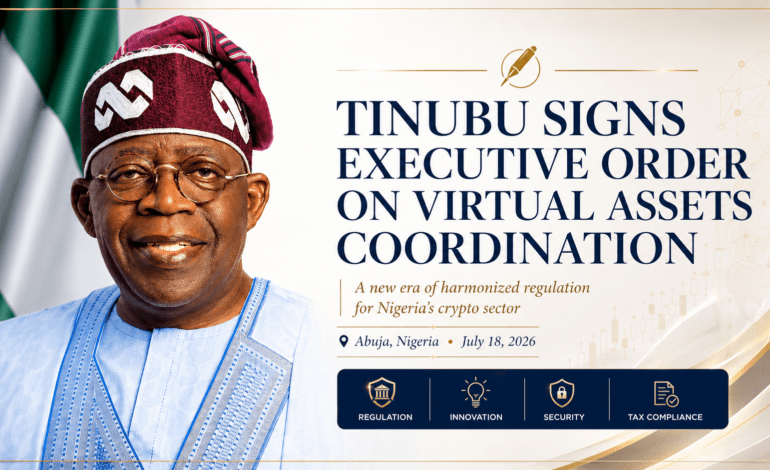
Nigeria’s virtual assets executive order has introduced a new system for coordinating cryptocurrency and digital-asset regulation across the country’s financial, tax, capital-market and security agencies.
President Bola Ahmed Tinubu signed the Presidential Executive Order on Virtual Assets Coordination, 2026, under Section 5 of the 1999 Constitution. The order took immediate effect.
Rather than create another regulator, the order brings existing authorities into a shared framework. Its goals include closing regulatory gaps, protecting Nigerians from fraud and strengthening oversight of a fast-growing digital economy.
The framework also seeks to reduce money-laundering, terrorism-financing, cybersecurity and data-privacy risks. At the same time, the government says it wants to support responsible innovation rather than suppress legitimate blockchain businesses.
Why Nigeria introduced the virtual assets executive order
Nigeria has become one of Africa’s largest cryptocurrency markets.
Between July 2024 and June 2025, Nigeria received more than $92.1 billion in cryptocurrency value, nearly three times the total recorded by South Africa during the same period. Inflation, foreign-currency shortages and demand for stablecoins helped drive that activity.
That figure does not capture every informal transaction. Peer-to-peer trades, private wallet transfers and some over-the-counter activity can fall outside centralised exchange data.
Nigerians use digital assets for several reasons. Some trade Bitcoin and other volatile tokens. Others use dollar-linked stablecoins to receive freelance payments, preserve value or send money across borders.
The growth created opportunities, but it also exposed weaknesses in Nigeria’s regulatory structure.
Different agencies approached virtual assets through their existing mandates. The SEC focused on investments and securities. The CBN concentrated on banking, payment services and financial stability. Tax authorities pursued reporting and revenue, while security agencies focused on illicit finance.
Those responsibilities sometimes overlapped. Other activities could fall between agencies altogether.
The State House said fraudulent and unregistered operators had exploited these gaps, sometimes costing Nigerian families their savings. The executive order attempts to replace that fragmented approach with coordinated supervision. ([State House Abuja][1])
Internal link: Add a link here to your existing guide on how cryptocurrency regulation works in Nigeria.
The Virtual Asset Council
The central feature of the Nigeria virtual assets executive order is the creation of a Virtual Asset Council.
The Central Bank of Nigeria will chair the council. The Nigeria Revenue Service and Securities and Exchange Commission will serve as vice-chairs.
The Nigerian Financial Intelligence Unit and Office of the National Security Adviser will also participate.
The council will provide policy direction and improve cooperation between the participating agencies. It will also work with the Attorney-General of the Federation on a harmonised legal and institutional framework.
That work must balance several national interests. These include financial stability, investor protection, national security, economic growth and innovation.
What the council will not do
The council does not replace the CBN, SEC, NRS, NFIU or ONSA.
Each body keeps its legal powers and independence. The council coordinates their work but does not transfer their statutory mandates to a new institution.
This distinction matters because Nigeria has not created a single cryptocurrency regulator.
Instead, the country has chosen a multi-agency model. Regulation will depend on the asset involved and the activity an operator performs.
The Virtual Asset Office
The order also creates a Virtual Asset Office as the council’s operational arm.
Its secretariat will sit within the CBN. It will manage day-to-day coordination, information sharing, applications and regulatory reporting.
The government also plans an integrated supervisory-technology platform. Participating agencies will use the system to gain shared visibility into regulated activities.
However, each agency will retain ownership and control of its information.
The platform could reduce duplication. For example, an operator may no longer need to provide substantially similar information separately to several agencies.
Its success will depend on implementation. Regulators will need clear rules on access, cybersecurity, data retention and lawful information sharing.
How activity-based registration will work
The order introduces an activity-based approach to registration.
Under the framework, the regulator responsible for an operator will depend on what the operator does and how the relevant asset is classified.
The SEC will oversee activities involving assets treated as securities. The CBN will oversee payment, settlement, custody and related services involving non-security virtual assets.
The Virtual Asset Council will resolve cases where responsibility remains unclear.
The SEC’s role
The Investments and Securities Act 2025 gives the SEC broad powers over Nigeria’s digital-asset capital market.
The law authorises the commission to register and regulate virtual and digital-asset exchanges. It also covers virtual-asset service providers, digital-asset operators, custodians and other market intermediaries.
The act includes virtual and digital assets within its definition of securities.
The executive order introduces a more detailed activity-based allocation of responsibilities. As a result, operators will need to examine both the legal classification of their assets and the services they provide.
The coming implementation framework should explain how regulators will handle activities that combine investment, exchange, payment and custody functions.
The CBN’s role
The CBN will lead the council and supervise certain non-security virtual-asset services.
These may include payment and settlement services, custody arrangements and other financial activities that fall within the central bank’s mandate.
The CBN had already started relaxing Nigeria’s earlier banking restrictions on cryptocurrency businesses. In December 2023, it issued guidelines allowing banks to operate accounts for compliant virtual-asset service providers under specified conditions.
The executive order now gives the CBN a central coordinating role.
However, this does not make cryptocurrencies legal tender. It also does not mean every token, exchange or wallet has received government approval.
Nigeria’s virtual-asset sandbox
The CBN will proceed with a regulatory sandbox for virtual assets.
A sandbox gives selected businesses a controlled setting in which to test products under regulatory supervision.
Eligible operators may test blockchain services, payment systems and other virtual-asset products before launching them to the broader market.
Regulators will use the process to examine possible effects on:
- Monetary sovereignty and financial stability
- Market integrity and consumer protection
- Financial inclusion
- Revenue administration
The CBN will publish further details on eligibility, application procedures and operating conditions.
For start-ups, the sandbox could provide a path to demonstrate that a product works safely. It may also help regulators understand new business models before issuing permanent rules.
However, admission to a sandbox is not the same as receiving an unrestricted licence.
SEC admits more firms into ARIP
The SEC has continued onboarding digital-asset and fintech firms through its Accelerated Regulatory Incubation Programme, known as ARIP.
In early July 2026, the commission cleared seven firms for admission:
- Bitbarter Technologies Limited
- Luno Fintech Nigeria Limited
- GetEquity Limited
- Koinkoin Global Network Limited
- Wrapped CBDC Ltd
- Trovotech Ltd
- Blockvault Custodian Ltd
The SEC later admitted GIGX Technologies and KuCoin Nigeria Limited, bringing the two July announcements to nine companies.
These firms received Approval-in-Principle.
That status confirms that they met the programme’s admission requirements. It does not amount to a final operating licence. Their approval remains subject to regulatory, operational and supervisory conditions.
Consumers should therefore distinguish between:
- Admission into a regulatory programme
- Approval-in-Principle
- Full registration or final licensing
An operator should not market conditional approval as permanent authorisation.
What the executive order means for crypto businesses
The Nigeria virtual assets executive order could give legitimate businesses greater certainty, but it will also increase compliance expectations.
Operators may need to identify every regulated activity within their business models. An exchange that also offers custody, staking, token issuance and payment services could interact with more than one authority.
Businesses should expect closer attention to:
- Corporate registration and ownership
- Customer identification
- Anti-money-laundering controls
- Transaction monitoring
- Cybersecurity
- Asset custody
- Consumer disclosures
- Tax reporting
- Complaints and dispute resolution
Offshore platforms serving Nigerian customers may also face more pressure to register locally or cooperate with Nigerian authorities.
The main unresolved question is how regulators will treat complex products. Stablecoins, tokenised deposits, yield products and decentralised-finance services can combine characteristics of payments, investments and securities.
The council’s classification and dispute-resolution procedures will therefore be important.
A new tax policy for virtual assets
The Nigeria Revenue Service will issue a dedicated virtual-assets tax policy.
The policy will not create taxation from nothing. Nigeria’s 2025 tax reforms already brought digital and virtual assets into the tax framework.
The Nigeria Tax Act treats gains from digital or virtual assets as taxable and limits the use of losses from such transactions to profits or gains within the same asset category. It also includes digital and virtual assets within the definition of chargeable property.
Separate tax-administration provisions place reporting duties on virtual-asset service providers. Depending on the transaction and applicable rules, providers may need to collect customer identity and transaction details.
The new NRS policy should explain how existing laws will work in practice. The State House says it will provide greater certainty for taxpayers, improve voluntary compliance and ensure that the growing sector contributes to public revenue.
What individual users should do
Users should keep records of:
- Purchases and sales
- Wallet transfers
- Exchange transactions
- Fees
- Asset values at the time of each transaction
- Gains and losses
- Payments received in cryptocurrency or stablecoins
The exact tax result will depend on the person, activity and transaction. Users should seek qualified tax advice rather than assume that every wallet transfer creates the same tax obligation.
What the order means for everyday crypto users
For the average Nigerian, the immediate effect may appear limited.
The order does not ban Bitcoin. It does not automatically approve every exchange. It also does not guarantee users against losses.
Its most visible effects will likely arrive through stricter registration, customer verification and transaction reporting.
Users may encounter more detailed Know Your Customer checks. Platforms may ask for identity, address, tax or transaction information.
That can help regulators trace fraud and illicit activity. It also creates data-protection responsibilities for platforms and government agencies.
How to check an operator
Before depositing money, users should confirm:
- The company’s Nigerian legal identity.
- Its current status with the SEC or CBN.
- Whether its approval is conditional or final.
- The services covered by that approval.
- Its withdrawal, custody and complaint procedures.
The 30-day implementation deadline
The council must produce a Harmonised Implementation Framework within 30 days.
That document will determine how agencies apply the executive order in practice. It should clarify application processes, information-sharing arrangements, supervisory responsibilities and the treatment of overlapping activities.
The government is also preparing a broader Virtual Assets White Paper. The paper will outline Nigeria’s long-term policy direction and implementation priorities.
Until those documents appear, several issues remain open.
Operators still need answers on classification, transition periods, application fees, capital requirements and cross-border enforcement.
They also need clarity on how the new framework will interact with existing SEC rules, CBN guidelines and tax-reporting obligations.
Possible benefits of coordinated regulation
A functioning coordination model could produce several benefits.
Legitimate companies may gain a clearer path to market. Investors may find it easier to distinguish regulated operators from fraudulent businesses.
Government agencies may share information faster and reduce conflicting instructions. Better supervision could also improve the country’s anti-money-laundering and counter-terrorism-financing controls.
The sandbox may encourage product testing without exposing the entire public to untested services.
The tax policy could give users and businesses clearer reporting standards.
These benefits are not automatic. They depend on transparent rules, reasonable compliance costs and consistent enforcement.
Risks and implementation challenges
Nigeria’s new framework will face difficult tests.
Offshore exchanges can serve Nigerian users without maintaining a visible local presence. Peer-to-peer trades can occur outside formal platforms. Decentralised protocols may not have a traditional company that regulators can license.
Regulatory capacity also matters. Agencies need people who understand blockchain analytics, token design, cybersecurity, custody and smart-contract risks.
Smaller businesses may struggle with capital, legal and reporting costs. Rules designed for large exchanges could unintentionally block responsible local start-ups.
The framework must also prevent duplication. A coordination order will have limited value if operators still face conflicting requests from multiple agencies.
Finally, regulators must protect personal information. Increased reporting can support enforcement, but weak data security could expose users to identity theft and other harm.
Coordination rather than prohibition
The Nigeria virtual assets executive order marks a shift toward structured integration.
Nigeria previously relied on restrictions, enforcement actions and rules issued by individual agencies. The new order tries to make those institutions work together.
It does not create a free market without oversight. It also does not revive a blanket prohibition.
Instead, the government has chosen coordination, activity-based registration, supervised testing and stronger tax and security controls.
That approach could make Nigeria one of the more structured virtual-asset markets in Africa. Whether it succeeds will depend on the 30-day implementation framework, the CBN sandbox rules, the NRS tax policy and the final Virtual Assets White Paper.
For businesses, the direction is clear: informal operation will become harder.
For investors, regulatory status will become more important.
For regulators, the challenge is to protect the public without pushing useful innovation back into unregulated markets.
Sources
- Official State House announcement on the executive order
- Nigeria’s Investments and Securities Act 2025
- SEC announcement admitting seven ARIP participants
- SEC announcement admitting KuCoin Nigeria and GIGX
- CBN guidance on bank accounts for VASPs
- Chainalysis data on Nigeria’s $92.1 billion crypto market
- Blockwisely