









Imagine you are trying to send Bitcoin during a period when thousands of other people are doing the same thing.
You enter the recipient’s address, choose the amount, press send and then wait.
A few minutes pass.
Then 20 minutes.
Then an hour.
Your transaction is still showing as unconfirmed.
Nothing is necessarily wrong with your wallet and your Bitcoin has not disappeared.
One possible reason is much simpler: there are more transactions waiting than Bitcoin can fit into the next block.
That raises an obvious question.
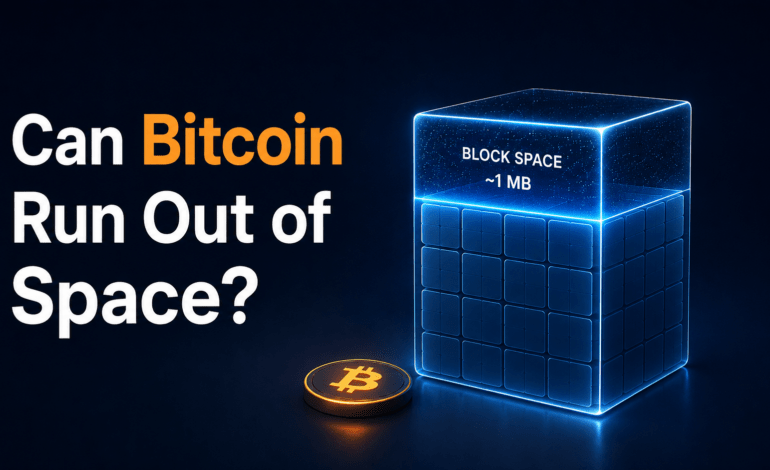
Can Bitcoin actually run out of space?
The short answer is not in the sense that the blockchain eventually becomes completely full and stops working.
But individual Bitcoin blocks have a limited amount of space. When demand for that space exceeds the available capacity, transactions begin competing with each other to get included.
That competition is one of the main reasons Bitcoin transaction fees can suddenly rise.
What Is a Bitcoin Block?
Bitcoin transactions are not individually added to the blockchain the moment you press send.
Instead, transactions are grouped together into blocks.
Think of a block as a container.
Bitcoin users around the world create transactions, and miners select transactions to place inside the next container.
Once a miner successfully produces a valid block, that block is added to the Bitcoin blockchain and the transactions inside it receive their first confirmation.
Another block is then built on top of it.
Bitcoin is designed so that a new block is produced roughly every 10 minutes on average.
That does not mean one will appear exactly every 10 minutes.
Sometimes two blocks can arrive only a few minutes apart.
At other times, users may wait considerably longer.
Over time, however, Bitcoin’s mining difficulty adjusts to keep the average near 10 minutes.
How Much Can Fit Into a Bitcoin Block?
Bitcoin blocks cannot contain unlimited amounts of transaction data.
Since the introduction of Segregated Witness, or SegWit, Bitcoin uses a measurement called block weight.
The SegWit specification in BIP-141 sets the maximum block weight at 4,000,000 weight units.
This is why simply saying that Bitcoin has a “1 MB block size” is no longer a complete description of the current system.
Different parts of a Bitcoin transaction are counted differently under the weight system.
A transaction using modern SegWit addresses can therefore use block capacity more efficiently than certain older transaction formats.
The important idea is much simpler:
Every block has a maximum capacity.
Once miners have filled that capacity, additional transactions have to wait for another block.
So What Does a “Full Bitcoin Block” Mean?
A full block is simply a block where miners have used most or all of the transaction capacity available to them.
Imagine a bus with 50 seats.
If only 20 people are waiting, everyone can get on.
If 200 people are waiting, the bus still has only 50 seats.
The remaining passengers have to wait for the next bus.
Bitcoin works in a similar way.
If the network has relatively few transactions waiting, a miner may be able to include nearly all suitable transactions in the next block.
But if tens or hundreds of thousands of transactions are competing for limited block space, miners have to decide which ones to include first.
That is where fees become important.
Where Do Transactions Wait?
Before a transaction gets confirmed, it normally sits in what is called the mempool.
Mempool is short for memory pool.
It is essentially a waiting area maintained by Bitcoin nodes for valid transactions that have been broadcast but have not yet been included in a block.
There is an important detail here.
Bitcoin does not have one single universal mempool.
Different nodes maintain their own versions.
Because transactions propagate across the network, these mempools are usually very similar, but they are not necessarily identical.
When your wallet broadcasts a transaction, Bitcoin nodes verify that it follows the network’s rules and can then relay it to other nodes.
Miners look at transactions available to them and choose which ones to include when constructing a new block.
Why Don’t Miners Just Take the Oldest Transactions First?
Because miners earn transaction fees.
Every Bitcoin transaction can include a fee.
When block space becomes scarce, miners generally have an economic incentive to include transactions paying the highest fee rate first.
The important term is fee rate.
A miner does not necessarily care only about the total number of satoshis you paid.
It also matters how much block space your transaction consumes.
Fees are therefore commonly compared using:
satoshis per virtual byte, usually written as sat/vB.
A small transaction paying 5,000 satoshis could potentially have a higher fee rate than a much larger transaction paying 8,000 satoshis.
The smaller transaction could therefore be more attractive to miners.
What Happens When Blocks Become Full?
Suppose the next Bitcoin block can accommodate 3,000 of the transactions miners want to include.
But 20,000 transactions are waiting.
Miners could choose the transactions offering the highest fee rates.
The remaining transactions stay in the mempool and compete for space in later blocks.
Then more transactions arrive.
If demand continues to exceed the amount of new block space becoming available, a backlog develops.
The result can look like this:
High-fee transactions → confirmed quickly
Medium-fee transactions → wait several blocks
Low-fee transactions → potentially wait hours or longer
Nothing has necessarily failed.
Bitcoin is simply rationing scarce block space through a fee market.
Why Do Bitcoin Fees Rise?
This is one of the most important things to understand about Bitcoin fees.
Bitcoin does not have one fixed transaction fee.
Fees largely depend on demand for block space.
Imagine that most transactions currently waiting are paying around 2 sat/vB.
If you pay 5 sat/vB, your transaction might have a good chance of being selected quickly.
Now imagine that a sudden surge of activity causes thousands of people to start paying 20, 30 or 50 sat/vB.
Your 5 sat/vB transaction has not become invalid.
But miners now have many more profitable transactions available.
You may have to wait.
Wallets therefore often estimate appropriate fees by looking at current network conditions.
Does Paying More Make Bitcoin Move Faster?
Not exactly.
Paying a higher fee does not make Bitcoin blocks appear faster.
The network still produces blocks according to its normal mining process.
What the higher fee can do is improve your transaction’s position in the queue.
Think again about the bus.
You cannot make the bus arrive sooner.
But imagine passengers are being allowed to board based on the price of their ticket.
A more expensive ticket can give you a better chance of getting onto the next bus.
That is roughly what a higher Bitcoin transaction fee does when block space is congested.
Can My Transaction Be Stuck Forever?
Usually not, although low-fee transactions can sometimes remain unconfirmed for a long time.
A transaction may sit in mempools until:
- miners eventually include it;
- network congestion falls;
- the fee is increased;
- nodes eventually drop it from their mempools; or
- the transaction is replaced under applicable transaction-replacement rules.
Bitcoin Core also limits how much unconfirmed transaction data a node keeps in memory.
When a node’s mempool becomes heavily congested, it can raise the minimum fee rate it is willing to keep and relay. Bitcoin Core documentation has long described how low-fee transactions can be removed when mempool limits are reached. (bitcoincore.org)
That does not mean the Bitcoin has disappeared.
If an unconfirmed transaction is eventually forgotten by the network and was never confirmed or replaced, the underlying coins can generally be spent again by the wallet controlling them.
What If I Accidentally Paid Too Little?
There are mechanisms that can sometimes help.
One is called Replace-by-Fee, commonly shortened to RBF.
RBF allows a suitable unconfirmed transaction to be replaced with another version that pays a higher fee.
Bitcoin Core’s Replace-by-Fee documentation explains that replaceable transactions can be replaced before confirmation by transactions paying higher fees.
Many modern wallets handle this through a button labelled something like:
Increase fee
or
Speed up transaction
There is also a technique known as Child Pays for Parent, or CPFP.
This can be useful where a second transaction spends an output from a low-fee unconfirmed transaction while attaching a sufficiently high fee.
A miner can then have an incentive to confirm both transactions together because the combined fees make the package worthwhile.
Users normally do not need to understand the technical mechanics unless a transaction becomes stuck.
Can Bitcoin Simply Increase the Block Size?
Technically, Bitcoin’s consensus rules could be changed.
But changing how much data blocks can contain is not as simple as adjusting a setting on a server.
Bitcoin is decentralised.
A consensus-rule change requires the ecosystem to coordinate around compatible software.
And this subject has already produced one of the biggest disagreements in Bitcoin’s history.
During the 2010s, developers, miners, businesses and users debated whether Bitcoin should dramatically increase on-chain block capacity.
One side argued that larger blocks could allow more transactions and potentially lower fees.
Others argued that dramatically larger blocks would increase the resources required to run a Bitcoin node and could gradually make the network more centralised.
That dispute eventually contributed to the creation of Bitcoin Cash in 2017, which increased its block-size limits while Bitcoin followed a different scaling path centred around SegWit and off-chain systems.
So yes, Bitcoin’s capacity rules can theoretically change.
But doing so involves economic, technical and decentralisation trade-offs.
Why Not Make Blocks Enormous?
Imagine Bitcoin allowed practically unlimited block sizes.
At first, that sounds convenient.
Everyone could put transactions into the next block and fees could potentially remain extremely low.
But somebody still needs to download, verify and store those blocks.
The larger blocks become, the more:
- internet bandwidth nodes require;
- storage space they consume;
- processing power is needed;
- time blocks may take to propagate around the world.
If running a full node became extremely expensive, fewer ordinary people might be able to verify Bitcoin independently.
The network could become increasingly dependent on large companies, mining operations or data centres.
Bitcoin therefore deliberately trades some transaction capacity for decentralisation and verifiability.
Whether the current balance is ideal remains a topic of debate.
Doesn’t Bitcoin’s Blockchain Keep Growing Forever?
Yes, the blockchain itself grows as new blocks are added.
That is different from a block being full.
A full block means:
This particular block has reached its transaction capacity.
It does not mean:
The entire Bitcoin blockchain has reached its maximum storage capacity.
Bitcoin does not have a predetermined point where the blockchain says, “There is no room for any more blocks.”
New blocks continue being added.
The blockchain consequently becomes larger over time.
Anyone running a full node needs enough storage to maintain the blockchain data required by their configuration.
Bitcoin Core also supports techniques such as pruning, which allow a node to validate the blockchain without permanently storing every old block on disk.
So Bitcoin’s long-term blockchain growth and short-term block-space congestion are two separate issues.
Why Does Bitcoin Deliberately Have Limited Block Space?
Limited block space creates trade-offs, but it also plays an important role in the network’s design.
Bitcoin miners currently earn money from two main sources:
Block subsidy + transaction fees
The block subsidy is the newly issued Bitcoin miners receive when producing a block.
That subsidy is cut roughly in half every four years through Bitcoin’s halving process.
Eventually, the subsidy becomes extremely small.
Transaction fees are therefore expected to become increasingly important to Bitcoin miners over the long term.
Scarce block space creates a fee market.
Users who value confirmation more urgently can offer higher fees.
Those fees help compensate miners for securing the network.
This does not mean expensive transactions are inherently desirable.
But Bitcoin’s fee market is part of the system’s long-term economic design.
Why Does the Number of Transactions Per Block Vary?
A common misconception is that every Bitcoin block can hold a fixed number of transactions.
It cannot.
Bitcoin transactions vary significantly in size.
A simple transaction might have one input and two outputs.
Another transaction could combine dozens of previous Bitcoin payments and send funds to many recipients.
Those two transactions consume very different amounts of block space.
That means one block might contain several thousand relatively small transactions while another contains fewer larger transactions.
The relevant constraint is primarily transaction weight, not a fixed transaction count.
Modern Bitcoin Addresses Can Help Reduce Fees
Transaction format matters too.
Older Bitcoin transaction types are generally less block-space-efficient than newer SegWit-based transactions.
Native SegWit addresses beginning with bc1 can reduce the effective weight of transactions compared with some legacy formats.
Taproot transactions can also offer efficiency advantages in certain circumstances.
That means two people sending similar amounts of Bitcoin may create differently sized transactions depending on the type and number of inputs and outputs their wallets use.
This is another reason Bitcoin fees are not simply based on how much BTC you are sending.
Sending $10 worth of BTC does not inherently cost less than sending $100,000.
What matters more is the transaction’s data footprint and the fee market at the time.
Why Can Someone Send $1 Million for Less Than Someone Sending $50?
Because Bitcoin miners do not calculate fees as a percentage of the money transferred.
Banks and payment processors often charge something like:
2% of transaction value
Bitcoin works differently.
A Bitcoin transaction fee is mainly related to:
How much block space does this transaction consume?
A $1 million Bitcoin transaction with a simple structure could therefore pay a relatively small network fee.
Meanwhile, someone consolidating many small Bitcoin outputs while sending $50 could create a large transaction that costs substantially more.
The amount of Bitcoin being transferred is not the primary factor.
What Causes Sudden Congestion?
Bitcoin demand can rise for many reasons.
Examples include:
- rapid movements in Bitcoin’s price;
- users moving funds between exchanges;
- large-scale exchange withdrawals;
- inscriptions and token activity;
- major market events;
- wallet consolidations;
- businesses batching payments;
- sudden increases in trading activity.
Sometimes congestion disappears quickly.
Other times a transaction backlog can persist for hours or days.
The key factor is whether new transaction demand is arriving faster than miners can clear it.
What Happens When Activity Falls Again?
This is the other side of Bitcoin’s fee market.
Suppose congestion has created a large backlog.
Eventually, activity slows.
Miners keep producing new blocks.
Each new block removes transactions from the mempool.
If fewer new transactions arrive than miners are confirming, the backlog starts shrinking.
Lower-fee transactions gradually move closer to the front of the queue.
Transaction fees can then fall dramatically.
This is why Bitcoin fees can sometimes be expensive one day and extremely cheap shortly afterwards.
The network did not suddenly gain more permanent capacity.
Demand simply changed.
Can I Wait for Fees to Become Cheaper?
If your payment is not urgent, yes.
This is one of the easiest ways to reduce Bitcoin transaction costs.
You do not necessarily need to compete for inclusion in the next block.
Many wallets allow you to choose between options such as:
Fast
Normal
Economy
The economy option generally uses a lower fee rate and accepts that confirmation may take longer.
If network demand falls, your transaction could still confirm relatively cheaply.
However, choosing an extremely low fee during severe congestion can leave a transaction waiting much longer than expected.
What Is the Lightning Network’s Role?
Bitcoin also scales beyond the base blockchain.
One of the most important systems is the Lightning Network.
Lightning allows users to make Bitcoin payments without placing every individual payment directly into a Bitcoin block.
Instead, users can perform many transactions through payment channels and ultimately settle the relevant results onto Bitcoin.
This can make Lightning useful for smaller and more frequent payments.
Imagine two people making 100 payments between each other.
If all 100 payments happen directly on Bitcoin’s base layer, they compete for block space individually.
Through a payment-channel system, much of that activity can happen away from the base blockchain while relying on Bitcoin for final settlement.
That is one of the ways Bitcoin can support more activity without simply making every block enormously larger.
Does a Full Block Mean Bitcoin Is Broken?
No.
Full blocks are generally evidence that people are competing for Bitcoin’s limited transaction capacity.
That can certainly create an unpleasant experience when fees rise sharply.
But the network is still functioning according to its rules.
The important distinction is between:
Congestion
and
Failure
Congestion means there are more transactions waiting than currently available block space.
Failure would mean Bitcoin is unable to continue validating transactions or producing blocks.
Those are very different situations.
A busy road is not necessarily a broken road.
It is simply experiencing more demand than it can comfortably handle at that moment.
How Can You Check Whether Bitcoin Is Congested?
Several blockchain explorers show the current Bitcoin mempool and estimated transaction fees.
For example, mempool.space provides a visual view of transactions waiting for confirmation, recent Bitcoin blocks and estimated fee rates for different confirmation priorities.
When the mempool is relatively empty, users may be able to get transactions confirmed with very low fees.
When large numbers of higher-fee transactions are waiting, wallets may recommend substantially higher fees.
Checking current network conditions before making a non-urgent transaction can therefore save money.
Should You Always Choose the Cheapest Fee?
Not necessarily.
It depends on why you are sending Bitcoin.
If you are moving funds between your own wallets and do not care whether confirmation takes several hours, a lower fee may make sense.
If you are paying someone who needs confirmation quickly, using the absolute lowest possible fee may create unnecessary delays.
The objective is not always:
Pay the lowest fee possible.
A better question is:
What fee makes sense for how quickly I need this transaction confirmed?
Good wallets attempt to estimate this automatically.
Can Bitcoin Really Run Out of Space?
Now we can return to the original question.
Bitcoin cannot run out of blockchain space in the same way a phone runs out of storage.
There is no final Bitcoin block after which the network has nowhere else to put transactions.
But each individual block has limited capacity.
When more users want that capacity than a block can accommodate, transactions compete through fees.
Some transactions get confirmed immediately.
Others wait.
As new blocks arrive, the queue gradually clears.
In other words, Bitcoin does not permanently run out of space.
It can temporarily run out of cheap space in the next few blocks.
That distinction explains much of what users experience during periods of congestion.