








EIP-3156 Explained: How Ethereum Flash Loan Standards Changed DeFi

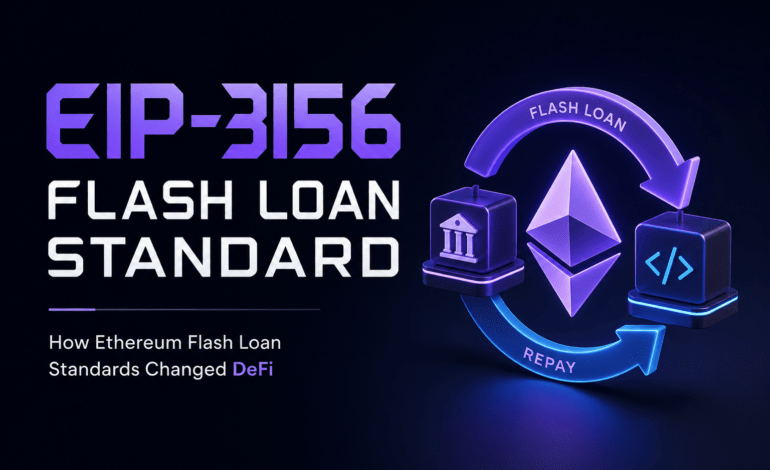
EIP-3156 flash loan standard introduced a unified interface for Ethereum flash loans, improving interoperability, security, and DeFi development.
Flash loans became one of the most revolutionary and controversial innovations in decentralized finance (DeFi).
They enabled users to borrow massive amounts of crypto instantly without collateral, as long as the funds were repaid within the same transaction. However, as flash loans grew in popularity, a major problem emerged: every protocol implemented them differently.
That fragmentation made integration difficult, increased security risks, and slowed developer adoption.
To solve this issue, Ethereum introduced the EIP-3156 flash loan standard, a proposal designed to standardize how flash loans work across DeFi protocols.
Today, EIP-3156 plays an important role in making flash loans more interoperable, secure, and developer-friendly across Ethereum’s expanding DeFi ecosystem.
What Is the EIP-3156 Flash Loan Standard?
The EIP-3156 flash loan standard defines a common interface for flash loan lenders and borrowers on Ethereum.
A flash loan allows users to borrow crypto assets without collateral under one strict condition:
- the borrowed funds must be repaid before the transaction ends.
If repayment fails, the entire transaction automatically reverts as if it never happened.
Before EIP-3156, protocols like Aave, dYdX, and Uniswap all used different flash loan implementations.
This forced developers to learn multiple systems and created unnecessary complexity across DeFi applications.
The EIP-3156 flash loan standard introduced a unified structure that protocols could adopt for better compatibility and safer integrations.
Why EIP-3156 Was Needed
The rapid growth of DeFi exposed several problems with early flash loan systems.
Fragmentation Across Protocols
Every protocol built its own custom flash loan interface. As a result, developers had to design separate integrations for different platforms.
This created:
- Compatibility issues
- Increased development overhead
- Greater security risks
- More room for implementation errors
According to the proposal, the lack of standardization was “bad for security when everyone is trying to design a secure mechanism on their own.”
Rising Security Concerns
Flash loans became associated with some of DeFi’s largest exploits because attackers could temporarily access enormous liquidity pools.
Without consistent standards, improper repayment checks and poorly designed implementations increased vulnerability risks.
Developer Adoption Challenges
Many developers avoided implementing flash loans because each system behaved differently.
The EIP-3156 flash loan standard aimed to simplify development while improving security and interoperability across the ecosystem.
How the EIP-3156 Flash Loan Standard Works
The standard introduces two primary interfaces:
1. IERC3156FlashLender
This interface is implemented by the lender protocol providing the flash loan.
Key functions include:
maxFlashLoan()
Returns the maximum amount available for borrowing of a specific token.
flashFee()
Calculates the fee required for borrowing a given amount.
flashLoan()
Initiates the flash loan process and transfers assets to the borrower contract.
2. IERC3156FlashBorrower
This interface is implemented by the borrower receiving the loan.
The borrower must implement:
onFlashLoan()
This callback function executes the borrower’s custom logic after receiving the loan.
Typical operations include:
- Arbitrage
- Liquidations
- Refinancing
- Collateral swaps
- Cross-protocol trading strategies
After execution, the borrower must repay the funds plus any fees before the transaction ends.
If repayment fails, the transaction reverts automatically.
Understanding Flash Loan Atomicity
One of the most important concepts behind flash loans is atomicity.
This means:
- either the entire transaction succeeds,
- or everything fails completely.
The EIP-3156 flash loan standard enforces this atomic repayment mechanism to reduce risk and maintain protocol security.
This structure is what makes uncollateralized borrowing possible in DeFi.
Real-World Use Cases of EIP-3156 Flash Loans
Flash loans are not just theoretical financial tools they power many real DeFi strategies today.
Arbitrage Trading
Arbitrage is one of the most common flash loan use cases.
A trader can:
- Borrow funds instantly
- Buy an asset cheaply on one exchange
- Sell it at a higher price elsewhere
- Repay the loan
- Keep the profit
The entire process happens within a single blockchain transaction.
Collateral Swaps and Refinancing
Flash loans also allow users to refinance debt positions without upfront capital.
For example:
- repay a loan on one protocol,
- retrieve collateral,
- move it to another platform with lower interest,
- borrow again,
- and repay the flash loan instantly.
This dramatically improves capital efficiency within DeFi.
Liquidations
DeFi liquidators frequently use flash loans to liquidate undercollateralized positions across lending protocols.
Because the borrowed funds exist temporarily, users can execute large liquidations without holding massive capital reserves themselves.
The Dark Side of Flash Loans
Despite their innovation, flash loans have also become infamous within crypto.
Attackers have used flash loans to:
- manipulate prices,
- exploit smart contract vulnerabilities,
- drain liquidity pools,
- and execute large-scale DeFi attacks.
The proposal itself acknowledges that flash loans are often used in exploits because they allow attackers to amplify vulnerabilities with borrowed capital.
However, flash loans themselves are not inherently malicious.
In many cases, exploits happen because of weak protocol design rather than the loan mechanism itself.
Security Improvements Introduced by EIP-3156
The EIP-3156 flash loan standard improves security through:
- standardized interfaces,
- repayment verification,
- borrower contract validation,
- and atomic transaction enforcement.
This reduces implementation mistakes and helps protocols integrate flash loans more safely.
The proposal also promotes clearer auditing practices because developers interact with consistent interfaces instead of custom implementations.
Why EIP-3156 Matters for Ethereum
EIP-3156 represents an important stage in Ethereum’s evolution toward modular and interoperable financial infrastructure.
Rather than reinventing flash loan systems repeatedly, developers can now build on a common standard.
This creates:
- Better cross-protocol compatibility
- Faster development cycles
- Improved user experiences
- Safer DeFi integrations
It also demonstrates how Ethereum Improvement Proposals continue refining the ecosystem through iterative standards and open collaboration.
Blockwisely Take
The EIP-3156 flash loan standard transformed flash loans from fragmented experimental tools into a reusable DeFi primitive.
While flash loans remain controversial because of their connection to high-profile exploits, they also represent one of DeFi’s most powerful innovations in capital efficiency and programmable finance.
As Ethereum continues evolving, standards like EIP-3156 will remain critical for balancing innovation, interoperability, and security across decentralized financial systems.
Sources