








How Decentralized Exchanges Work: Trading Crypto Without Middlemen

Cryptocurrency trading usually happens on platforms called exchanges. These platforms allow people to buy, sell, and swap digital assets like Bitcoin, Ethereum, and thousands of other cryptocurrencies.
Most beginners start with centralized exchanges such as Coinbase or Binance. These platforms act as intermediaries that hold users’ funds and process trades.
But blockchain technology introduced a different type of exchange.
These are called Decentralized Exchanges, often shortened to DEXs.
Decentralized exchanges allow users to trade cryptocurrencies directly from their wallets without relying on a central company to hold their funds.
DEXs have become a core part of the decentralized finance ecosystem, commonly known as DeFi.
Understanding how decentralized exchanges work can help beginners better understand how blockchain is transforming financial systems.
What Is a Decentralized Exchange (DEX)
A Decentralized Exchange (DEX) is a cryptocurrency trading platform that allows users to trade digital assets directly with each other using smart contracts.
Unlike centralized exchanges, decentralized exchanges do not hold users’ funds.
Instead, users connect their crypto wallets and interact directly with blockchain based smart contracts that execute trades automatically.
In simple terms, a decentralized exchange allows you to trade cryptocurrency without trusting a company to control your funds.
This model reflects one of the core ideas behind blockchain technology: removing intermediaries.
How Decentralized Exchanges Work
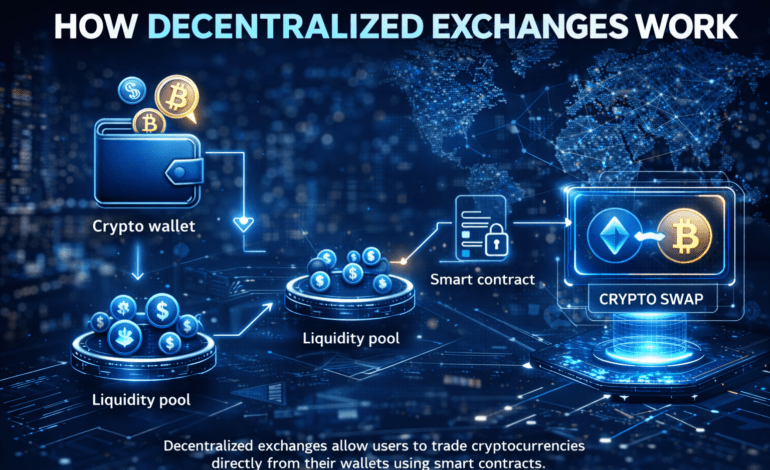
Decentralized exchanges operate using smart contracts, which are pieces of code deployed on blockchain networks.
These smart contracts automatically handle trading operations.
When a user makes a trade on a decentralized exchange, the process typically follows these steps:
First, the user connects a crypto wallet such as MetaMask or another Web3 wallet.
Second, the user selects the tokens they want to swap.
Third, the smart contract calculates the exchange rate based on the available liquidity.
Finally, the smart contract executes the trade directly on the blockchain.
Because the transaction occurs on the blockchain, it becomes publicly recorded and verifiable.
No central authority needs to approve or process the trade.
Liquidity Pools: The Engine Behind Most DEXs
Most modern decentralized exchanges rely on something called liquidity pools.
A liquidity pool is a collection of tokens deposited by users into a smart contract.
These pools allow traders to swap tokens instantly.
For example, a pool might contain:
Ethereum
USDC stablecoins
When someone wants to trade Ethereum for USDC, the smart contract uses the liquidity pool to complete the swap.
Users who deposit tokens into these pools are called liquidity providers.
In return for providing liquidity, they usually earn a portion of the trading fees generated by the exchange.
Automated Market Makers (AMMs)
Many decentralized exchanges use a system called an Automated Market Maker, or AMM.
Traditional exchanges rely on buyers and sellers placing orders in something called an order book.
AMMs work differently.
Instead of matching buyers and sellers directly, AMMs use mathematical formulas to determine token prices.
The most common formula used in many DEXs ensures that the ratio between two assets in a liquidity pool remains balanced.
When someone trades one token for another, the pool adjusts the prices automatically.
This system allows trades to happen instantly without requiring another trader on the opposite side of the transaction.
Examples of Popular Decentralized Exchanges
Several decentralized exchanges have become important platforms in the crypto ecosystem.
Some of the most well known include:
Uniswap on Ethereum
PancakeSwap on BNB Chain
Curve Finance for stablecoin trading
dYdX for decentralized derivatives
Each platform operates using smart contracts and liquidity pools, but they may specialize in different types of trading.
Many decentralized exchanges contribute to the broader Total Value Locked (TVL) across DeFi platforms. TVL across DeFi ecosystems can be tracked using platforms such as
https://defillama.com
Advantages of Decentralized Exchanges
Decentralized exchanges offer several advantages compared with traditional centralized platforms.
Users keep control of their funds
With a DEX, users trade directly from their wallets. This means the platform never holds custody of their assets.
Greater transparency
All transactions are recorded on public blockchains, which allows anyone to verify activity.
Permissionless access
Most decentralized exchanges allow anyone with a crypto wallet to trade without creating an account or completing identity verification.
Reduced censorship risk
Because DEXs operate using smart contracts on blockchain networks, it is more difficult for a single authority to shut them down.
Risks and Limitations of DEXs
Despite their advantages, decentralized exchanges also have several risks.
Smart contract vulnerabilities
If the smart contracts powering a DEX contain bugs, attackers may exploit them to steal funds.
Impermanent loss
Liquidity providers can experience losses if token prices change significantly after they deposit assets into liquidity pools.
Slippage
Large trades may move prices significantly in smaller liquidity pools.
User responsibility
Since users control their own wallets, losing private keys can result in permanent loss of funds.
For beginners, it is important to understand these risks before using decentralized exchanges.
How DEXs Changed the Crypto Industry
Decentralized exchanges played a major role in the growth of decentralized finance.
Before DEXs became popular, most crypto trading happened on centralized platforms.
DEXs introduced a new model where trading happens directly on blockchain networks.
This innovation allowed developers to build entire financial systems without relying on banks or centralized companies.
Today, decentralized exchanges support a wide range of financial services including:
Token swaps
Liquidity provision
Yield farming
Decentralized derivatives
Many blockchain ecosystems now include multiple decentralized exchanges competing to attract liquidity and users.
Frequently Asked Questions
What is a decentralized exchange in crypto?
A decentralized exchange is a trading platform that allows users to swap cryptocurrencies directly from their wallets using smart contracts.
Are decentralized exchanges safe?
DEXs can be secure, but they also carry risks such as smart contract vulnerabilities and user errors.
Do decentralized exchanges require accounts?
Most DEXs do not require traditional accounts. Users connect their crypto wallets instead.
What is the difference between a centralized exchange and a decentralized exchange?
Centralized exchanges hold users’ funds and manage trades internally. Decentralized exchanges allow users to trade directly from their wallets using blockchain based smart contracts.
Decentralized exchanges represent one of the most important innovations in the cryptocurrency ecosystem.
By allowing users to trade digital assets without intermediaries, DEXs demonstrate how blockchain technology can power open and permissionless financial systems.
For beginners exploring decentralized finance, understanding how decentralized exchanges work is an important step toward understanding the broader Web3 ecosystem.
As blockchain technology continues to evolve, decentralized exchanges will likely remain a key part of the global cryptocurrency infrastructure.