








The WikiLeaks Tweet That Proved Bitcoin Had a Real Use Case

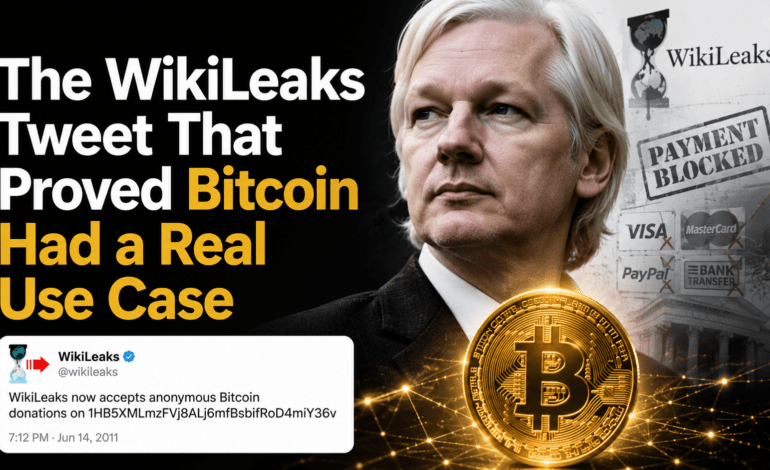
On June 14, 2011, WikiLeaks posted a simple message on X, then known as Twitter:
“WikiLeaks now accepts anonymous Bitcoin donations.”
At the time, Bitcoin was still young. It was not yet an institutional asset. There were no spot Bitcoin ETFs. There was no Wall Street race to accumulate BTC. There were no presidents, banks, or billion-dollar funds publicly discussing it the way they do today.
But that tweet showed something important.
Bitcoin was not just internet money. It was not just a strange experiment for developers and early adopters. It had a real use case.
It could move value when traditional financial companies refused to help.
What Is WikiLeaks?
WikiLeaks is a media organization and document archive that publishes leaked materials, including government, military, diplomatic, and corporate documents. It was founded in 2006 by Australian computer programmer and publisher Julian Assange. WikiLeaks describes itself as a multinational media organization and library, while Britannica describes it as an organization created to publish primary source materials with limited editorial commentary.
WikiLeaks became famous for publishing sensitive and classified documents that exposed government actions, wars, diplomacy, surveillance, and corporate conduct. Some of its best-known releases include the “Collateral Murder” video showing a 2007 U.S. helicopter attack in Baghdad, U.S. military war logs from Afghanistan and Iraq, and a large cache of U.S. diplomatic cables.
The organization became one of the most controversial publishers in the world. Supporters saw it as a tool for transparency and whistleblowing. Critics argued that its publications could endanger people, damage national security, and create diplomatic harm.
Julian Assange became the public face of WikiLeaks. He founded the organization in 2006 and led many of its most famous releases. His work with WikiLeaks later led to years of legal battles, including a long fight against extradition to the United States.
Why WikiLeaks Turned to Bitcoin
To understand why that tweet mattered, you have to go back to the financial pressure WikiLeaks was facing.
In 2010, WikiLeaks came under heavy global pressure after publishing U.S. diplomatic cables and other sensitive documents. Soon after, major financial companies stopped processing donations to the organization.
WikiLeaks said Bank of America, Visa, MasterCard, PayPal, and Western Union were involved in a financial blockade that began on December 7, 2010. According to WikiLeaks, the blockade destroyed about 95% of its revenue.
Reuters also reported in 2011 that Visa and MasterCard had stopped processing donations for WikiLeaks after the United States criticized the organization’s release of sensitive diplomatic cables.
For WikiLeaks, this created a serious problem.
It depended on public donations. But if major payment companies refused to process those donations, supporters could not easily send money.
That is where Bitcoin entered the story.
The 2011 Tweet That Made Bitcoin Useful
On June 14, 2011, WikiLeaks announced that it was accepting Bitcoin donations. Forbes covered the announcement the same day, describing Bitcoin as a fully digital currency that WikiLeaks was using to receive donations.
The tweet was short, but the message was powerful.
Traditional payment rails could be blocked. Bank transfers could be restricted. Card payments could be stopped. PayPal accounts could be frozen.
But Bitcoin offered another path.
Anyone with BTC could send value directly to a Bitcoin address. The transaction did not need approval from a bank, card network, or payment processor.
That was Bitcoin’s real-world use case.
It was money that could move without permission.
Bitcoin Was Still Tiny
This is easy to forget now, but in 2011 Bitcoin was still a small and risky experiment.
Most people had never heard of it. The technology was new. Exchanges were immature. Wallets were not beginner-friendly. Bitcoin’s price was volatile. The legal and regulatory questions around it were still unclear.
Even some early supporters worried that WikiLeaks using Bitcoin too early could attract unwanted government attention to the network.
WikiLeaks needed Bitcoin because it was being financially blocked. But Bitcoin was still too young to comfortably carry such a political use case.
Still, the moment happened.
And once it did, Bitcoin was no longer just theory.
What This Proved About Bitcoin
The WikiLeaks donation story proved one of Bitcoin’s most important ideas:
Money should be able to move without needing permission from powerful intermediaries.
This does not mean every person has to support WikiLeaks. People can disagree about WikiLeaks, its methods, and its politics.
But the financial lesson is bigger than one organization.
If a payment company can decide who receives money, then that payment company has power over speech, activism, journalism, business, and personal freedom.
Bitcoin challenged that model.
It showed that people could send value directly to each other through an open network.
No bank account was needed.
No card processor was needed.
No company had to approve the transaction.
That is why the tweet became part of Bitcoin history.
How WikiLeaks Helped Bitcoin’s Story
WikiLeaks did not create Bitcoin. But its use of Bitcoin helped show the world why Bitcoin could matter.
Before this, Bitcoin was often discussed as a technical experiment or a strange online currency. After WikiLeaks, people could see a clear use case.
Here was an organization that had been cut off by major financial companies. It needed donations. Bitcoin allowed supporters to send value anyway.
That was simple. It was visible. And it was powerful.
Bitcoin was no longer just an idea on a forum.
It was being used in the real world.
The Controversy Around the Use Case
This story is also controversial.
Some people argue that financial institutions have the right to avoid supporting organizations they consider risky. Others argue that payment companies should not have the power to financially silence publishers, activists, or political groups without due process.
That debate is still alive today.
Crypto does not remove the debate. It changes the battlefield.
Bitcoin gives individuals another option when centralized financial rails close. But it also forces society to ask hard questions about money, speech, regulation, and power.
That is why this tweet remains important.
It sits at the center of one of Bitcoin’s biggest questions:
Should money be controlled by institutions, or should people have a way to transact without permission?
FAQ
When did WikiLeaks start accepting Bitcoin donations?
WikiLeaks publicly announced that it was accepting Bitcoin donations on June 14, 2011.
Why did WikiLeaks accept Bitcoin?
WikiLeaks turned to Bitcoin after facing restrictions from major financial companies that stopped processing donations to the organization.
What did the WikiLeaks Bitcoin tweet prove?
It showed that Bitcoin could be used to receive value even when traditional payment companies refused to process payments.
Was Bitcoin popular in 2011?
No. Bitcoin was still very young and mostly known among early adopters, developers, and internet communities.
Is Bitcoin anonymous?
Bitcoin is not fully anonymous. Transactions are public on the blockchain. However, users can send and receive Bitcoin without needing a bank account or traditional payment processor.
Why is this story important today?
It reminds users that Bitcoin’s original value was not only price speculation. It was also about censorship-resistant payments and financial access.