







For years, conversations about blockchain adoption in Africa have often been reduced to a simple question:
Which blockchain is winning Africa?
The reality is far more nuanced.
Africa is not a single market. It is a continent of more than 1.4 billion people, over 50 countries, diverse regulatory environments, and vastly different economic challenges. As a result, no single blockchain ecosystem dominates the continent.
Instead, different regions have embraced different networks based on their unique needs. Some prioritize low-cost payments and remittances, while others focus on institutional adoption, mobile money integration, decentralized finance, or developer growth.
In 2026, Africa’s blockchain landscape is increasingly defined by regional specialization rather than continental dominance.
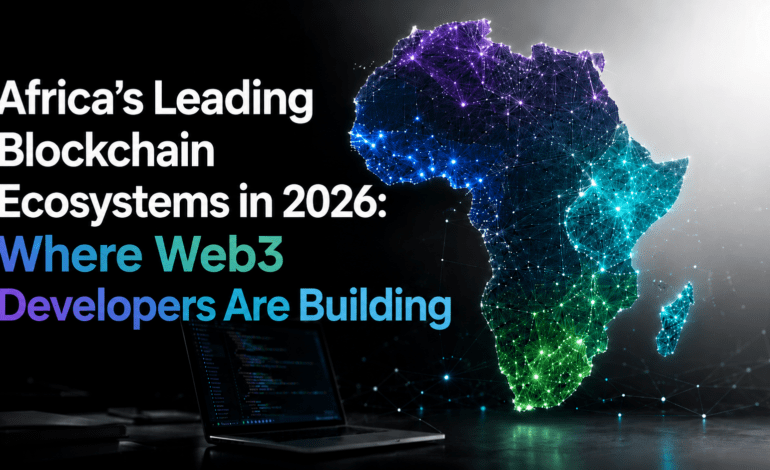
From Nigeria’s Solana-powered developer boom to South Africa’s institutional Ethereum ecosystem, here is a comprehensive look at where Web3 developers are building across Africa.
Why Africa’s Blockchain Landscape Is Different
Unlike North America or Europe, where blockchain adoption is often driven by investment activity and financial innovation, Africa’s growth is largely tied to solving real-world economic problems.
These include:
- Currency instability
- High inflation
- Expensive remittances
- Limited access to banking services
- Cross-border payment challenges
- Financial exclusion
- Lack of investment infrastructure
As a result, blockchain adoption in Africa is often more practical than speculative.
The most successful ecosystems are those that directly address these everyday challenges.
West Africa: Nigeria’s Solana Dominance and Ghana’s Multi-Chain Growth
Nigeria: Africa’s Solana Powerhouse
When discussing blockchain development in Africa, Nigeria stands out as one of the continent’s most important markets.
According to SuperteamNG’s Q1 2026 Impact Report, Nigerian developers account for approximately 67% of active Solana developers in Africa, placing the country sixth globally in Solana developer participation.
This achievement did not happen overnight.
Over the last three years, communities such as:
- SuperteamNG
- Web3bridge
- Web3Ladies
- Solana All Stars
- University blockchain clubs
have aggressively onboarded thousands of developers through hackathons, bootcamps, grants, workshops, and ecosystem events.
Why Solana Works in Nigeria
Several factors explain Solana’s popularity:
- Low transaction fees
- Fast transaction settlement
- Strong developer support
- Active grant programs
- Growing stablecoin infrastructure
Most importantly, Solana aligns with Nigeria’s financial realities.
Millions of Nigerians rely on stablecoins for:
- Savings
- International payments
- Remittances
- Inflation hedging
This creates natural demand for fast and affordable blockchain infrastructure.
Projects such as Evolution and NectarFi have demonstrated meaningful traction, while fintech platforms continue integrating Solana-powered solutions into their products.
Although Ethereum remains active in Nigeria, developer momentum currently favors Solana.
Ghana: The Emerging Sui and BNB Chain Hub
While Nigeria has become synonymous with Solana development, Ghana presents a different picture.
The country’s blockchain ecosystem is increasingly becoming a multi-chain environment, with strong activity around Sui and BNB Chain.
One major catalyst has been Sui’s growing partnership network across Africa.
Integrations involving fintech players and payment providers have helped position Sui as an attractive infrastructure layer for:
- Stablecoin payments
- Cross-border transactions
- Digital banking
- Mobile-first financial products
Why Ghana Is Different
Unlike Nigeria’s concentrated Solana ecosystem, Ghana’s blockchain growth is more diversified.
The country’s developers and startups tend to prioritize practical infrastructure over ecosystem loyalty.
This flexibility may ultimately become one of Ghana’s biggest strengths as multiple chains compete for adoption across Africa.
East Africa: Kenya’s Mobile Money Advantage
Kenya’s Multi-Chain Approach
Kenya occupies a unique position in Africa’s blockchain landscape.
Unlike Nigeria’s concentration around Solana or South Africa’s institutional Ethereum ecosystem, Kenya has embraced a more balanced, multi-chain approach.
The country shows activity across:
- Ethereum
- Stellar
- Solana
- Stablecoin infrastructure
Much of this can be attributed to Kenya’s long-standing leadership in mobile money innovation.
Platforms like M-Pesa transformed digital payments long before blockchain became mainstream.
As a result, Kenyan builders often focus on integrating blockchain into existing payment systems rather than replacing them entirely.
Why Kenya Matters
Kenya’s strengths include:
- Strong mobile penetration
- Digital payment culture
- Progressive regulatory discussions
- Fintech innovation
The country has become a testing ground for blockchain-powered remittances, tokenized financial products, and stablecoin payment systems.
While Kenya may not lead Africa in developer numbers, it remains one of the continent’s most important markets for practical blockchain adoption.
Southern Africa: South Africa’s Institutional Blockchain Leadership
Ethereum Leads the South African Ecosystem
South Africa’s blockchain sector differs significantly from much of the continent.
Rather than focusing on retail crypto adoption, South Africa has emerged as Africa’s leading institutional blockchain market.
Ethereum remains the dominant ecosystem.
The country’s developers and businesses are actively exploring:
- Tokenization
- Digital asset custody
- Enterprise settlement systems
- Stablecoin infrastructure
- Financial market modernization
The Regulatory Advantage
One major reason for South Africa’s leadership is regulatory clarity.
The country now has hundreds of licensed crypto asset service providers operating under a more structured framework.
This has encouraged:
- Institutional investment
- Corporate experimentation
- Banking sector participation
Compared to other African markets, South Africa prioritizes infrastructure quality and regulatory compliance over rapid retail expansion.
North Africa: Quiet but Growing
North Africa remains one of the least visible blockchain regions globally.
Countries such as Egypt continue to maintain restrictive regulatory environments, limiting public blockchain activity.
However, adoption continues beneath the surface.
Developers and startups across the region are increasingly experimenting with:
- Stablecoins
- Ethereum-based applications
- Cross-border payment systems
- Digital commerce infrastructure
As regulations evolve, North Africa could become one of the continent’s next major growth markets.
Ethereum Still Leads Africa Overall
While Solana dominates headlines in Nigeria, Ethereum remains Africa’s largest blockchain ecosystem overall.
Developer reports consistently show Ethereum maintaining the broadest developer base across the continent.
Its dominance is driven by:
- Mature tooling
- Institutional trust
- Large developer communities
- Extensive DeFi infrastructure
Meanwhile, Stellar continues to play an important role in remittances and financial inclusion initiatives.
Emerging ecosystems such as Starknet and Sui are also gaining traction among African developers seeking scalability and lower costs.
The Rise of Stablecoins Is Reshaping Everything
Regardless of blockchain preference, one trend unites Africa’s Web3 ecosystem:
Stablecoins.
Across the continent, users increasingly rely on dollar-backed digital assets for:
- Savings
- Cross-border transfers
- International commerce
- Freelance payments
- Business settlements
This explains why ecosystems optimized for fast, affordable transactions continue attracting developers.
The battle for Africa may ultimately be less about blockchain brands and more about who builds the best stablecoin infrastructure.
Fragmentation Is a Strength, Not a Weakness
Some observers view Africa’s multi-chain environment as a sign of fragmentation.
In reality, it may be one of the continent’s greatest strengths.
Different countries face different challenges.
As a result:
- Solana excels in Nigeria’s high-volume retail economy.
- Ethereum powers South Africa’s institutional sector.
- Stellar supports remittance-focused markets.
- Sui gains traction through fintech partnerships.
- Emerging chains continue experimenting with new models.
This diversity creates resilience and encourages innovation.
Rather than relying on a single ecosystem, Africa benefits from multiple networks competing to solve local problems.
Looking Ahead
The next phase of Africa’s blockchain growth will likely be driven by collaboration rather than competition.
Imagine:
- Nigerian Solana developers building payment rails.
- Kenyan fintech operators integrating mobile money.
- South African institutions providing regulatory frameworks.
- Ghanaian startups deploying multi-chain financial products.
Together, these strengths could position Africa as one of the world’s most important blockchain growth regions over the next decade.
The question is no longer which blockchain will dominate Africa.
The more important question is how Africa’s diverse blockchain ecosystems will collectively shape the future of global finance.
Sources
- Electric Capital Developer Report
- Chainalysis Africa Reports
- Stellar Development Foundation Ecosystem Updates
- Various ecosystem publications and developer community reports (2025–2026)
- Blockwisely