








Has AI Finally Cracked Encryption? What the RSA Rumours Mean for Bitcoin

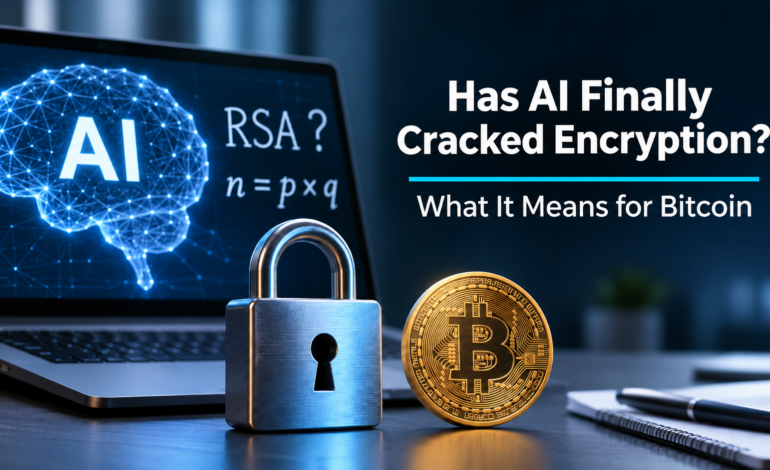
Artificial intelligence may be getting closer to solving some of mathematics’ most difficult problems. But new rumours that OpenAI or Anthropic has discovered a way to break RSA encryption have raised an alarming question: could AI eventually crack the cryptography protecting Bitcoin wallets?
The speculation emerged in late November 2026 after computer scientist Scott Aaronson discussed reports of possible cryptographic breakthroughs at leading AI laboratories.
At almost the same time, Google Research published new AI-generated mathematical work on integer factorization, a problem closely connected to RSA security.
The developments have attracted significant attention because a sufficiently efficient algorithm for factoring large numbers could undermine important cryptographic systems.
But the available evidence does not establish that modern RSA encryption has been broken.
And there is another important distinction.
Bitcoin does not use RSA to authorize transactions.
Its digital signatures rely on different mathematics.
So, what have AI researchers actually discovered, and how worried should cryptocurrency holders be?
Where Did the Rumours About AI Breaking RSA Begin?
The controversy gained momentum after Scott Aaronson, a computer scientist at the University of Texas at Austin, discussed reports of potentially significant discoveries at OpenAI and Anthropic.
In comments on his Shtetl-Optimized blog, Aaronson said he had heard repeated rumours that one or both laboratories might have found a way to solve integer factorization in polynomial time.
Researchers sometimes describe this possibility as “Factoring in P.”
If confirmed, such a discovery would represent a major change in computational mathematics.
However, Aaronson later clarified that he was much less certain about the exact nature of any undisclosed findings.
He said he had not personally examined the alleged cryptographic results or received a complete explanation directly from the laboratories.
He also warned that the details could have become distorted as rumours spread.
This distinction matters.
Aaronson was discussing information he had heard, not publishing a verified RSA-breaking algorithm.
As of November 27, no publicly available and independently verified result establishes that OpenAI or Anthropic has developed a practical method to break modern RSA encryption.
The controversy was also examined by Nature on November 26, which reported on the rumours and the questions they raised among computer scientists.
What Is RSA Encryption?
RSA is a public-key cryptographic system developed by Ron Rivest, Adi Shamir and Leonard Adleman in 1977.
It is used in digital security applications, including encryption and digital signatures.
The mathematics behind RSA involves multiplying very large prime numbers.
A prime number is a whole number greater than one that can only be divided evenly by one and itself.
For example, 7 and 11 are prime numbers.
Multiplying them gives 77.
That calculation is straightforward.
But suppose someone only gives you the number 77 and asks you to identify the two prime numbers that produced it.
For such a small number, the answer is easy to find.
Now imagine a number hundreds of digits long, created by multiplying two very large primes.
Identifying its original factors becomes much harder.
RSA uses carefully chosen mathematical relationships involving these numbers.
In ordinary RSA key construction, recovering the prime factors of the public modulus can allow an attacker to derive the private key.
That is why a major breakthrough in factoring large integers could have serious consequences for RSA security.
However, RSA is only one family of public-key cryptographic systems.
Different security technologies rely on different mathematical problems.
What Does “Factoring in P” Mean?
In computer science, P refers to a class of problems that can be solved using algorithms whose running time grows polynomially with the length of the input.
That sounds technical, but the main idea is relatively simple.
Imagine a mathematical problem involving a number with 100 digits.
Now imagine increasing the input to 1,000 digits.
Some algorithms become extraordinarily slow as the input grows.
Others require additional work that increases more manageably.
A polynomial-time factoring algorithm would be a major theoretical breakthrough because integer factorization has no known general-purpose classical polynomial-time algorithm.
It could have serious implications for RSA.
However, polynomial time does not automatically mean an algorithm is fast enough for every practical application.
Some polynomial-time algorithms have enormous constants or require substantial computing resources.
Researchers would still need to examine the algorithm’s real-world performance.
The more immediate point is that no publicly verified polynomial-time factoring algorithm has emerged from the OpenAI and Anthropic rumours.
What Has Google Research Actually Published?
While the rumours about OpenAI and Anthropic remain unverified, Google has released a concrete mathematical research paper.
On November 25, 2026, Google Research published work titled Unconditional Integer Factorization in Time L_N[1/3, O(1)].
The paper was generated through a mathematical research system called Cogentic, which uses Gemini 4 as its underlying AI model.
According to Google Research’s published documentation, the work describes a randomized algorithm for finding the prime factors of integers.
The researchers claim a worst-case expected running-time bound of:
L_N[1/3, 105]
This is an important theoretical result if its proof withstands scrutiny.
The claimed algorithm is unconditional, meaning its stated guarantee does not rely on the unproven number-theoretic assumptions identified in the paper.
Google also says the research system completed a formal mathematical proof using Lean 4, a tool used to check mathematical reasoning.
However, the repository states that the full formalization will be released in a companion submission.
That means the complete formal proof was not available for independent examination through the published README at the time of this review.
Does Google’s research break RSA?
No practical RSA-breaking result has been established by this publication.
The key distinction is that Google’s claimed algorithm is subexponential, not polynomial-time.
It therefore does not prove that factoring belongs to P.
The research may improve theoretical understanding of integer factorization.
But it does not demonstrate that attackers can efficiently factor modern RSA-2048 moduli using ordinary computing equipment.
Nor does the published documentation show successful practical attacks against deployed RSA keys.
It would be misleading to describe Google’s work as proof that RSA encryption has already collapsed.
Why Is Google’s Research Still Important?
The significance lies in the mathematical guarantee claimed by the paper.
Some established integer-factorization techniques have strong practical performance, but their mathematical complexity analyses may depend on assumptions or use different bounds.
Google’s work attempts to establish a rigorous, unconditional subexponential bound with explicit constants.
That could be valuable for theoretical computer science.
It also illustrates how AI systems may contribute to mathematical research.
Instead of merely answering questions or generating software code, AI systems are increasingly being used to develop mathematical arguments and explore difficult proofs.
However, new research requires scrutiny.
A mathematical paper can make an important claim without immediately establishing that the result is correct or useful in practice.
Independent examination, replication and proof verification remain essential.
Has OpenAI or Anthropic Actually Broken Encryption?
There is no publicly verified evidence that either company has broken modern RSA encryption.
The rumours discussed by Aaronson concern possible unpublished research.
They are not equivalent to a published algorithm with a complete proof and reproducible results.
For a claim of this magnitude, researchers would need to provide enough information for independent experts to assess the mathematics.
If the claim involved a practical attack, they would also need to demonstrate performance against relevant cryptographic key sizes.
An algorithm that works only on small numbers or special examples would not establish a practical break of RSA-2048.
Until such evidence becomes available, reports about an undisclosed RSA breakthrough should remain clearly labelled as speculation.
This is especially important because claims about broken encryption can create unnecessary panic among cryptocurrency holders and businesses.
Would Breaking RSA Also Break Bitcoin?
Not automatically.
Bitcoin uses cryptographic digital signatures to authorize transactions.
Its traditional signatures rely on the Elliptic Curve Digital Signature Algorithm, commonly called ECDSA.
Bitcoin’s Taproot upgrade introduced Schnorr signatures.
Both use the secp256k1 elliptic curve.
These details are described in the Bitcoin developer documentation and Bitcoin Improvement Proposal 340.
RSA and Bitcoin’s signature algorithms rely on different mathematical problems.
RSA’s security is closely connected to the difficulty of factoring large integers.
Bitcoin’s ECDSA and Schnorr signatures depend on the difficulty of solving the elliptic-curve discrete logarithm problem.
An algorithm that efficiently factors RSA moduli would not automatically solve that different problem.
Therefore, a confirmed breakthrough against RSA would not necessarily allow someone to recover Bitcoin private keys.
However, a separate mathematical breakthrough against elliptic-curve cryptography could create serious risks for Bitcoin.
No such general-purpose practical break has been established by the current research and rumours.
How Do Bitcoin Private Keys Work?
A Bitcoin private key is a secret number used to produce digital signatures.
The corresponding public key can be used to verify those signatures.
When someone spends Bitcoin, their wallet creates a valid signature proving that the transaction has been authorized using the relevant private key.
The network checks the signature without requiring the private key itself to be revealed.
This works because it is computationally easy to derive a public key from a private key.
But calculating the private key from the public key is believed to be extremely difficult using currently known practical classical algorithms.
That mathematical difference is a foundation of Bitcoin’s transaction security.
If an attacker found a practical way to reverse the process, they could potentially forge signatures for vulnerable keys.
But the current RSA factoring rumours do not establish that such a method exists.
Are Bitcoin addresses and public keys the same?
Not always.
Some Bitcoin address types represent hashes of public keys.
For certain older address types, the full public key becomes visible when the corresponding output is spent.
Other arrangements, including Taproot outputs, expose public-key-related information more directly.
These distinctions matter when examining hypothetical attacks that require knowledge of public keys.
However, hiding a public key behind a hash should not be treated as a complete solution to every possible future cryptographic threat.
Could AI Break Bitcoin Without Quantum Computers?
In principle, yes, if researchers discovered a sufficiently powerful algorithm against the mathematics Bitcoin relies on.
There is no rule that says a cryptographic breakthrough must come from quantum computing.
Mathematical research can reveal previously unknown weaknesses in algorithms.
AI could potentially help discover such weaknesses.
But possibility is different from proof.
There is no publicly verified AI-generated general-purpose algorithm that can efficiently recover arbitrary Bitcoin private keys from their public keys.
AI can also create other cryptocurrency security risks.
For example, attackers may use AI to produce convincing phishing messages, malicious software or fraudulent websites.
Those are real security concerns, but they do not mean Bitcoin’s underlying cryptography has been broken.
How Is This Different From Quantum Computing?
Quantum computing presents a separate mathematical challenge.
In 1994, mathematician Peter Shor developed a quantum algorithm capable of solving integer factorization and certain discrete logarithm problems efficiently on an appropriate quantum computer.
That is relevant to both RSA and elliptic-curve cryptography.
A sufficiently powerful fault-tolerant quantum computer could therefore threaten Bitcoin’s current signature algorithms.
However, the existence of Shor’s algorithm does not mean such a machine is currently available for breaking real-world keys.
Quantum computers must overcome major engineering problems involving scale, reliability and error correction.
The latest rumours about AI and RSA concern potential discoveries in classical algorithms.
They should not be confused with the development of practical quantum computers.
Is the World Already Preparing for Cryptographic Threats?
Yes.
Cryptography researchers and standards organizations have been preparing for potential quantum attacks for years.
In August 2024, the US National Institute of Standards and Technology finalized its first three major post-quantum cryptography standards.
According to NIST’s official announcement, these include:
- FIPS 203: ML-KEM, used for establishing shared secrets.
- FIPS 204: ML-DSA, a digital signature standard.
- FIPS 205: SLH-DSA, a hash-based digital signature standard.
These standards provide alternatives intended to resist attacks by sufficiently capable quantum computers.
Their development began long before the November 2026 AI factoring rumours.
Bitcoin would require carefully designed protocol changes to introduce new transaction signature arrangements.
Any such changes would involve substantial technical review and adoption across the ecosystem.
Should Bitcoin Holders Be Worried Right Now?
The developments deserve attention, but the evidence does not establish an immediate cryptographic emergency.
No publicly verified practical attack has demonstrated that AI can derive arbitrary Bitcoin private keys from public keys.
For most cryptocurrency users, more familiar security threats remain important.
These include phishing, malicious wallet applications, stolen recovery phrases, compromised devices and fraudulent exchanges.
A person claiming that AI software can unlock any Bitcoin wallet should be treated with considerable scepticism unless independently verifiable technical evidence exists.
Users should continue protecting private keys and recovery phrases, keeping wallet software updated and following credible security research.
The current rumours do not provide evidence-based grounds for assuming that every Bitcoin wallet is compromised.
What Would Prove That AI Has Actually Broken RSA?
A credible result would require a clearly described algorithm and supporting mathematical evidence.
Independent researchers would need to examine the proof and establish whether it is correct.
For a practical RSA break, the technique would also need to work against relevant key sizes within feasible time and resource limits.
Recovering the prime factors of a small example number would not be enough.
Similarly, claims about Bitcoin would require a demonstrated attack against the mathematics or implementation of its actual signature algorithms.
That is why reproducibility matters.
Scientific claims become much stronger when other experts can inspect and independently verify them.
A viral social media post does not meet that standard.
Frequently Asked Questions
Has AI cracked RSA encryption?
No publicly verified practical break of modern RSA encryption has been established by the research and rumours discussed here.
Did OpenAI or Anthropic discover a secret factoring algorithm?
Scott Aaronson discussed rumours of significant undisclosed results, but the specific factoring claim has not been publicly verified.
What did Google publish?
Google released AI-generated research claiming an unconditional subexponential algorithm for integer factorization.
Is Google’s algorithm polynomial-time?
No. The published running-time bound is subexponential, not polynomial.
Does Bitcoin use RSA?
No. Bitcoin uses ECDSA and Schnorr signatures based on elliptic-curve cryptography.
Would breaking RSA automatically break Bitcoin?
No. The mathematical problems involved are different.
Can AI currently calculate Bitcoin private keys?
There is no publicly verified general-purpose AI breakthrough demonstrating that capability.
Could quantum computing threaten Bitcoin?
Yes. A sufficiently capable fault-tolerant quantum computer could threaten Bitcoin’s current signature algorithms.
Has Google released its complete formal proof?
Google says a Lean 4 formalization has been completed and will be released separately. The complete formalization was not publicly available through the examined repository README.
Is Bitcoin already quantum-resistant?
Bitcoin’s current ECDSA and Schnorr signatures are not designed to resist a sufficiently powerful quantum attack.
Should Bitcoin holders move their funds because of these rumours?
The available evidence does not establish a new immediate cryptographic threat requiring a general migration of Bitcoin holdings.
Key Takeaways
- Scott Aaronson discussed unverified rumours of AI cryptography breakthroughs.
- The specific claim that OpenAI or Anthropic has discovered polynomial-time integer factorization remains unconfirmed.
- Google published AI-generated research on integer factorization on November 25, 2026.
- Google’s paper claims a subexponential factoring algorithm, not a polynomial-time solution.
- A practical break of modern RSA has not been demonstrated by the published research.
- Bitcoin does not rely on RSA for transaction signatures.
- Bitcoin uses ECDSA and Schnorr signatures based on secp256k1.
- An RSA factoring breakthrough would not automatically reveal Bitcoin private keys.
- Quantum computing remains a separate long-term cryptographic concern.
- Independent verification is essential before declaring any cryptographic system broken.
Editor’s note: This article was reviewed using Scott Aaronson’s original commentary, Google Research’s published mathematical work, Bitcoin’s technical specifications and NIST’s official standards. Research claims are distinguished from independently verified practical attacks. The publicly discussed OpenAI and Anthropic RSA rumours remain unconfirmed as of November 27, 2026.