



Anthropic Prepares for $1.4 Trillion IPO as Wall Street Bets on the Future of AI

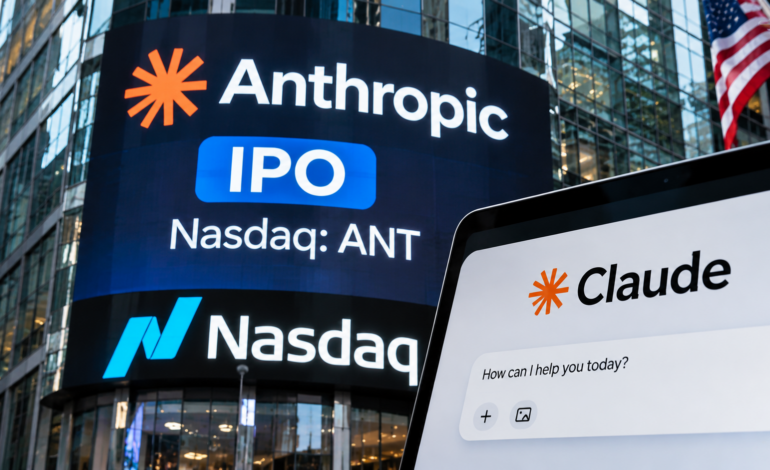
Anthropic, the artificial intelligence company behind Claude, is preparing for a potentially historic stock market debut on November 19, 2026. The company is offering 825 million shares at an estimated price of $70 to $78 each, in a listing that could value the business at approximately $1.4 trillion.
If completed at the upper end of the proposed range, the offering would have a gross value of approximately $64.35 billion before underwriting costs and other expenses.
The planned listing has attracted significant attention from Wall Street investors, who are weighing Anthropic’s rapid revenue growth against the enormous costs involved in developing and operating advanced AI systems.
According to Anthropic’s November 17 filing with the US Securities and Exchange Commission, the company plans to list its Class A shares on the Nasdaq Global Select Market under the ticker ANT.
The proposed listing date is November 19.
However, the IPO has not yet been completed as of November 18.
The final offer price, amount raised, and public-market valuation will depend on the completed transaction and subsequent trading.
What Has Anthropic Announced?
Anthropic has filed an updated registration statement detailing its proposed initial public offering.
An initial public offering, or IPO, is the process through which a private company sells shares to public investors and begins trading on a stock exchange.
Before an IPO, ownership is generally held by founders, employees, private investment funds, and other existing investors.
After listing, eligible investors can buy or sell publicly traded shares through brokerage accounts.
Anthropic plans to offer a total of 825 million Class A shares.
Of those, approximately 801.35 million shares are being sold by Anthropic itself.
The remaining 23.65 million shares are being sold by existing stockholders.
That distinction matters because Anthropic will not receive the proceeds from the sale of shares owned by selling stockholders.
The company expects its shares to trade on Nasdaq under the symbol ANT.
Key Anthropic IPO details
| Detail | Proposed terms |
|---|---|
| Company | Anthropic, PBC |
| Product | Claude AI |
| Proposed exchange | Nasdaq |
| Ticker | ANT |
| Total shares offered | 825 million |
| New company shares | Approximately 801.35 million |
| Existing shareholder shares | Approximately 23.65 million |
| Estimated offer price | $70–$78 |
| Gross offering value at $78 | $64.35 billion |
| Proposed valuation | Up to approximately $1.4 trillion |
| Expected debut | November 19, 2026 |
These details come from Anthropic’s November 17 amended SEC registration statement.
How Much Money Could Anthropic Raise?
At the upper end of the proposed $78 price range, the 825 million shares being offered would have a combined gross value of $64.35 billion.
However, the full amount would not go to Anthropic.
The company is selling approximately 801.35 million new shares.
At $78 per share, those shares would have a gross value of approximately $62.51 billion.
The remaining shares are being offered by existing stockholders.
Their proceeds would go to the sellers rather than Anthropic.
These figures are calculated before underwriting expenses, commissions, and other offering costs.
The exact amount of new capital received will depend on the final IPO price and completed offering terms.
Does a $1.4 trillion valuation mean Anthropic has $1.4 trillion?
No.
A company’s market valuation is not the same as the amount of cash it holds.
For example, if a company has one billion shares and each share trades at $100, its market capitalization would be $100 billion.
That does not mean the company has $100 billion in its bank accounts.
Similarly, Anthropic’s proposed $1.4 trillion valuation represents an estimate of the value investors may assign to the company’s equity.
It is not cash that Anthropic has already raised.
How Fast Is Anthropic Growing?
Anthropic has reported extraordinarily rapid revenue growth.
According to its SEC registration statement, revenue reached approximately $33.24 billion during the nine months ending September 30, 2026.
That compares with approximately $2.55 billion during the same period in 2025.
The increase represents growth of roughly 1,206%.
The company also reported approximately $4.59 billion in revenue for the full year 2025.
These are company financial disclosures, not forecasts of future revenue.
Anthropic revenue figures
| Reporting period | Revenue |
|---|---|
| Full year 2024 | $386 million |
| Full year 2025 | $4.59 billion |
| January–September 2025 | $2.55 billion |
| January–September 2026 | $33.24 billion |
The figures show how quickly the company has expanded.
However, its registration statement explicitly warns that such growth rates may not continue.
An AI company can experience rapid early adoption without maintaining the same pace indefinitely.
Where Is Anthropic’s Revenue Coming From?
Anthropic develops Claude, a family of AI models used for writing, programming, research, data analysis, and business applications.
The company provides services through consumer products, developer tools, and enterprise offerings.
Many organizations use Claude through application programming interfaces, commonly called APIs.
An API allows a software application to communicate with an AI model.
For example, a customer-service company could build an application that sends customer questions to Claude and receives suggested responses.
Another business might use Claude to summarize documents or assist software developers.
Anthropic earns revenue from subscriptions, usage-based services, and commercial agreements.
Its filing reports growing demand from large business customers.
However, revenue growth alone does not establish that every business customer is profitable for Anthropic to serve.
The company must also pay for the computing resources needed to run its models.
Why Is AI So Expensive?
Building advanced AI models requires substantial computing infrastructure.
Companies need specialized processors, data centres, electricity, networking equipment, technical staff, and other resources.
Training a model can involve enormous numbers of calculations.
Once a model is trained, serving customer requests also requires computing capacity.
This second activity is called inference.
For example, when someone asks Claude to analyze a document, the system performs calculations to generate a response.
The more customers use the service, the more computing capacity the company may need.
How much is Anthropic spending on computing?
Anthropic reported approximately $18.81 billion in compute and infrastructure expenses during the first nine months of 2026.
That compares with approximately $4.38 billion during the same period in 2025.
This represents a substantial increase in spending.
However, revenue grew even faster during that period.
Compute and infrastructure expenses represented approximately 57% of revenue in the first nine months of 2026, down from 172% in the comparable period of 2025.
That is an improvement in the company’s reported cost relationship.
Still, AI infrastructure remains extremely expensive.
Anthropic’s filing also describes substantial future computing commitments and financial obligations.
Investors must therefore consider whether the company’s revenue growth can support its long-term investment requirements.
Is Anthropic Profitable?
The answer depends on the financial measurement used.
Anthropic reported an operating loss of approximately $1.3 billion during the nine months ending September 30, 2026.
That was an improvement from an operating loss of approximately $5.2 billion during the same period in 2025.
However, its financial statements also include substantial non-operating and non-cash accounting effects related to financing arrangements and changes in the value of certain liabilities.
These can make reported net losses much larger than operating losses.
That distinction is important.
An operating loss measures the difference between operating revenue and operating expenses under the company’s accounting arrangements.
A net loss may also include financing costs, taxes, changes in the fair value of liabilities, and other items.
Investors should not confuse revenue growth with net profitability or cash generation.
The IPO valuation will depend partly on whether investors believe Anthropic can eventually generate sustainable profits and positive cash flow.
Why Are Investors Excited About the Anthropic IPO?
Anthropic is one of the best-known developers of advanced AI models.
Its Claude products compete in a rapidly developing industry where companies and individuals are incorporating AI into everyday work.
The IPO would give public-market investors a more direct opportunity to own shares in a leading AI model developer.
According to Reuters’ November 18 report, banks, investment firms, and other market participants are preparing products and events around the potential listing.
Some investment companies are also exploring funds designed to provide leveraged exposure to Anthropic shares.
Leverage can increase potential gains, but it can also amplify losses.
Investors should understand those risks before purchasing such products.
Reuters also reports that up to 20% of IPO shares have been set aside for retail investors.
That is an offering allocation arrangement, not a guarantee that every individual investor will receive shares.
Are All Investors Convinced About the Valuation?
No.
The proposed valuation has created debate.
Some investors believe AI companies may generate enormous revenue as organizations adopt AI across more activities.
Others are concerned that valuations have grown faster than sustainable earnings.
Anthropic’s proposed $1.4 trillion valuation is particularly large for a company that has only recently begun reporting revenue at its current scale.
Investors must assess several risks.
These include competition, infrastructure costs, the possibility of slower revenue growth, regulatory developments, and the difficulty of predicting how the AI market will evolve.
Reuters reported that some institutional fund managers were unwilling to purchase shares at the proposed valuation.
That does not mean the IPO will fail.
It means different investors disagree about the price they are prepared to pay.
Why Does Anthropic Have an Unusual Governance Structure?
Anthropic is organized as a Delaware public benefit corporation.
This structure requires the company to consider its public benefit purpose alongside the financial interests of stockholders.
Its stated purpose includes the responsible development and maintenance of advanced artificial intelligence.
The company has also established a Long-Term Benefit Trust.
According to its SEC filing, the trust has special governance powers intended to influence how the company balances commercial objectives with AI safety considerations.
These arrangements are relevant for investors because they can affect who controls important corporate decisions.
A person purchasing Class A shares should not assume those shares provide the same governance influence as other classes of stock.
The filing describes several share classes and specialized voting arrangements.
Investors should examine those details before making decisions.
Could Anthropic’s IPO Affect Other AI Companies?
Potentially.
A successful listing could give investors a new reference point for valuing advanced AI companies.
It may also affect the expectations of startups and venture capital investors.
For example, a high public-market valuation could encourage investment in AI infrastructure, developer tools, and companies building applications around large language models.
However, it could also increase pressure on AI businesses to demonstrate revenue and profitability.
If the IPO performs poorly, investors may become more cautious about paying high valuations for companies with significant computing expenses.
Either outcome could influence private fundraising.
But the extent of those effects cannot be predicted from the proposed IPO terms alone.
What Could This Mean for African AI Startups?
African AI startups often depend on international technology providers for computing infrastructure and access to advanced models.
The financial performance of companies such as Anthropic may influence the pricing and availability of AI services worldwide.
For example, a startup in Kenya could use Claude to power a customer support system.
If the cost of accessing the model changes, the startup’s operating expenses could also change.
International investment sentiment may influence funding for companies developing AI applications in African markets.
However, the IPO does not automatically create new funding opportunities for African businesses.
Nor does it guarantee cheaper AI services.
The effects will depend on commercial decisions, competition, pricing, and broader market conditions.
What should African developers learn?
One important lesson concerns the difference between building advanced AI models and developing applications that use them.
Training a large general-purpose model requires substantial resources.
Building useful products around existing AI models may be possible with much smaller budgets.
African developers can focus on applications involving local languages, education, healthcare, agriculture, financial services, and business automation.
The commercial opportunity depends on solving problems customers are willing to pay for.
Anthropic’s IPO highlights the scale of investment going into the underlying technology.
It also raises questions about how smaller businesses can participate in the AI economy without needing to build enormous data centres themselves.
What Happens on November 19?
Anthropic is expected to begin trading on Nasdaq under the ticker ANT.
However, the final offer price and completed financing amount have not yet been confirmed in the November 17 registration statement.
The share price may change after trading begins.
For example, strong demand could push the market price above the offering price.
Weak demand could cause it to fall.
The first trading day will therefore provide additional information about how public-market investors value the company.
But even a strong debut would not guarantee future returns.
Blockwisely Take: Anthropic’s IPO Could Become a Defining Test for the AI Investment Boom
Anthropic’s proposed IPO is important because it will give public investors an opportunity to evaluate a leading AI model developer using actual financial disclosures.
For years, much of the debate around advanced AI companies has focused on their potential.
Investors have discussed how AI could change software development, office work, customer service, research, and many other industries.
Anthropic’s filings now offer a clearer view of the economics behind that ambition.
The company’s reported revenue growth is extraordinary.
But so is its spending on computing infrastructure.
That creates an important question.
Can an AI company continue growing quickly enough to justify such a high valuation while managing the cost of building and operating increasingly powerful models?
For African startups, there is another lesson.
Success in AI does not require every company to develop its own frontier model.
Many of the most useful business opportunities may involve applying existing AI systems to local problems.
Anthropic’s IPO could influence the cost, availability, and development of those systems.
But investors should distinguish the industry’s potential from the price of an individual company’s shares.
A promising technology does not automatically make every valuation a good investment.
The most important test will be whether Anthropic can turn its rapid growth into a sustainable business over time.
Frequently Asked Questions
Is Anthropic going public?
Anthropic has filed for an IPO and is preparing to list shares on Nasdaq, with trading expected to begin on November 19, 2026.
What is Anthropic’s proposed valuation?
The company could be valued at approximately $1.4 trillion at the upper end of the proposed offering terms.
What is Anthropic’s stock ticker?
The proposed Nasdaq ticker is ANT.
How much will Anthropic shares cost?
The November 17 registration statement estimates an IPO price range of $70 to $78 per share. The final price has not yet been confirmed.
How much could the IPO raise?
The 825 million shares offered have a gross value of up to $64.35 billion at $78 per share. Some proceeds would go to selling stockholders.
What is Claude?
Claude is Anthropic’s family of AI models and products used for tasks such as writing, coding, analysis, and business applications.
Is Anthropic profitable?
The company reported an operating loss of approximately $1.3 billion for the nine months ending September 30, 2026, despite rapid revenue growth.
How much revenue does Anthropic generate?
Anthropic reported approximately $33.24 billion in revenue during the first nine months of 2026.
Can Kenyan investors buy Anthropic shares?
Access depends on whether a brokerage offers trading in US-listed shares to eligible Kenyan residents and the applicable legal, tax, and platform requirements.
Will Anthropic shares rise after the IPO?
There is no guarantee. The market price could rise or fall depending on demand, financial performance, valuations, and broader market conditions.
Key Takeaways
- Anthropic is preparing for a Nasdaq IPO expected on November 19, 2026.
- The proposed ticker is ANT.
- The company plans to offer 825 million shares.
- The estimated price range is $70–$78 per share.
- The gross value of the offering could reach approximately $64.35 billion.
- The proposed company valuation is approximately $1.4 trillion at the upper end.
- Anthropic reported $33.24 billion in revenue during the first nine months of 2026.
- Its computing infrastructure expenses reached approximately $18.81 billion during the same period.
- Its reported operating loss was approximately $1.3 billion.
- The IPO’s final price, proceeds, and public-market performance remain uncertain.