




Binance Hit by $6.3 Billion Security Breach, Freezes $3 Billion as Investigation Continues

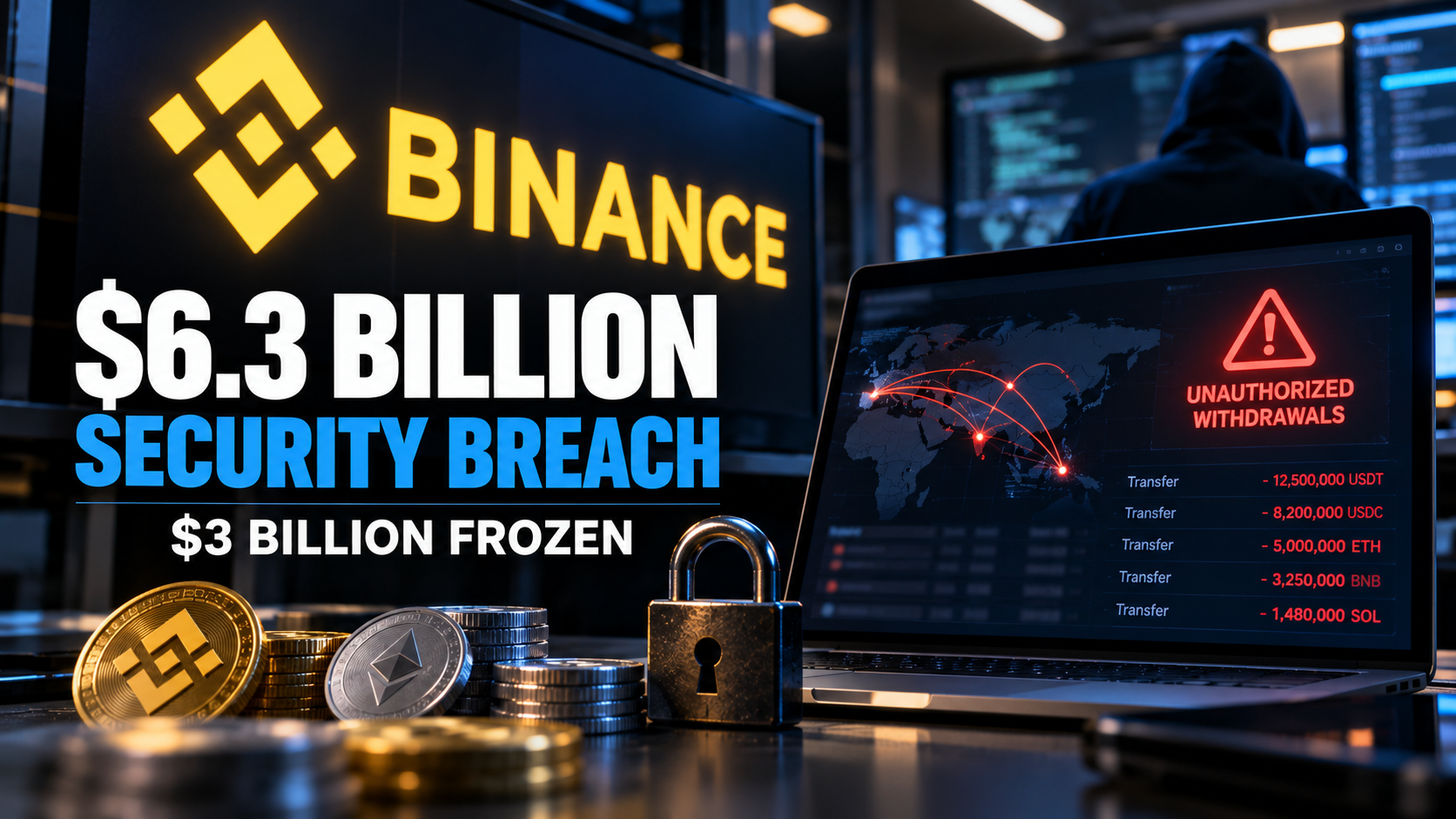
Binance, the world’s largest cryptocurrency exchange by trading volume, has reported a major security breach affecting an estimated $6.3 billion in digital assets. The exchange says approximately $3 billion has been frozen as investigators work to trace stolen funds and determine how the attack happened.
The incident began on October 29, 2026, and was publicly addressed in an official Binance security update published on October 30.
According to Binance, its preliminary investigation suggests that attackers may have compromised a laptop belonging to one of its DevOps engineers. The attackers allegedly used the compromised device to gain access to internal infrastructure and submit unauthorized cryptocurrency withdrawal transactions.
The exchange temporarily suspended deposits and withdrawals while carrying out security checks.
Binance has promised to compensate affected customers using its Secure Asset Fund for Users (SAFU) and company funds.
If the reported losses are confirmed, the incident would be the largest cryptocurrency theft ever recorded, surpassing the approximately $1.5 billion stolen from Bybit in February 2025.
However, investigators are still determining the full circumstances of the breach, the exact amount stolen, and how much can ultimately be recovered.
What Happened to Binance?
Binance confirmed that it was investigating a security incident after reports of suspicious cryptocurrency movements emerged on October 29.
In its October 30 announcement, the exchange disclosed that the estimated financial impact was approximately $6.3 billion.
The company said it had coordinated with blockchain networks, stablecoin issuers, and other industry partners to freeze approximately $3 billion worth of affected assets.
The remaining amount had not been confirmed as recovered at the time of the announcement.
Blockchain investigation companies, including Chainalysis, also began tracing the unauthorized transactions.
According to Reuters’ reporting on the incident, the suspected attack affected multiple blockchain networks and triggered a rapid response from cryptocurrency companies.
The incident raises concerns about the security of centralized cryptocurrency exchanges, particularly their internal systems for approving and processing withdrawals.
What we know so far
| Detail | Reported information |
|---|---|
| Exchange affected | Binance |
| Incident date | October 29–30, 2026 |
| Estimated financial impact | Approximately $6.3 billion |
| Assets frozen | Approximately $3 billion, according to Binance |
| Possible entry point | Compromised DevOps engineer’s laptop |
| Suspected activity | Unauthorized cryptocurrency withdrawals |
| Wallet private keys | Binance says no evidence of leakage |
| Customer compensation | Binance promises to cover losses |
| Investigation | Ongoing |
These figures reflect preliminary findings and may change as the investigation continues.
How Did the Binance Security Breach Happen?
Binance’s initial investigation points to a possible compromise of a DevOps engineer’s laptop.
A DevOps engineer is a technology professional who helps develop, maintain, and operate software systems and infrastructure.
Such employees may work with servers, deployment tools, automated processes, and systems that keep online services running.
According to Binance, the compromised laptop may have allowed attackers to access a service container within its infrastructure.
A service container is an isolated software environment used to run an application or part of a larger system.
In this case, investigators suspect that the attackers used access to the container to submit withdrawal transactions that should not have been authorized.
What might the attack have involved?
Based on Binance’s preliminary explanation, the suspected sequence was:
- An attacker gained unauthorized access to an engineer’s laptop.
- The compromised device provided a route into part of Binance’s infrastructure.
- The attacker accessed a service container.
- Unauthorized cryptocurrency withdrawals were submitted.
- Funds were transferred to external blockchain addresses.
- Binance and its partners began tracing and freezing affected assets.
This sequence is based on preliminary company findings rather than a completed forensic investigation.
Binance has not yet published a detailed technical explanation establishing exactly how the laptop was compromised, which permissions were abused, or what security controls failed.
The company says a full technical report will follow once the investigation is complete.
Were Binance’s Private Keys Stolen?
Binance says investigators have not found evidence that its wallet private keys were leaked.
This distinction is important.
A cryptocurrency private key is a secret value that allows its holder to authorize transactions from a cryptocurrency wallet.
If attackers obtain a wallet’s private key, they may be able to move the associated funds without needing access to the owner’s exchange account or internal systems.
However, unauthorized cryptocurrency transfers can also occur without a private key being directly stolen.
For example, an attacker who compromises a system responsible for approving withdrawals may be able to misuse that system’s existing authorization capabilities.
That is one possible explanation for how cryptocurrency could leave a platform even if private keys remain protected.
The current Binance investigation appears to be examining this type of internal infrastructure compromise.
However, the company has not yet established the complete attack mechanism publicly.
The absence of evidence of a private-key leak does not mean the breach was harmless or that all relevant security controls worked as intended.
How Much Cryptocurrency Was Stolen?
Binance estimates that the incident affected approximately $6.3 billion in digital assets.
Independent blockchain investigators have reported related but not identical figures.
For example, Chainalysis said it had confirmed at least $5.912 billion in stolen assets during its early investigation, according to comments reported by Reuters.
The difference matters because analysts may calculate losses using different blockchain snapshots, asset prices, transaction classifications, and recovery assumptions.
Cryptocurrency prices also change continuously, which can affect the reported dollar value of transferred assets.
How Did Binance Freeze $3 Billion in Stolen Cryptocurrency?
One of the most important developments was the rapid coordination between Binance and other cryptocurrency companies.
Binance says approximately $3 billion in affected assets was frozen on-chain.
This was possible partly because certain cryptocurrencies, particularly centrally issued stablecoins, have mechanisms that allow authorized issuers to block specific addresses from transferring tokens.
How can a cryptocurrency be frozen?
Not all cryptocurrencies work the same way.
Bitcoin, for example, does not have a central issuer that can simply freeze a particular wallet using an administrator-controlled token contract.
However, some stablecoins operate through smart contracts that give their issuers certain administrative powers.
A smart contract is software that runs on a blockchain and follows predefined rules.
Depending on how a stablecoin is designed, its issuer may be able to block a wallet address or prevent particular tokens from moving.
This can be useful when responding to theft, fraud, sanctions, or court orders.
It also means that some stablecoins operate differently from decentralized cryptocurrencies such as Bitcoin.
Tether and Circle helped freeze assets
According to Associated Press, stablecoin issuers Tether and Circle froze substantial amounts connected to the incident.
Tether reportedly froze more than $1.5 billion in USDT.
Circle reportedly froze more than $800 million in USDC.
Other blockchain organizations and token issuers also participated in efforts to restrict the movement of affected funds.
These actions helped prevent some stolen assets from being moved or exchanged further.
However, freezing cryptocurrency is not the same as returning it to the victim.
The assets may remain blocked while companies coordinate with investigators, law enforcement, and other relevant parties.
Is Binance Safe After the Hack?
Binance says customer funds are safe and has promised to cover all losses arising from the incident.
In its official statement, the exchange said it would use its SAFU fund and company resources to compensate affected users.
The SAFU fund is a reserve created by Binance to provide an additional source of financial protection in certain emergencies.
The company also announced that it would publish an updated Proof of Reserves after completing its security remediation.
What is Proof of Reserves?
Proof of Reserves is a method cryptocurrency exchanges use to provide information about assets they hold in custody.
It can help customers assess whether an exchange controls sufficient on-chain assets to support reported balances.
However, Proof of Reserves alone does not necessarily provide a complete picture of an exchange’s financial position.
For example, a reserve disclosure may not independently establish all liabilities, operational risks, or financial obligations.
An updated Proof of Reserves could provide useful information following the Binance incident, but it would not replace a complete independent financial assessment.
Are customers guaranteed to receive compensation?
Binance has publicly committed to covering all losses.
However, the actual compensation process, eligibility rules, and final amounts have not yet been fully documented in the available announcements.
Customers should follow official Binance communications for information relevant to their accounts.
Why Did Binance Suspend Deposits and Withdrawals?
Binance temporarily suspended deposits and withdrawals as a precaution while investigating the breach.
The exchange said the suspension would allow its security teams to inspect affected systems and prevent further unauthorized activity.
It also revoked authorization associated with the affected address and engaged law enforcement and blockchain intelligence companies.
Temporarily restricting withdrawals during a serious security incident can help an exchange prevent additional losses.
However, such restrictions can also create uncertainty for customers who need access to their funds.
At the time of the initial announcement, Binance had not provided a confirmed time for the complete restoration of all deposit and withdrawal services.
Users should check the exchange’s official status updates rather than assume that every cryptocurrency or blockchain network has resumed normal operations.
Was North Korea Behind the Binance Hack?
Several blockchain intelligence companies have reportedly attributed the attack to hackers associated with North Korea.
According to Reuters, investigators including TRM Labs and Chainalysis identified patterns they believe are consistent with North Korean-linked activity.
Such assessments may consider transaction behavior, infrastructure, techniques, and similarities to previous attacks.
However, Binance has not publicly confirmed the identity of the attackers.
The attribution should therefore be treated as a finding reported by security researchers, not a proven conclusion from a completed investigation.
North Korean-linked groups have previously been associated with major cryptocurrency thefts, including the February 2025 Bybit incident.
That history provides context but does not independently prove responsibility for the Binance breach.
Could This Be the Biggest Cryptocurrency Hack in History?
Yes, if the reported figures are confirmed, the incident would surpass previously documented cryptocurrency thefts by a substantial margin.
The February 2025 Bybit breach involved approximately $1.5 billion in stolen cryptocurrency.
The Binance incident’s estimated $6.3 billion impact is more than four times that amount.
Other major cryptocurrency thefts have included attacks on decentralized finance protocols, cross-chain bridges, and centralized platforms.
A major difference between such incidents is the method used.
Some attacks exploit weaknesses in smart contracts.
Others involve stolen private keys, compromised employees, fraudulent transactions, or failures in internal authorization systems.
The latest Binance incident appears, based on preliminary reporting, to involve unauthorized access to internal operational infrastructure.
The final classification will depend on Binance’s technical investigation.
How Did the Binance Hack Affect Bitcoin and Cryptocurrency Prices?
Cryptocurrency markets reacted negatively to news of the incident.
Reuters reported that Bitcoin fell more than 3%, reaching a six-week low around $76,368 during early Asian trading on October 30.
Ethereum also declined by more than 3%, falling to approximately $2,178 in the same reporting period.
Shares of some cryptocurrency-related companies also moved lower.
Several factors may have contributed to the declines.
First, a security incident involving one of the world’s largest cryptocurrency exchanges can undermine confidence in centralized trading platforms.
Second, investors may worry about the possibility of further asset sales, withdrawal restrictions, or disruptions to market liquidity.
Third, news of a major theft can encourage traders to reduce exposure to risky assets.
However, it is difficult to isolate the exact impact of the Binance breach from other market developments.
Cryptocurrency prices are affected by trading activity, broader financial markets, liquidity, and investor expectations.
The reported price declines should therefore be understood as market reactions occurring alongside the incident, rather than proof that the breach alone caused every movement.
What Does the Binance Hack Mean for African Crypto Users?
Binance is widely used by cryptocurrency traders and businesses across Africa.
Many users rely on centralized exchanges to buy, sell, hold, and transfer digital assets.
The security incident therefore raises questions beyond the immediate financial losses.
1. Exchange custody carries risks
When users hold cryptocurrency on a centralized exchange, they generally depend on the exchange to safeguard the assets and process withdrawals.
This differs from self-custody, where users control their own wallet keys.
Neither approach eliminates risk.
Centralized custody creates dependence on the platform’s security and financial operations.
Self-custody requires users to protect their own recovery phrases, devices, and wallet software.
2. Access to funds can be interrupted
Even if an exchange promises to compensate customers, security investigations can temporarily disrupt deposits and withdrawals.
That can affect traders and businesses that depend on quick access to their cryptocurrency.
3. Stablecoin freezes can affect payment services
The freezing of USDT and USDC linked to the attack demonstrates that some stablecoins can be restricted by their issuers.
African businesses using stablecoins for international payments should understand the rules, controls, and risks associated with the assets they accept.
4. Security is becoming a competitive issue
Cryptocurrency exchanges may face stronger pressure to demonstrate how they protect operational systems, employees, digital wallets, and withdrawal authorization processes.
For users, this means security should be an important consideration when selecting a cryptocurrency platform.
Trading fees and token availability are not the only factors that matter.
What Should Binance Users Do Now?
Binance customers should avoid taking unnecessary risks while the investigation continues.
Use only official announcements
Check the exchange’s website and verified support channels for updates on deposits, withdrawals, and account security.
Scammers sometimes exploit major security incidents by creating fake recovery pages and impersonating customer support employees.
Never share recovery phrases or passwords
Legitimate cryptocurrency support staff should not ask customers to disclose private keys or recovery phrases.
Anyone requesting such information should be treated with suspicion.
Review account security
Users can review their two-factor authentication, account activity, connected devices, and withdrawal address settings.
Where available, consider stronger authentication methods and additional withdrawal protections.
Avoid fake compensation links
Do not connect a wallet to an unfamiliar website claiming to distribute Binance compensation.
A genuine compensation process should be confirmed through Binance’s official communication channels.
Keep records
Customers who experience unusual account activity should preserve transaction records, relevant notifications, and communications with support.
These records may assist with reporting and dispute resolution.
Blockwisely Take: The Binance Hack Exposes a Problem That Crypto Cannot Ignore
The reported $6.3 billion Binance security incident is significant for more than its extraordinary size.
It highlights a basic challenge facing the cryptocurrency industry.
Blockchain transactions can be protected by strong cryptography, but the systems surrounding them can still be vulnerable.
Employees use computers. Companies operate servers. Exchanges rely on software that processes customer withdrawals.
If attackers compromise these systems, they may be able to exploit access and authorization mechanisms without directly breaking the cryptography protecting the blockchain itself.
This is particularly important for centralized exchanges.
Customers may trust a platform because it is large, popular, or has operated for many years.
But size does not eliminate cybersecurity risks.
The incident also illustrates a complicated aspect of stablecoin adoption.
The ability of issuers to freeze certain assets may help protect victims and disrupt criminals.
At the same time, it demonstrates that some digital assets depend on centralized administrative controls.
For African users, the immediate lesson is not that every centralized exchange should be abandoned.
Instead, users should understand the risks of keeping significant amounts of cryptocurrency with any single provider.
For Binance, the most important questions now are whether affected customers are fully compensated, how much cryptocurrency is recovered, what security controls failed, and what changes are introduced to prevent a similar incident.
The promised technical report and updated Proof of Reserves will be important tests of the company’s transparency.
Ultimately, cryptocurrency adoption depends on more than price movements, new tokens, and trading activity.
It also depends on whether users can trust the infrastructure responsible for protecting their money.
Frequently Asked Questions
Was Binance hacked in October 2026?
Binance confirmed a major security incident involving unauthorized cryptocurrency withdrawals. Its initial investigation suggests that an engineer’s laptop may have been compromised.
How much was stolen from Binance?
Binance estimates the incident affected approximately $6.3 billion. Chainalysis separately reported confirming at least $5.912 billion in stolen assets during its early investigation. The final amount remains subject to verification.
How much of the stolen cryptocurrency has been frozen?
Binance says approximately $3 billion has been frozen on-chain with help from blockchain companies and stablecoin issuers.
Have Binance users lost their money?
Binance says customer funds are safe and has promised to compensate affected users. The full financial impact and compensation process remain under investigation.
Was Binance’s private key stolen?
Binance says investigators have found no evidence that wallet private keys were leaked.
Can users withdraw funds from Binance?
Binance temporarily suspended deposits and withdrawals during security checks. Customers should consult official announcements for the latest availability of individual services.
Who hacked Binance?
The identity of the attackers has not been conclusively established publicly. Some blockchain investigation companies have attributed the attack to North Korean-linked hackers, but the investigation continues.
What is Binance SAFU?
SAFU stands for Secure Asset Fund for Users. It is a reserve maintained by Binance to provide an additional source of protection in certain emergency situations.
Is Binance going bankrupt?
The incident does not establish that Binance is insolvent. Binance says it will cover losses using SAFU and company funds. An independent assessment of its financial position would require additional verified information.
Is the Binance hack bigger than the Bybit hack?
Based on preliminary figures, yes. Binance estimates an impact of approximately $6.3 billion, compared with around $1.5 billion stolen from Bybit in February 2025.
Key Takeaways
- Binance confirmed a major security incident on October 30, 2026.
- The exchange estimates approximately $6.3 billion in digital assets was affected.
- Around $3 billion has reportedly been frozen with help from industry partners.
- A compromised DevOps engineer’s laptop is a possible entry point under investigation.
- Binance says it has found no evidence of leaked wallet private keys.
- Deposits and withdrawals were temporarily suspended during security checks.
- Binance has promised to compensate affected customers using SAFU and company resources.
- The final stolen amount, recovery total, and identity of the attackers remain under investigation.
Sources and Further Reading
- Binance: Official Security Incident Update, October 30, 2026
- Reuters: Crypto Exchange Binance Freezes Assets After $6.3 Billion Security Breach
- Associated Press: Binance Investigates Major Security Incident
- CoinDesk: Binance Loses Over $6 Billion in Major Cryptocurrency Hack
- Bitquery: On-Chain Investigation of the Binance Hack
- The Hacker News: Binance Security Breach Affects Billions in Digital Assets
Editor’s note: This is a developing story based on information available on October 30, 2026. Binance’s investigation remains ongoing, and financial estimates, recovery figures, and technical findings may change.