




Binance Resumes Withdrawals After $6.3 Billion Hack, Says 95% of Stolen Assets Replenished

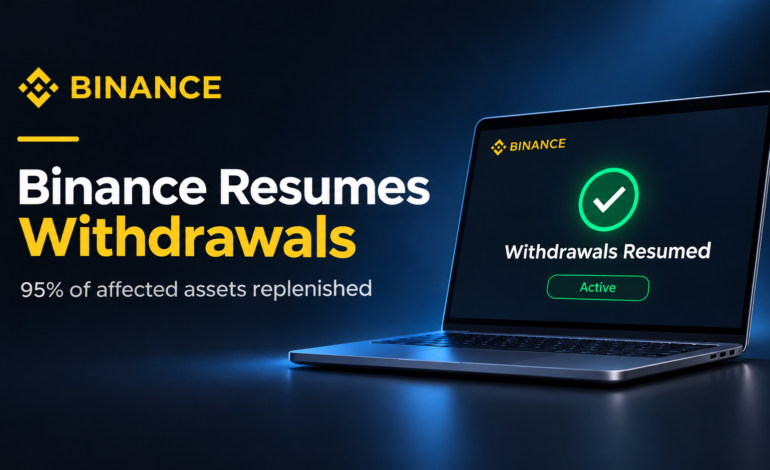
Binance has started restoring cryptocurrency withdrawals after a security breach that resulted in approximately $6.3 billion in stolen digital assets. The exchange says it has replenished 95% of the affected assets using company resources and has promised that customers will not bear the losses.
In an official announcement on November 1, 2026, Binance confirmed that it would restore withdrawals in stages after conducting security checks.
The announcement represents an important development following the October 29 attack, which affected Binance’s hot wallets and led to temporary withdrawal restrictions.
However, withdrawals are not necessarily available for every cryptocurrency and blockchain network.
Binance also says its investigation and attempts to recover the stolen funds are continuing.
What Is the Latest Update on the Binance Hack?
According to Binance, the first phase of withdrawal restoration was scheduled to begin between 06:00 and 09:00 UTC on November 1.
That corresponds to 9:00 a.m. to 12:00 p.m. in Kenya.
The exchange said the rollout would be gradual, with individual cryptocurrencies and networks becoming available after security and operational checks.
Later reporting from Reuters confirmed that withdrawals had begun.
Binance warned that some customers could experience delays or failed withdrawal attempts during the initial rollout.
It advised users to check the withdrawal page for their selected cryptocurrency and blockchain network before trying again.
The exchange also confirmed that deposits remained operational during the latest restoration phase.
Which Cryptocurrencies Can Binance Users Withdraw?
Binance’s first restoration phase covers several major cryptocurrencies and blockchain networks.
These include Bitcoin, Ethereum, BNB, Solana, XRP, Dogecoin, Tron, Zcash, and selected stablecoin transactions.
The initial network arrangements include:
| Blockchain network | Supported assets in the first phase |
|---|---|
| Bitcoin | BTC |
| Ethereum | ETH, USDT, USDC |
| BNB Smart Chain | BNB, USDT, USDC |
| Tron | TRX, USDT |
| Solana | SOL, USDT, USDC |
| XRP Ledger | XRP |
| Polygon | POL, USDT, USDC |
| Arbitrum | ETH, USDT, USDC, ARB |
| Base | ETH, USDC |
| Optimism | ETH, USDT, USDC |
Additional supported networks include Avalanche C-Chain, Sui, TON, Dogecoin, and Zcash.
These were listed for phased restoration, rather than guaranteed simultaneous availability.
For example, someone withdrawing USDT through Tron may find that the service becomes available at a different time from USDT withdrawals through Ethereum.
This matters because sending cryptocurrency through an unsupported or incorrectly selected network can lead to serious problems.
Users should check the current status directly in their Binance accounts.
What Does Binance Mean by 95% of Assets Replenished?
One of the most important details in Binance’s announcement is its claim that approximately 95% of affected assets have been replenished.
This does not mean that 95% of the stolen funds were recovered from the attackers.
There is a difference between recovering stolen assets and replacing them.
Recovering stolen funds
Recovery means locating stolen cryptocurrency and successfully returning it to the rightful owner or otherwise regaining control of it.
For example, if investigators trace stolen USDT and the issuer freezes it, the funds may be prevented from moving further.
However, freezing tokens does not automatically return them to Binance.
Replenishing stolen funds
Replenishment means replacing missing cryptocurrency using other available resources.
For example, if an exchange loses Bitcoin in a security breach, it could purchase replacement Bitcoin using its corporate funds.
That would help restore the assets backing customer balances, even if the original stolen Bitcoin remains under the attacker’s control.
Binance says it has used company resources to purchase replacement assets through cryptocurrency markets and over-the-counter transactions.
The exchange previously reported replenishment levels of approximately 80% and 90%.
By November 1, it said that figure had reached 95%.
The remaining 5% consists of less-liquid digital assets that Binance says are more difficult to purchase in the quantities required.
Are Binance Customers’ Funds Safe?
Binance has repeatedly stated that it will absorb the financial impact of the stolen funds rather than pass the losses to its customers.
The exchange says the following assets are fully backed at 100%:
- Bitcoin (BTC)
- Ethereum (ETH)
- Tether (USDT)
- BNB
- Solana (SOL)
- USD Coin (USDC)
- XRP
- USD1
- RLUSD
- Zcash (ZEC)
Binance has directed customers to its Proof of Reserves information for relevant reserve snapshots.
These are statements made by the exchange and do not replace an independent assessment of its complete financial position.
Nevertheless, restoring withdrawn assets using corporate resources is an important part of Binance’s response to the incident.
What is Proof of Reserves?
Proof of Reserves is a method exchanges use to demonstrate that they control cryptocurrency assets corresponding to customer balances.
It often involves blockchain records and cryptographic verification techniques.
However, Proof of Reserves is not necessarily the same as a full financial audit.
A complete assessment would also consider liabilities, operational risks, ownership arrangements, and other financial obligations.
What Happened During the $6.3 Billion Binance Hack?
Binance disclosed that its hot wallets were compromised at approximately 20:05 UTC on October 29, 2026.
Hot wallets are cryptocurrency wallets connected to internet-accessible infrastructure.
Exchanges use them to process customer deposits and withdrawals efficiently.
However, internet-connected systems can face security risks if attackers compromise the surrounding infrastructure or obtain unauthorized access.
In its October 30 incident update, Binance estimated the loss at approximately $6.3 billion.
It said it had isolated affected systems, revoked compromised authorizations, strengthened security controls, and worked with law enforcement and blockchain companies.
Approximately $3 billion in assets had been frozen on-chain during the initial response, according to Binance.
That freeze is distinct from the replacement of assets using Binance’s corporate treasury.
What Happened After Withdrawals Resumed?
The reopening of withdrawals provided an early indication of how customers were responding to the incident.
According to Reuters reporting on November 1, Binance experienced an initial increase in withdrawal activity after services resumed.
A Binance spokesperson said withdrawal volumes subsequently declined toward levels the company considered normal.
These comments describe the exchange’s observations at that point in time.
They do not establish that all customers regained access to every asset or that confidence in the platform has fully recovered.
What Should Binance Users Do?
Users should take several precautions while services continue returning to normal.
Check network availability. Make sure the particular cryptocurrency and blockchain network are available before attempting a withdrawal.
Verify withdrawal addresses. Blockchain transfers are often irreversible. An incorrect destination address can result in lost funds.
Expect possible delays. Binance has warned that high traffic may temporarily affect processing.
Avoid phishing links. Scammers may use the security incident to impersonate Binance support or promote fake compensation schemes.
Protect account credentials. Use strong authentication and never share passwords, private keys, or recovery phrases.
Follow official announcements. The status of individual assets may change as Binance completes additional security checks.
Users should also understand the trade-offs between leaving cryptocurrency on an exchange and managing it through a self-custody wallet.
Both options involve different responsibilities and risks.
What Does the Incident Mean for African Cryptocurrency Users?
Binance provides cryptocurrency trading services used by individuals and businesses across Africa.
For some users, centralized exchanges are important for converting between digital assets, managing trading balances, and accessing P2P markets.
A major interruption to withdrawals can therefore affect customers who rely on these services.
The incident raises three important questions.
First, how much of an exchange’s infrastructure can be compromised before customer assets are affected?
Second, how can an exchange maintain adequate reserves and restore access following a major attack?
Third, how clearly does the exchange communicate with customers when something goes wrong?
These questions are particularly important in markets where cryptocurrency users may have limited access to alternative international financial services.
What Happens Next?
Binance says it is continuing to purchase the remaining affected assets and restore additional withdrawal networks.
It is also working with law enforcement and blockchain investigation companies to trace stolen cryptocurrency.
The exchange has promised to publish a post-incident technical report after the investigation is complete.
That report could provide more information about the attack method, the security controls affected, and the changes introduced to prevent similar incidents.
Until then, some technical details remain unresolved.
Blockwisely Take: Replacing Stolen Funds Is Not the Same as Solving the Security Problem
Binance’s ability to replenish approximately 95% of affected assets within days is a significant development.
It suggests that the exchange has been able to mobilize substantial company resources in response to an extraordinary security incident.
However, restoring reserves and solving the underlying cybersecurity problem are two different challenges.
Even if customers are fully compensated, the industry still needs to understand how unauthorized withdrawals involving billions of dollars became possible.
Large cryptocurrency exchanges operate complicated systems involving software, internal permissions, wallet infrastructure, and employees.
The security of the blockchain itself does not eliminate vulnerabilities in these surrounding systems.
For users in Kenya and across Africa, the incident reinforces the importance of understanding custody risk and avoiding unnecessary dependence on a single platform.
The next important milestone will not simply be Binance reaching 100% asset replenishment.
It will be the publication of a credible technical explanation, evidence of improved security, and a sustained return to reliable customer access.
Frequently Asked Questions
Has Binance resumed withdrawals?
Yes. Binance began restoring selected cryptocurrency withdrawals on November 1, 2026. Services are being restored in phases.
Can users withdraw USDT from Binance?
USDT withdrawals are included in the first phase through selected networks, including Ethereum, BNB Smart Chain, Tron, Solana, Polygon, Arbitrum, and Optimism. Availability should be checked for each network.
Did Binance recover 95% of the stolen funds?
Not necessarily. Binance says it replenished 95% of affected assets, largely using company resources. This is different from recovering the original stolen cryptocurrency.
How much cryptocurrency was stolen?
Binance estimated the October 29 breach resulted in losses of approximately $6.3 billion in digital assets.
Are Binance users going to lose their money?
Binance says it will absorb the financial impact and fully protect customer balances. The outcome remains dependent on its ongoing restoration and recovery efforts.
What is the remaining 5%?
Binance says the remaining assets are less-liquid tokens that take longer to purchase in the quantities required.
Is the Binance investigation complete?
No. Binance says it will publish a post-incident report once the investigation is completed.
Key Takeaways
- Binance began restoring withdrawals in phases on November 1, 2026.
- The October 29 breach resulted in an estimated $6.3 billion in stolen assets.
- Binance says approximately 95% of affected assets have been replenished.
- Replenishment largely involves company resources, not necessarily recovery from attackers.
- Selected major cryptocurrencies and stablecoin networks are included in the first phase.
- The investigation and security remediation process are ongoing.