








BitMart Joins BitMEX in Closing: What Is Happening to Crypto Exchanges?

Imagine waking up, opening the crypto exchange where you keep your Bitcoin, USDT and several smaller tokens, and seeing a notice announcing that the platform is shutting down.
Your balance is still visible. Withdrawals are still available. But new deposits and trades are being stopped, your open positions must be closed, and you now have a deadline to move your assets elsewhere.
That is the situation facing users of BitMart and BitMEX.
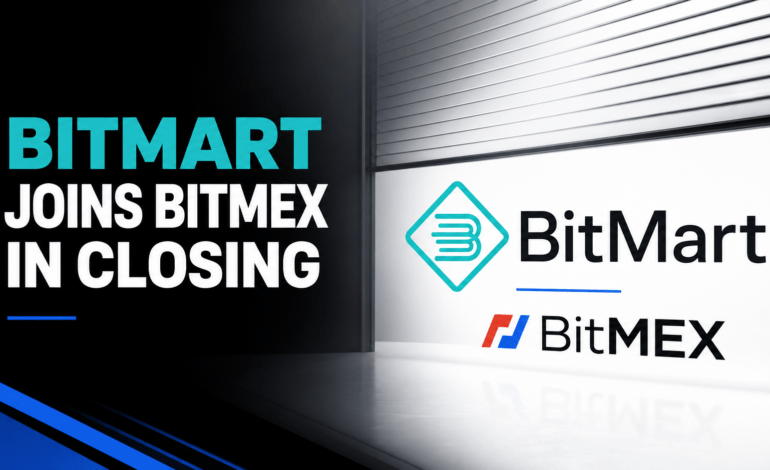
On July 26, 2026, BitMart announced that it would begin winding down its trading platform. The announcement came only three days after BitMEX, one of the earliest major cryptocurrency derivatives exchanges, confirmed that it would close in September.
The two exchanges describe their closures as orderly business decisions rather than bankruptcies. Nevertheless, their near-simultaneous departures raise a bigger question: are these isolated cases, or is the crypto exchange market entering a period of consolidation?
BitMart announces an orderly shutdown
BitMart said it decided to close after evaluating its operating conditions, the wider market environment and its future strategic direction. The exchange did not provide a more detailed explanation.
The shutdown began almost immediately.
From July 26, BitMart started suspending new registrations, cryptocurrency and fiat deposits, new spot orders and new futures positions. Futures accounts were placed in reduce-only mode, meaning traders could close or reduce existing positions but could not open new ones.
Copy trading, grid trading, API trading and other automated services are also being discontinued.
All spot, futures and other trading services are scheduled to stop on August 26, 2026, at 01:00 UTC. BitMart plans to officially cease platform operations on January 31, 2027, at 15:59 UTC, according to the official BitMart shutdown notice.
Important BitMart dates
| Date and time | What happens |
|---|---|
| July 26, 2026, 01:30 UTC | New registrations, deposits and new trading orders begin closing |
| August 26, 2026, 01:00 UTC | All trading services stop |
| August 26, 2026, 05:00 UTC | BitMart’s recommended deadline for submitting withdrawals |
| January 31, 2027, 15:59 UTC | BitMart officially ceases platform operations |
The August deadline is BitMart’s recommended withdrawal date, not necessarily the final moment when withdrawals will be possible. BitMart says users will still be able to access their accounts and submit withdrawal requests for a specified period after the platform closes. However, the exchange has not said how long that additional period will last.
Users should therefore avoid treating January 2027 as a reason to delay.
What happens to funds held on BitMart?
BitMart says withdrawals remain available during the shutdown process.
However, some withdrawals may be placed under manual review. The exchange may ask users to verify their identity, login devices, withdrawal address, source of funds or ownership of the receiving wallet.
Withdrawals may also be checked for Travel Rule compliance, sanctions exposure and other regulatory risks. BitMart warned that increased demand, blockchain congestion or requests for supporting documents could result in longer processing times.
Submitting a withdrawal request does not necessarily mean the transaction has already been approved or sent to the blockchain.
Assets held in BitMart Earn, staking, lending, Launchpad and other products will be released or settled in phases. Users of these products should monitor official announcements and in-app notifications for specific redemption instructions.
Any futures positions left open when trading stops may be settled by the exchange using the applicable mark price, index price or settlement rules.
BitMEX is also closing
BitMEX announced its closure on July 23, 2026.
Its parent company, HDR Global Trading Limited, said the decision followed a strategic review of the business and the wider crypto industry. Like BitMart, BitMEX did not identify a single specific reason for closing.
BitMEX will stop new positions from being opened on August 26 at 04:00 UTC. From that point, traders will only be able to reduce their positions. The exchange will then begin closing remaining positions as part of the wind-down.
The platform will officially close on September 23, 2026, at 04:00 UTC. Any positions still open at that point will be force-closed, according to the official BitMEX closure announcement.
For East African users, those deadlines fall at 7:00 a.m. EAT.
BitMEX has also warned verified users about leaving funds on the platform after it closes. Accounts that still hold assets after the September deadline will be charged either $50 or 1% per year, whichever is greater, with the charge applied monthly.
The exchange has encouraged users to close their positions and withdraw as soon as possible.
Why BitMEX’s departure is significant
BitMEX was not just another trading platform.
Established in 2014, it helped popularise cryptocurrency perpetual swaps and high-leverage derivatives trading. Its perpetual swap model was later adopted across much of the crypto industry.
However, being an early innovator did not guarantee continued dominance.
According to Kaiko data reported by Reuters, BitMEX had fallen to less than 0.01% of the crypto exchange market and was processing approximately $400,000 in daily trading volume before announcing its closure.
The exchange may have retained a recognised name, but much of the liquidity and trading activity had moved elsewhere.
That distinction matters. A crypto exchange can have millions of registered accounts and a strong historical reputation while still struggling to generate enough active trading to remain competitive.
Why are established crypto exchanges closing?
BitMart and BitMEX have not published financial statements showing that the same issue caused both closures. It would therefore be inaccurate to claim that they failed for one confirmed reason.
Their announcements do, however, come during several broader changes in the crypto exchange business.
1. Trading volumes have fallen
Crypto exchanges earn much of their revenue from trading fees. When fewer people trade, fee income falls even if the exchange continues carrying many of the same technology, security, staffing and compliance costs.
Centralised exchange activity weakened significantly during the second quarter of 2026.
The top 10 centralised spot exchanges processed $1.95 trillion in the quarter, down 27.9% from $2.70 trillion during the first quarter. May’s volume fell to $619 billion, the lowest monthly level of the year at the time.
Centralised perpetual exchange volume also declined, although less sharply. The top 10 platforms processed $12.7 trillion during the quarter, down 10% from $14.1 trillion in the first quarter, according to CoinGecko’s Q2 2026 industry report.
A smaller exchange feels this decline more severely because it has less trading activity over which to spread its operating costs.
2. Liquidity is concentrating on the largest platforms
An exchange needs buyers and sellers to remain useful.
When a platform has strong liquidity, users can normally complete large trades with less price movement. When liquidity is thin, the difference between buying and selling prices becomes wider, orders take longer to fill, and traders are more likely to move to another platform.
This creates a network effect. More liquidity attracts more traders. More traders attract market makers. Additional market makers then deepen liquidity further.
CoinGecko found that Binance controlled 38.7% of top-10 centralised spot exchange volume in the second quarter of 2026. Binance and Bybit were the only two exchanges with double-digit shares.
The derivatives market shows a similar pattern. During the first four months of 2026, Binance and OKX held approximately 33% and 15% respectively of trading volume among the leading centralised perpetual exchanges. CoinGecko’s perpetual markets report described the two platforms as continuing to consolidate their positions.
For smaller and mid-sized exchanges, competing with this concentration becomes increasingly difficult.
3. Decentralised exchanges are becoming serious competitors
Centralised exchanges still process most crypto trading activity. However, decentralised exchanges are taking a growing share of the derivatives market.
Unlike a traditional centralised exchange, a decentralised exchange generally allows users to trade directly from a wallet without depositing their assets with a company.
Perpetual decentralised exchanges processed approximately $6.38 trillion in 2025, up from $1.5 trillion in 2024. Monthly average volume among the leading perpetual DEXs rose from $531.65 billion in 2025 to $611.57 billion during the first four months of 2026.
The ratio of decentralised to centralised perpetual trading volume reached 13% in late 2025 before easing to around 10% in April 2026, according to CoinGecko.
Platforms such as Hyperliquid and Lighter now offer fast execution, competitive fees and interfaces that feel familiar to centralised exchange users. This gives derivatives traders alternatives that were not as mature several years ago.
4. Running a global exchange has become more demanding
A global exchange must maintain trading infrastructure, wallets, cybersecurity systems, customer support, liquidity relationships and asset-monitoring processes.
It may also need licences or registrations in multiple countries. Compliance teams must handle identity verification, transaction monitoring, sanctions screening, Travel Rule requirements, suspicious activity reporting and requests from law-enforcement agencies.
These responsibilities do not prove that regulation caused either closure. Neither BitMart nor BitMEX identified regulatory costs as the direct reason for shutting down.
They do show why operating a crypto exchange is more complicated than simply providing a website where people can buy and sell tokens.
5. A recognisable brand is no longer enough
BitMEX helped create one of the crypto market’s most influential trading products. BitMart, meanwhile, offered more than 1,900 spot assets and had expanded into payments, lending, staking, traditional asset-linked products and prediction markets.
Yet both are leaving the exchange business.
Their departures demonstrate that product variety and brand history do not automatically produce sustainable liquidity or revenue.
BitMart’s announcement raises a transparency question
One particularly surprising part of the BitMart closure is its timing.
On July 15, only 11 days before announcing the wind-down, BitMart published an optimistic report about its performance during the first half of 2026.
The exchange said its asset-management assets had increased by approximately 256%, card issuance had risen by 150%, transaction volume had grown by 300%, and stablecoin assets under management had increased by nearly 90%.
BitMart’s CEO also said the company intended to remain in business for another eight years, according to the exchange’s H1 2026 report.
That does not prove misconduct or insolvency. Businesses can change direction quickly, especially after a board-level review. But the dramatic difference between the July 15 growth message and the July 26 closure announcement leaves important questions unanswered.
What changed during those 11 days? Was the closure already being considered when the report was published? How should users evaluate future claims about an exchange’s growth and long-term plans?
BitMart has not publicly answered those questions.
What should BitMart and BitMEX users do?
Users should not wait for the final closure dates.
If you have funds or positions on either exchange:
- Confirm that you are visiting the official website or application.
- Cancel outstanding trading orders.
- Close futures, margin and other leveraged positions.
- Redeem funds held in Earn, staking or lending products.
- Complete any outstanding identity verification.
- Download your transaction and trading history.
- Confirm the receiving wallet address and blockchain network.
- Send a small test transaction before making a large withdrawal.
- Keep transaction IDs and screenshots showing completed withdrawals.
- Ignore direct messages claiming to offer faster withdrawals or account recovery.
Users moving funds to another exchange should first confirm that it serves their country and supports the relevant token and blockchain network.
Those moving assets into self-custody must secure their recovery phrase offline. Self-custody removes the risk of an exchange controlling the funds, but it also means there may be no customer-support team capable of recovering a lost wallet.
Frequently Asked Questions
Is BitMart closing permanently?
Yes. BitMart plans to stop all trading services on August 26, 2026, and officially cease platform operations on January 31, 2027.
Can users still withdraw from BitMart?
Yes. BitMart says withdrawals remain available. It recommends submitting withdrawal requests before 05:00 UTC on August 26, 2026. Some requests may require additional identity, source-of-funds or wallet-ownership checks.
Is BitMart bankrupt?
BitMart has not announced bankruptcy or insolvency proceedings. It describes the closure as an orderly wind-down following an evaluation of its operating conditions, market environment and future strategy.
When is BitMEX closing?
BitMEX will close on September 23, 2026, at 04:00 UTC. Restrictions on opening new positions begin on August 26 at 04:00 UTC.
Can BitMEX users withdraw after the closure?
BitMEX says users will still be able to access their accounts and withdraw remaining balances. However, verified accounts holding funds after the closure may be charged $50 or 1% annually, whichever is greater, applied monthly.
Are the BitMart and BitMEX closures connected?
There is no public evidence that the closures are directly connected. Each company announced its own strategic review and wind-down process.
Are all centralised crypto exchanges in trouble?
No. Centralised exchanges continue to dominate crypto trading. However, falling volumes, greater concentration among market leaders and competition from decentralised platforms may make it harder for smaller exchanges to remain profitable.
Where should users move their funds?
The appropriate destination depends on how the assets will be used. Active traders may choose another reputable exchange that operates in their country. Long-term holders may consider a self-custody wallet, provided they understand private-key and recovery-phrase security.